Get Full Government Meeting Transcripts, Videos, & Alerts Forever!
Get email alerts on the Water Transfers topic
No spam. Unsubscribe anytime.
Senate Natural Resources committee hears SB 427, a proposal to bar water-right transfers that diminish streamflow
Summary
The Senate Committee on Natural Resources and Wildfire met Feb. 25 for a public hearing on Senate Bill 427, which would prohibit approval of proposed water-right transfers that diminish streamflow for applications filed or changes proposed on or after Jan. 1, 2026.
The Senate Committee on Natural Resources and Wildfire met Feb. 25 for a public hearing on Senate Bill 427, which would prohibit approval of proposed water-right transfers that diminish streamflow for applications filed or changes proposed on or after Jan. 1, 2026. The committee heard a 10-minute agency orientation followed by testimony from conservation groups, municipal and agricultural water suppliers, and other stakeholders; no committee vote was taken at the hearing.
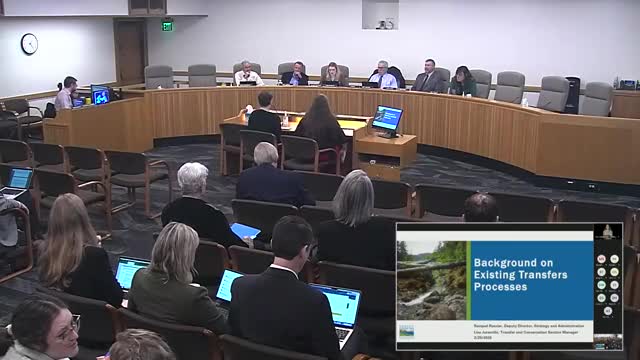
The Oregon Water Resources Department (WRD) provided a ten-minute technical briefing on the existing transfer process, describing transfers as the statutory mechanism to change a water right’s point of diversion, place of use or type of use and explaining the department’s current review criteria: application completeness (including land-use approvals when required), demonstration of continuing beneficial use (forfeiture considerations), and protections against injury and enlargement of other water rights. WRD staff described how injury is evaluated (for example, whether moving a diversion would reduce return flows that downstream users rely on) and how enlargement is prevented (for example, by limiting the quantity transferred so the right does not effectively increase). WRD staff noted the agency can condition transfers — including requiring fish screens at a new point of diversion if requested by Oregon Department of Fish and Wildlife (ODFW) — but said the precise effect of SB 427 on WRD workload and outcomes would depend on individual applications and the department would provide a written analysis to the committee.
Supporters told the committee SB 427 closes a loophole that allows older water rights to be repurposed without accounting for modern environmental values. Kaitlyn Barter, Water Policy Director at Wild Salmon Center (testifying for the Oregon Water Partnership), said the bill is intended to “equip Oregon for our 21st century water reality.” James Fraser, Oregon policy director for Trout Unlimited, argued the bill protects fish and water quality by ensuring transfers do not further reduce summer streamflows; Fraser said, “water is fish habitat.” Karen Lewatsky of the Oregon Environmental Council told the committee other Western states use similar transfer reviews and said SB 427 “modernizes transfer policies to ensure changes to water rights don't do further harm to the environment.” Several conservation organizations emphasized the bill is limited to proposed changes and does not affect ongoing uses that are not being transferred.
Opponents — including municipal and agricultural water providers and water-utility trade groups — said the draft language is overly broad and would impede urgently needed operational changes and infrastructure projects. Steve Shropshire, representing the Oregon Association of Nurseries and a long-time water attorney, said, “This is a solution looking for a problem,” and warned the bill could “tie up Oregon’s water for generations” by substantially slowing or blocking transfers. Nikki Iverson, general manager of the Joint Water Commission (Hillsboro and partner cities), said, “The way that the language is written in this measure would result in the denial of all transfer applications for drinking water utilities,” explaining that planned intake relocations and other resiliency projects rely on the existing transfer process. Other municipal and special‑district witnesses (including representatives from Medford Water, Eugene Water & Electric Board and several association groups) described similar concerns about building redundant or seismically resilient intakes, the potential effect on housing and service reliability, and the need for clearer, collaborative drafting.
Several irrigation and water‑user groups — including the Klamath Irrigation District, Klamath Water Users Association, Northeast Oregon Water Association, and the Oregon Water Resources Congress — testified in opposition, saying transfers are central to delivering water where new rights are scarce and that an across‑the‑board “diminishment” prohibition is overbroad and would invite litigation. Testimony from Sustainable Northwest and others supporting the bill stressed tight basin‑specific shortages (for example, the Deschutes Basin) and argued a new “no diminishment of streamflow” screen would protect fish, water quality and recreation without curtailing existing uses.
Committee chair and members asked WRD staff about the practical effect of SB 427 on application processing time and outcomes. WRD staff replied they could not say that “no application would be approved” under the bill; they identified many similarities between SB 427’s proposed analysis and the department’s existing injury/enlargement review but said some aspects differ and that the department would provide a written, application‑by‑application analysis for the committee. WRD staff also explained how they currently handle “losing reaches” (river segments that lose water to the substrate) and said the department already accounts for such hydrologic details when conditioning transfers.
The hearing closed without a committee vote. Chair Golden adjourned the committee after taking public testimony and asking WRD to supply further analysis. Committee members indicated they expect additional conversations about how SB 427 would interact with other pending water bills, municipal projects and existing in‑stream water protections.
Looking ahead: SB 427 remains a debated policy proposal that the committee may hold for further work, amend, or refer for a vote at a later date. WRD committed to providing written follow‑up analysis to the committee on how the bill’s standards would alter current transfer reviews and staff workload.