
District presents integrated services model to address growing special‑needs caseload
Get AI-powered insights, summaries, and transcripts
Sign Up Free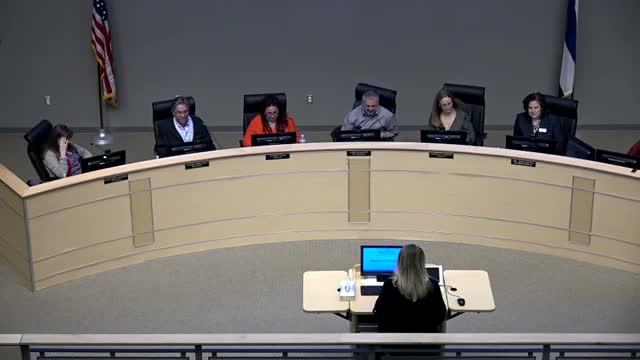
Summary
District staff told the Board of Education that a coordinated "integrated services" model and distributed learning centers are central to meeting diverse student needs; presenters cited program locations, co‑teaching at Westminster High and recent assessment changes but no formal board action was taken.
Heidi Weekley, a district administrative staff member, outlined an "integrated services model" for Westminster Public Schools during the Board of Education's Feb. 25 meeting, saying the approach connects special‑education, multilingual, gifted and mental‑health supports with classroom instruction.
Weekley said the model uses interventionists and specialists to “anchor in the classroom,” expands co‑teaching, and relies on learning centers for students whose needs cannot be met in general education. She told the board the district maintains six learning‑center sites and operates a therapeutic day program in the Instructional Services Center at the lower level of Shaw Heights.
The presentation matters because Weekley said a large share of the district’s students belong to one or more state subgroups: “14.3 percent of our students qualify for special education, 33.8 percent are multilingual learners and 2.5 percent are identified as homeless,” she said. She added that 82.2 percent of students were eligible for free or reduced‑price lunch; Weekley noted many students fall into multiple categories and that the exact percentage identified as gifted was not specified in the presentation.
Weekley described how the model operationalizes support: interventionists and specialists work inside general education classrooms for strategic and small‑group instruction, master schedules are adjusted to allow common planning time, and implementation checklists guide administrators. She said the model is a companion to the district’s earlier interventionist framework and is intended to make service delivery measurable and sustainable.
For Westminster High School, Weekley cited co‑teaching and an intervention block for math and literacy as examples. She credited common planning time and PLC (professional learning community) work for measurable improvement in a subgroup at the high school, showing a jump in a median growth score for math from 38 last year to 42 this year. She also presented STAR assessment snapshots: for the subgroup discussed, 48.6 percent of students were in the “urgent intervention” category in winter 2024–25 for literacy; in math, the share in the “urgent intervention” category fell from 71.5 percent last year to 47.6 percent this year.
Board members asked operational questions. One member asked for the total number of students covered by the percentages; Weekley said she did not have that exact number on hand and that she would provide it later. Another question sought clarification of “sites” versus “centers”; Weekley explained that a “site” refers to a school that hosts programs and “centers” are the individual classrooms or specialized program rooms within those schools.
Weekley emphasized that individual service amounts and locations remain driven by individualized education plans, language proficiency levels and other individualized student plans. She also noted the model includes intensive language development classes and family wraparound supports offered at the Daniel C. Vaez Family Education Center.
The board did not take formal action on the integrated services model during the meeting; Weekley concluded by offering to take questions and the board moved on to other agenda items.