Get Full Government Meeting Transcripts, Videos, & Alerts Forever!
Get email alerts on the Student Technology topic
No spam. Unsubscribe anytime.
Romulus High implements stricter cell‑phone policy; principals report fewer classroom disruptions
Summary
Romulus High School principals told the Board of Education that a January policy requiring confiscation of visible/active phones has reduced disruptions, with two students reaching the third offense and improvements reported in classroom climate and behavior.
Romulus High School principals said the district’s new cell‑phone practice, implemented in January, has reduced classroom disruptions and improved building climate.
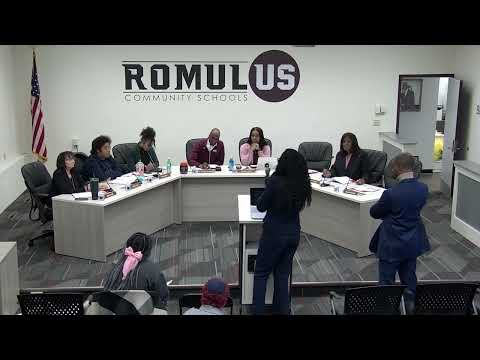
The policy, described at the Jan. 27 Romulus Community Schools Board of Education meeting, requires teachers to confiscate visible or audible devices. If a student voluntarily places a device in a classroom storage container, it is returned at the end of the hour. If a device is confiscated because it rang or otherwise disrupted learning, the teacher gives it to security, and it is returned to the student at the end of the day with a parent notification. A second confiscation requires a parent to pick up the device; a third leads to after‑school detention and parent pickup; a fourth would be escalated to the superintendent, the principals said. Lunchtime device use is allowed when students are not in instructional settings.
"That is the first part of our process and it has worked very well," Mrs. Marino said, describing how containers in classrooms and stepwise discipline are being enforced. "At this time, the policy began in January. I have two students who have gotten to the third time. And those parents are very adamant that it won't happen again." Mr. Petty and Marino said students and staff have responded positively to the change.
Principals also reported informal day‑to‑day counts and impacts: about 15 devices are brought to the office daily from the high school; roughly 20 percent of those represent repeat violations that have reached the second step (parent pickup). Board members asked whether the policy has affected academic dishonesty and whether the district is tracking related referrals. "Academic dishonesty will always exist," Mr. Petty said, but the policy, together with closer supervision and traditional instructional practices, is expected to make cheating easier to detect.
Superintendent Doctor Edmonson said the district is monitoring implementation and looking at two broader supports: stronger filtering on district devices and ensuring that students who need a school device can receive one if personal devices are restricted.
Board members and principals described complementary efforts: positive behavior interventions (PBIS) and student government involvement to continue gathering feedback; lunchtime incentives such as a supervised game room that requires students to show grades before participation; and teacher training and ongoing questionnaires to measure effects on culture, climate and academic integrity.
The principals said early anecdotal evidence points to fewer interruptions, fewer incidents of students posting classroom images on social media, and improved behavior, but they said more time and data are needed to confirm academic outcomes.
The board received the presentation as an update and did not take formal action on the policy at the Jan. 27 meeting.