Get Full Government Meeting Transcripts, Videos, & Alerts Forever!
Get email alerts on the Career And Technical Education topic
No spam. Unsubscribe anytime.
Belton ISD outlines expanded career-readiness plan, cites rise in industry certifications
Summary
Belton ISD staff presented an academic progress update focused on College, Career and Military Readiness (CCMR), describing new program-of-study materials, earlier K–12 career exposure, partnerships with employers and colleges, and a near doubling of industry-based certifications last year.
Belton Independent School District staff on Monday presented a progress update on the district’s College, Career and Military Readiness (CCMR) work, describing new program-of-study materials for students and families, deeper employer and college partnerships, efforts to expand dual-credit and AP access, and a reported increase in industry-based certifications.
The update was led by Gabby Nino, a Belton ISD staff member, and Denise Ayers, a Belton ISD staff member who leads the district’s career-readiness work. Nino said the presentation “zero[ed] in on CCMR which is our college career military readiness through the frame of career readiness in Belton ISD.” Ayers described the district’s vision as “to foster a spirit of curiosity and career exploration, ignite aspirations, and empower each and every student to envision and shape their future.”
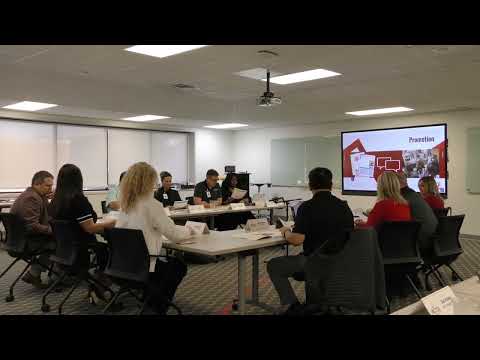
The nut graf: District staff framed the work under four “P” pillars — promotion, participation, performance and partners — and said the steps are intended to expand students’ awareness of career pathways, provide guaranteed grade-level experiences across pre-K–12, and remove access barriers to AP, dual credit and industry-based certification (IBC) opportunities.
Staff said the district has developed visually oriented program-of-study sheets that counselors already use and that will be turned into posters for junior highs and other campuses so students see pathway options earlier. Ayers and Nino said the district aims to move some course offerings into middle school where appropriate and to make advising conversations routine and intentional so students know which options best match their interests and goals. “Students will never be career ready if they don’t know what their options are,” Nino said.
The pair described several partner relationships used to expand hands-on experiences: Baylor Scott & White and Baylor College of Medicine provide regular classroom visits and clinical-style learning in elementary grades; Temple College is engaged in crosswalk work to map Belton ISD courses to college and transfer pathways; and Don Ringler Automotive Group supports automotive work-based learning and donated equipment. Nino said Don Ringler has donated about $40,000 in shop equipment to support on-site training.
On performance measures, staff briefed the board on industry- and program-level outcomes. They reported that in the 2022–23 school year 438 students earned a total of 723 industry-based certifications (IBCs), and that the number of IBCs nearly doubled from the prior reporting period, an increase staff described as roughly 78 percent. Ayers said the district is working to convert gains in certifications into increases in the number of students earning at least one credential and into longer-term progressions — from “explorers” to “concentrators” to “completers.”
Staff also reviewed AP and dual-credit strategies. They said AP enrollment and the share of students who choose to sit for AP exams has increased, and noted that college credit from AP requires a score of 3 or higher on the exam though some universities may require higher scores. The district said it has identified fee reductions for economically disadvantaged students (Ayers cited a reduced assessment fee of about $20.25 for eligible students) and is seeking further donor or scholarship supports. On dual credit, staff said they are working with human resources to credential more district teachers to deliver dual-credit courses on-site to reduce tuition and scheduling barriers.
Board members asked about the grade level for exposure to career pathways; staff said the intention is for structured, age-appropriate experiences to begin in elementary school and to form a pre-K–12 continuum. Staff pointed to recent events — an eighth-grade career day called Transition to Career Quest at Cadence Bank Center and a middle-school Healthcare Horizons mini-conference — as examples of participation and early exposure.
Nino reported the district’s CCMR goal of reaching an 84 percent attainment level for the 2024 graduate class and said current projections indicate the district expects to exceed that target, while adding that more growth is still needed across advanced academics and certification completion. The presentation closed with staff noting that Belton ISD earned a district recognition from the state career-technical organization (one of 38 districts statewide) and with thanks to staff and partners for the work underway.
Ending: Board members did not take a formal vote or adopt new policy at the workshop; the presentation was an informational academic progress update and concluded with staff direction to continue the partnership, advising and access work described during the presentation.