Get Full Government Meeting Transcripts, Videos, & Alerts Forever!
Get email alerts on the Water Supply Emergency topic
No spam. Unsubscribe anytime.
Hanover confirms local emergency after multiday water outage, pledges after-action review
Summary
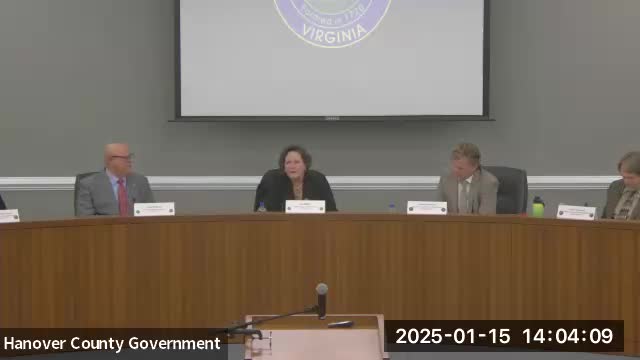
Hanover County confirmed a local emergency on Jan. 7 after a failure at the City of Richmond treatment plant cut water supplies to parts of the county; the Board of Supervisors authorized the declaration and county staff pledged an after-action report and work on short‑ and long‑term resilience.
Hanover County confirmed a local emergency on Jan. 7 after a failure at the City of Richmond water treatment plant cut supplies to parts of Hanover and neighboring jurisdictions, county officials said.
County Administrator John Badeski told the Board of Supervisors the outage began Monday morning when the Richmond plant flooded and experienced equipment and computer control failures; Hanover was notified at 2 p.m. that day and moved immediately to emergency operations. "I want to be very clear. That was an event that was preventable," Badeski said during his briefing to the board.
The county said it stood up water distribution sites starting Tuesday and ran multiple distribution operations through the week, bringing in staff and equipment (including staff sent to Richmond to assist) and deploying tankers at courthouse and shopping complex sites. Pumps were turned back on for Hanover's system on Wednesday night; the county maintained a boil water advisory while testing for contamination and lifted that advisory after two negative tests late Saturday (county staff said the advisory was lifted "roughly 11:30 on Saturday").
Why it matters: thousands of residents in Hanover's eastern service area — described repeatedly as the portion of county served by Richmond's plant — experienced low or no water pressure, followed by a precautionary boil-water advisory. County officials said the outage highlighted regional dependence on Richmond's facilities and prompted commitments to short-term resilience measures and a longer-term review of infrastructure options and costs.
What the county said it did: Badeski described repeated coordination calls with Richmond and neighboring Henrico County, mobilization of Hanover fire, sheriff and social services personnel to staff distribution and welfare checks, and the deployment of county vehicles and staff to assist Richmond crews. He told the board the county initially believed it had a 24‑hour supply, but as demand rose that reserve waned: "As soon as we put out the water conservation notice ... our demand for water actually went up by a third," he said. The county also delivered bottled water to shut-in residents via social services and volunteers.
Planned follow-up and limits on local authority: the board directed staff to prepare a local after-action report and a separate resiliency assessment; Badeski said the county will publish a local after-action report within about 30 days and participate in a broader regional after-action review (the county noted that detailed plant-level findings likely will appear in the regional report, which officials said will take 60–90 days). He cautioned that building independent regional water capacity (reservoirs, treatment capacity) is a long-term, multi-decade and high‑cost undertaking — citing historical examples and order‑of‑magnitude estimates for new reservoirs — and said interim resilience measures will be pursued.
Board action: the board passed a resolution confirming the county administrator’s Jan. 7 declaration of a local emergency under Virginia Code § 44‑146.21; the motion was made on the record and adopted by voice vote.
Community response and communications: residents and community leaders praised county responders and also urged better communications. Patricia Hunter Jordan, speaking during citizens’ time, thanked staff for the response but said communications could improve and recommended broader promotion of the county’s emergency alerts and supervisors’ social‑media notices to reach people more quickly.
What remains unresolved: county officials said monitoring continues (they report twice‑daily calls with Richmond at times) and that some Richmond pumps and computer systems must be repaired or retrofitted before the region can declare the systems fully stable. County staff said they are evaluating options to extend local water reserves and reduce near‑term dependence on Richmond while noting large capital solutions would require years or decades and major funding.
Ending: the county described the outage as a regional incident that affected Richmond, Henrico and eastern Hanover customers and emphasized next steps: complete the county after‑action report in roughly 30 days, continue resiliency engineering work with consultants, and participate in the regional review that will explore plant‑level failures.