Get Full Government Meeting Transcripts, Videos, & Alerts Forever!
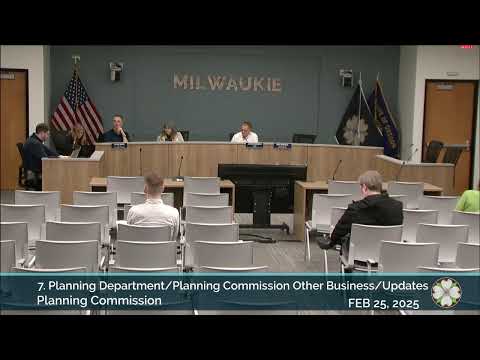
Milwaukie planning commission advances Transportation System Plan work; staff to refine bike/ped maps and project scoring
Summary
At a Feb. 25 work session, Milwaukie planning commissioners reviewed updated maps and methodology for the city's Transportation System Plan (TSP) update, raised concerns about the Lake Road bike-stress rating and school walk-shed size, and directed staff to refine classifications, outreach and project evaluation ahead of a fall adoption target.
Milwaukie planning commissioners spent their Feb. 25 meeting in a work session on the city's Transportation System Plan, reviewing updated pedestrian and bicycle level-of-traffic-stress (PLTS/BLTS) maps, proposed multimodal functional classifications and an initial project-evaluation framework.
The session, led by consultant Matt Hugart of Kittelson and Associates and city planning staff, presented a revised inventory of sidewalks, bike lanes and other facilities, introduced "priority focus areas" (Milwaukie Town Center, schools, parks, transit stops, grocery/retail hubs and certain low-income or senior housing sites) to guide prioritization, and outlined an 11-goal scoring table the team will use to evaluate candidate projects.
Why this matters: The TSP update will guide where the city proposes walking, biking and transit investments for years. Commissioners flagged several items that could change which projects rise to the top of future funding lists: the BLTS rating assigned to Lake Road, the size of the walk-shed used to prioritize school-area projects, and a set of high-cost rail/roadway intersections that need long-term planning if the city pursues major solutions.
Most of the presentation focused on two performance measures the project team is using: Bicycle Level of Traffic Stress (BLTS) and Pedestrian Level of Traffic Stress (PLTS). Hugart explained the BLTS method relies mainly on bike-lane width (the team used 5.5 feet as a threshold) and posted speed; PLTS relies chiefly on sidewalk width and obstructions. The packet that commissioners received contains the maps (the team noted several packet figures by number), and Hugart said the slides shown in the meeting were the most recently updated versions.
Commissioner concerns and staff responses - Lake Road BLTS: Several commissioners, including Commissioner Edge, said the segment of Lake Road through the city feels more stressful than the…
Already have an account? Log in
Subscribe to keep reading
Unlock the rest of this article — and every article on Citizen Portal.
- Unlimited articles
- AI-powered breakdowns of topics, speakers, decisions, and budgets
- Instant alerts when your location has a new meeting
- Follow topics and more locations
- 1,000 AI Insights / month, plus AI Chat