Get Full Government Meeting Transcripts, Videos, & Alerts Forever!
Get email alerts on the Public Safety Gun Violence topic
No spam. Unsubscribe anytime.
OIC-led coalition wins $1.6 million DOJ grant for Springfield gun violence reduction program
Summary
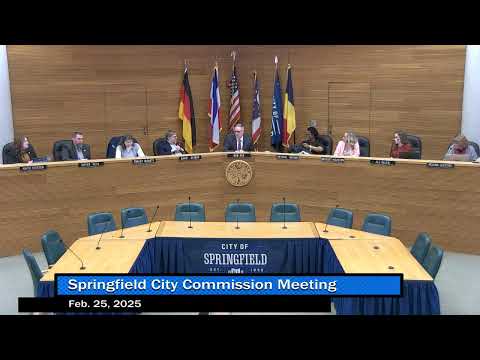
Caleb Perkins of OIC told the Springfield City Commission the community-based initiative secured $1.6 million from the Department of Justice to fund research, planning and initial services focused on youth and neighborhood hotspots, and called for community partners to help implement the plan.
Caleb Perkins, gun violence prevention coordinator for the Community-Based Violence Intervention and Prevention Initiative (CVIPI) at the OIC of Clark County, told the Springfield City Commission the initiative secured $1,600,000 in federal funds from the U.S. Department of Justice’s Bureau of Justice Assistance to support research, planning and early implementation of community-led gun-violence reduction work.
Perkins said the initiative grew from a voluntary coalition of local stakeholders that includes Clark County Juvenile Court, the OIC of Clark County, the City of Springfield, Springfield Police Division, the Springfield Foundation, Springfield City Schools, the Mental Health and Recovery Board, and the Springfield NAACP. The OIC of Clark County is the group’s designated fiscal agent, and Perkins said he is currently the initiative’s only employee.
The grant comes from the Bureau of Justice Assistance’s Community-Based Violence Intervention and Prevention Initiative (CVIPI). Perkins said the initiative partnered with Case Western Reserve University to collect and analyze data for a community assessment required by the grant. That assessment used data sources including Springfield Police arrest records, Clark County dispatch data and public-health information, plus community surveys and interviews.
Perkins highlighted findings that firearm offenders aged 14 to 24 accounted for the largest share of firearm-related arrests in recent years and that incidents cluster in several census tracts. He identified Census Tract 3 and adjacent tracts 12 and 13 as concentration areas for shots-fired calls and firearm arrests between 2021 and early 2024.
Perkins said the grant-funded work includes identifying and strengthening evidence-based protective programs already operating locally, closing gaps in services, and building a gun-violence reduction plan required by the DOJ grant. Implementation priorities he named include trauma-informed practices, increasing access to positive role models, creating safe spaces for youth and offering social and mentoring opportunities for those at risk of firearm involvement.
Perkins said the initiative is moving from assessment to implementation over the next year and a half and asked for community support and collaboration. He invited citizens and organizations to contact him directly at Cperkins@oicofclarkco.org to participate or to learn how existing local nonprofits and programs can work together under the initiative.
Commissioners thanked Perkins and OIC. Several commissioners asked whether citizens can get involved; Perkins repeated his contact information and said the initiative is still identifying partner organizations and will work with existing community providers.
The presentation described planned next steps and partnership-building rather than a formal commission action. No vote was taken on the program during the meeting.