Get Full Government Meeting Transcripts, Videos, & Alerts Forever!
Get email alerts on the Comprehensive Plan topic
No spam. Unsubscribe anytime.
Joint meeting reviews draft Knox County comprehensive plan; adoption to proceed separately
Summary
A joint session of the Mount Vernon City Council, the Knox County Commissioners and the Regional Planning Commission reviewed the draft Knox County comprehensive plan, its public engagement and the technical analysis that shaped it; adoption will proceed separately by each body after further review and comment.
A joint session of the Mount Vernon City Council, the Knox County Commissioners and the Regional Planning Commission reviewed the draft Knox County comprehensive plan and the public engagement and technical analysis that shaped it. Staff and planning consultants described findings on growth, farmland, housing and mobility and said each of the three bodies will follow its own process to consider adoption.
The meeting focused on why the plan was prepared, what community input and data informed it, and how local governments might move from plan to implementation. Jamie, a Planning Next consultant, summarized the plan’s vision as “a place with a demonstrated commitment to conserving the essential town and country elements” while supporting economic prosperity. He and other presenters emphasized the document is a guide for decision-making, not a legally binding regulation.
Why it matters: presenters said the county faces rising development pressure—especially along western edges tied to regional employment growth—while residents consistently identified the rural landscape, farmland and small-town downtowns as core values. The plan is intended to help towns, villages and townships align zoning, capital projects and incentives to protect valued open space while accommodating new housing and jobs.
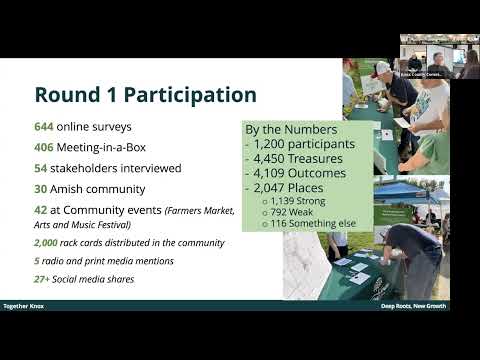
Key findings and public input - Public engagement and outreach: the project team reported nearly 1,400 engagements over the outreach period, a public testing event with about 100 attendees, and multiple stakeholder meetings and pop-up events such as nights at the county fair and the farmers market. Planners described two rounds of outreach that included online surveys, “meetings in a box,” stakeholder group convenings and map-based input (green/yellow/red dots) that yielded detailed qualitative comments. - Data and technical work: planners said they compiled census, IRS and other demographic and economic data and produced more than 10,000 unique data points used to develop principles, goals and a future land-use framework. - Land and natural resources: the plan identifies roughly 30.5% of county acreage as prime farmland based on soils, and emphasizes conservation of farmland and natural assets. Presenters noted Knox County has abundant parkland (reported as 16.1 acres of parkland per 1,000 people) compared with the national standard cited in the presentation. - Housing and demographics: presenters reported differing demographic trends for the city and the county—Mount Vernon shows growth in the 25–55 workforce cohort while the county overall showed growth concentrated among older cohorts— and flagged housing affordability and neighborhood stabilization as priorities. The presentation included average-sale and income figures provided by planners (average home sale cited as $275,750; median income figures presented during the meeting) to illustrate affordability challenges.
Plan content and recommendations - Structure: presenters said the plan is organized from a high-level vision and goals down to specific projects, policies and programs. It pairs a conservation-focused open-space framework with a future land-use map and “character types” (design guidance for how places should look and feel). Planners said character types are intended to make later zoning or design-code updates less surprising for residents and developers. - Implementation emphasis: consultants repeatedly urged that the work not stop at adoption. Recommendations include institutionalizing the plan in annual work programs and staff reports, forming an implementation task force, creating a grant binder, and preparing a monitoring/annual-report rhythm so the plan encourages predictable decision-making for developers and residents.
Discussion of tools and local examples - Regulatory vs. advisory guidance: presenters clarified that some recommended actions are statements of intent (strong policy direction) while others are flagged for further study (for example, studying potential changes to building codes rather than immediately adopting a new code). The plan text uses that range intentionally where public opinion or technical complexity varies. - Local programs and incentives: Mount Vernon officials highlighted existing local tools in use or under development, including a Community Reinvestment Area (CRA) housing abatement and the Liberty Crossing development (which includes a mix of unit types). City presenters said recent council actions and a revised code have reduced barriers and encouraged private investment. - Fairfield County implementation model: Fairfield County Commissioner Jeff Fix described that county’s post-adoption work with Planning Next. Fix outlined a strategy that pairs: 1) outreach and individual meetings with townships and villages; 2) a model zoning code made available to local governments; and 3) finance arrangements intended to preserve farmland while funding infrastructure. His office uses New Community Authorities (NCAs) and cooperative agreements to capture incremental tax revenues from development and share those funds among municipalities, townships, schools and infrastructure needs. Fix characterized those tools as a way to “preserve the land and protect the taxpayers.” He said Fairfield County also worked to align townships and municipalities to reduce annexation conflict and make development outcomes more predictable.
Limits and next steps - Not legally binding: presenters and staff reiterated that the comprehensive plan is a nonbinding guide; zoning and subdivision codes remain the legally enforceable rules. Planners noted that courts sometimes look to an adopted plan to interpret intent where a zoning question is unclear, but emphasized adoption alone does not change property rights. - Adoption process and comment compilation: the project team said the Regional Planning Commission will review the draft at its upcoming meeting and that the commissioners and Mount Vernon council will follow their own timelines and procedures. Project staff said they are collecting public comments (online and on paper) and will compile a compendium of feedback, technical responses and recommended edits to accompany the version each adopting body considers.
Voices at the meeting - Jeff Gautke, Area Development Foundation, opened remarks on the purpose of a joint session and the multi‑sponsor nature of the plan. - Daryl Severns, Regional Planning Commission, described the comprehensive plan as “a guide for decision making” and explained the countywide scope of the document. - Jamie (Planning Next consultant) gave the presentation of findings, data and the plan’s vision and implementation approach. - Bailey (Planning Next consultant) presented technical findings on demographics, land-use patterns and parkland metrics. - Commissioner Jeff Fix (Fairfield County) described his county’s post‑adoption tools including NCAs, model zoning and intergovernmental revenue-sharing agreements. - Mount Vernon elected officials and city staff described local steps already taken, including CRA incentives, code changes and housing projects in process.
What was not decided No adopting body took final action at the joint session. The meeting was informational and intended to gather questions and direction; the plan’s adoption will occur separately according to each jurisdiction’s rules. The transcript and presenters indicate additional local review and comment will be compiled before any entity takes a final vote.
How to follow up Presenters said the project website is open for comments and staff are collecting paper comment forms left at the meeting. Regional Planning Commission review and subsequent formal adoption actions by the Knox County Commissioners and the Mount Vernon City Council were described as the next procedural steps; specific meeting dates for those adoption votes were not given in the joint session.
Ending The joint meeting framed the draft as a tool to guide land-use and infrastructure decisions in coming years and emphasized implementation—through coordinated zoning updates, financial agreements such as NCAs, and a sustained outreach and monitoring program—will determine whether the plan’s conservation and growth goals are realized.