Get Full Government Meeting Transcripts, Videos, & Alerts Forever!
Get email alerts on the County Budget Schools Taxes topic
No spam. Unsubscribe anytime.
Frederick County staff present updated budget numbers, school transfer options and tax-rate scenarios
Summary
County staff reviewed updated FY26 budget figures, outlined a proposed $118 million operating transfer to schools, compared tax-rate scenarios (revenue-neutral 0.424 vs. current $0.51), and identified major cost drivers including firefighter staffing and software subscription growth.
At a Frederick County budget workshop, county staff reviewed updated budget worksheets and fiscal scenarios, including a proposed $118 million school operating transfer and options for setting the county real-estate tax rate.
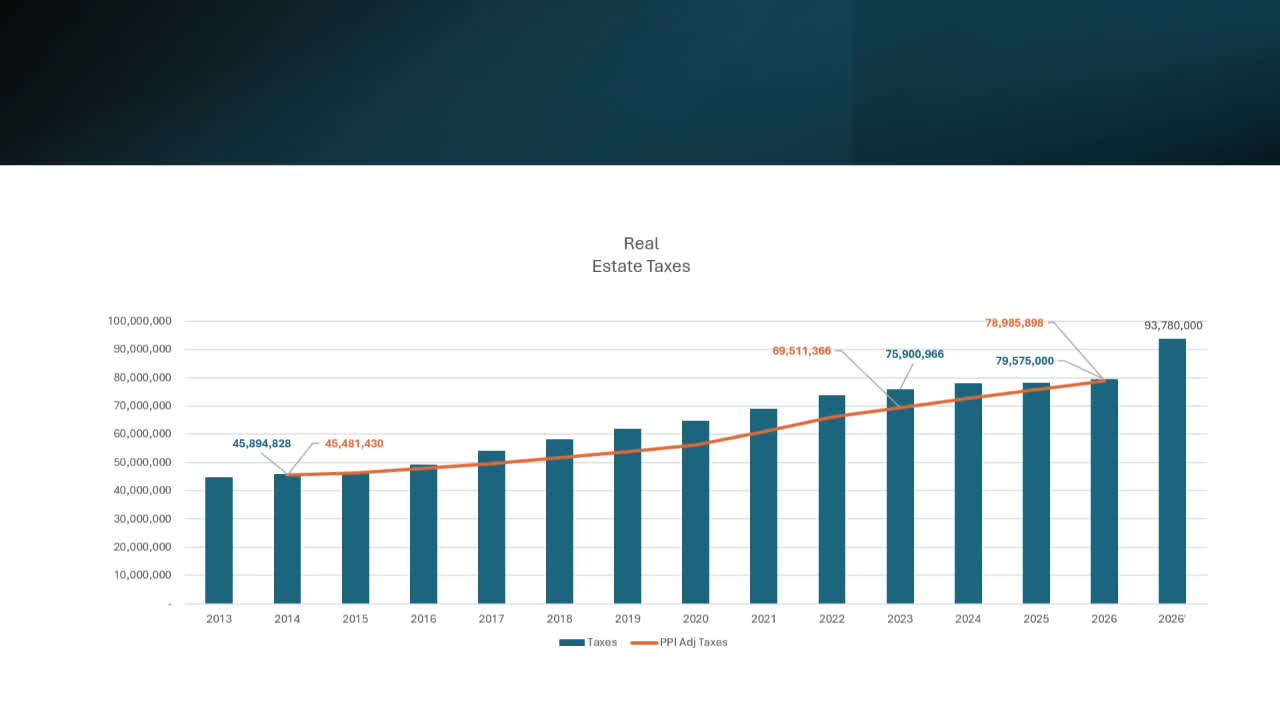
The presentation outlined three tax-rate scenarios: a revenue-neutral rate of 0.424, a mid-range proposal of 0.468 and the current rate of $0.51. County staff said the difference in property-tax revenue between the revenue-neutral and current rates is currently in the mid- to high-single-digit millions of dollars; staff noted earlier estimates that 1 cent of tax rate equals roughly $1.8 million may need updating as the numbers were revised during the meeting.
County staff member Cheryl said staff had updated sheets from the schools and other departments and that the sheet with the budget summary would be the ‘‘starting point going forward.’’ She told the board the budget summary shows $123.9 million in county operating expenses before school and other transfers and that the draft adds a $118 million school operating transfer, a $19 million school debt transfer and other items including a $5.5 million placeholder for general fund capital and a $3.1 million contingency and COLA package (a $300,000 contingency and a $2.8 million 4% COLA included in the draft).
The workshop highlighted long-term trends: staff said the county's transfer to public schools has increased from about $60 million in 2014 to roughly $110 million most recently and that transfers have outpaced population growth and inflation. Staff warned the county's costs have risen for several reasons: a major driver is a sustained growth in firefighter staffing (staff contrasted the number that would be expected if personnel had merely grown with population versus the actual, larger increase), plus higher costs in social services and recurring subscription and software licensing expenses.
"We are trying to update numbers, find more ways to improve the revenue projections and to reduce expenses," Cheryl said. She and other staff noted software subscription costs have risen significantly since 2013 and that while some software could be built in-house, most attempts are not successful or cost-effective.
Board members questioned the school requests and staffing assumptions. One supervisor said the school system had about 45 authorized positions this year that remained unfilled and that the schools are proposing roughly 40 additional positions for the next year; board members discussed trade-offs between funding more positions and increasing pay to improve retention. Staff reiterated that, under state law, the county can recommend categories for reductions but the school division ultimately determines where to cut if the county provides less funding.
Staff also walked the board through a draft calendar of key budget dates intended to guide adoption: a reassessment workshop (proposed for Feb. 26 in the presentation), an advertisement date of March 4, a budget public hearing (presented as March 26) and a reassessment hearing (presented as April 12), with budget adoption identified as a target for April 9. Staff stressed those dates are working targets and can change.
The administrator presented illustrative balancing steps in the draft: shifting several items from the general fund to the capital fund (transportation and some general fund capital), a placeholder reduction of $3 million applied to the schools' request (staff emphasized this was a numeric example, not a recommendation), and a $1.6 million allowance for new positions. Staff said capital requests submitted by departments remain under review and that the capital number is still fluid.
Next steps: staff said they will circulate the updated spreadsheets, refine the 1-cent tax-rate revenue estimate, and meet with supervisors individually on request. The county will also receive the school division's full FY26 budget book and supporting materials, which staff said would be posted and distributed ahead of the joint meeting with the school board.