
Lawmakers, Agency of Education walk through governor's proposal to remake Vermont school system
Get AI-powered insights, summaries, and transcripts
Subscribe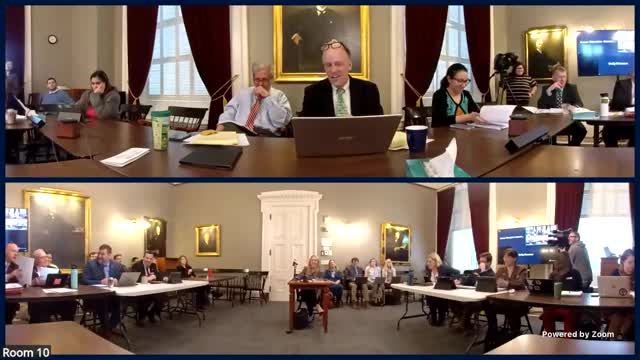
Summary
Secretary of Education Mike Saunders and Agency of Education staff on Feb. 23 walked House and Senate education committees through draft legislative language for the governor's education transformation proposal, explaining structural changes to governance, finance, school choice and district operations and answering lawmakers' procedural and policy questions.
Secretary of Education Mike Saunders and Agency of Education staff on Feb. 23 walked House and Senate education committees through draft legislative language for the governor's education transformation proposal, explaining structural changes to governance, finance, school choice and district operations and answering lawmakers' procedural and policy questions.
The bill would replace Vermont's existing supervisory-union structure with five unified union school districts, establish a new foundation funding formula with a cited base amount of $13,200 per student in fiscal year 2025, move many duties from the State Board of Education to the secretary of education and create new rules for so-called "school choice schools," among other changes.
Why it matters: supporters say the proposal is intended to address long-term enrollment and performance declines, reduce administrative cost and equalize opportunity across the state. Opponents and several legislators questioned the timeline, local impacts on small and remote communities, the treatment of independent schools and the mechanics of transferring debt, employees and contracts into the new districts.
State officials told lawmakers the package is designed as a comprehensive, multi-year transition rather than a quick fix. "We can't just make small leaps, we must redesign our system," Saunders said while describing the plan's goals to improve equity, student supports and long-term affordability. He said Vermont has seen "over 20%" enrollment decline over the past 20 years and that achievement measures and other indicators are moving in the wrong direction.
Agency counsel Emily Simmons, who guided the committees through the draft, summarized the bill's core elements: five statewide school districts governed by elected boards and a funding model that pairs a base amount with additional weights for student need, district sparsity and school scale. "We have the statement of the bill, which is to transform Vermont's education governance, quality, and finance systems," Simmons said as she began the section-by-section read-through.
Major provisions explained during the hearing
- Governance: The bill would dissolve existing districts and supervisory unions and create five unified union school districts that begin operation July 1, 2027. The draft lists the towns and proposed groupings and names example district labels such as Winooski Valley Unified Union School District and Champlain Valley Unified Union School District. The secretary would certify district designations not later than 30 days after enactment.
- Funding: The draft sets a base per‑pupil amount (presented in the walkthrough as $13,200 for FY2025) and calls for a weighted, evidence-based funding formula adjusted for Vermont's context. Agency staff said additional weightings would reflect student need, school scale and sparsity; lawmakers asked when the new formula would take effect and were told the foundation formula is expected to begin in fiscal year 2028 under the timetable discussed in the hearing.
- Education quality standards and class sizes: The bill moves rulemaking for education quality standards from the State Board to the Agency of Education and adds minimum average class-size expectations used in the funding model: a teacher-to-student ratio equivalent to 1:25 for grades 4–12 and 1:15 for kindergarten through grade 3. Agency staff said further specificity would be resolved in rulemaking.
- Duties and roles: Many duties currently listed in statute for the State Board of Education would be shifted to the secretary of education; the State Board would retain oversight and some new duties such as administering statewide board-member training and annually reviewing district quality outcomes.
- Independent schools and school choice: The draft eliminates the current statutory "approved independent school" status and creates a narrower "school choice school" construct limited to grades 9–12. To be designated by a district as a school choice school, an independent school would need Agency of Education certification meeting criteria that include use of state assessments, minimum graduation requirements, provision of special education services comparable to public schools, an annual single audit, minimum financial reserves (to be set by rule), compliance with nondiscrimination laws (citing Title 9, Chapter 139), and announced capacity for incoming publicly funded students. The draft also requires that, to qualify as a school choice school, at least 51% of the school's enrollment was comprised of district‑funded tuition students as of a date‑certain (the draft uses July 1, 2025).
- Transition mechanics: The bill text assigns property, debt, reserve funds and operating surpluses/deficits of forming districts to the new union districts effective June 30 or July 1, 2027, and establishes a transitional board (made up of designees from existing district boards) to perform preparatory tasks such as drafting the FY2028 budget and producing a superintendent candidate shortlist. The transitional board must convene its first meeting by Jan. 10, 2026. The draft provides that new union districts shall honor individual employment contracts in force on June 30, 2027, subject to limitations for contracts entered after May 1, 2025.
- Studies and deliverables: The Agency of Education must convene experts and submit a summary and recommended language for oversight of therapeutic independent schools and cooperative services by Dec. 15, 2025, and include recommendations for a statewide salary schedule.
Questions and concerns raised by lawmakers
Lawmakers pressed on several operational and equity matters: how towns without nearby public schools would be served, the effect on towns that recently passed bonds, who would negotiate payouts for multiyear employment contracts, how proportional board representation would be apportioned across dense and sparsely populated areas, whether class-size ratios would be enforced immediately or phased in, and how foundation funding changes would affect local property tax burdens. Several members noted the proposal's schedule is ambitious and flagged the work needed to develop local carve-outs and the district-level details.
What was decided or directed in the hearing
No formal votes were taken at the hearing. Committees directed the Agency of Education to continue to provide detail and follow-up materials — for example, data on current independent and school choice enrollments, an organizational chart showing the notional new structure and a timeline and fiscal model that lays out the expected savings and their timing. The agency also was asked to provide editing and drafting clarifications (for example, where the statute still uses the term "supervisory union") and to return with more detailed rule language and impact estimates.
What comes next
Agency staff and legislators said they will continue work on drafting, rulemaking details and targeted policy questions. The agency committed to producing several deliverables, including the therapeutic‑schools study and a proposed statewide salary schedule by Dec. 15, 2025. The bill as drafted sets a July 1, 2027 effective date for the new districts and calls for the new foundation funding to begin on the timetable outlined in the draft (the agency indicated fiscal‑year 2028 for the new funding model). Lawmakers signaled more hearings and committee work will follow before any final action.
Ending note
Committee members and agency staff acknowledged the scope of the proposal and the need for extensive follow-up. Several lawmakers urged diagrams and a clear timeline to explain when savings and transitions would occur for constituents; agency staff said they would prepare additional materials and engage further with legislators.