Get Full Government Meeting Transcripts, Videos, & Alerts Forever!
Get email alerts on the Seismic Grants Hospitals topic
No spam. Unsubscribe anytime.
HCAI says about $60 million available for seismic upgrades at small, rural hospitals
Summary
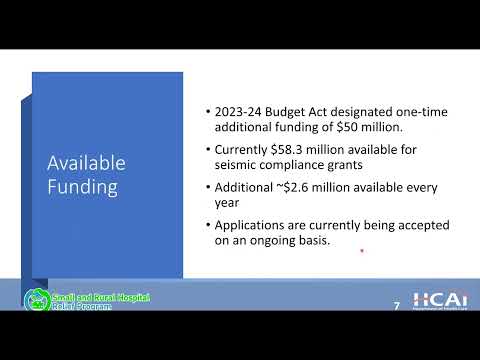
The Department of Health Care Access and Information (HCAI) told attendees at a webinar that about $60,000,000 is available to help small and rural hospitals pay for seismic resiliency work and that applications are accepted on an ongoing basis.
The Department of Health Care Access and Information (HCAI) told attendees at a webinar that about $60,000,000 is available to help small and rural hospitals pay for seismic resiliency work and that applications are accepted on an ongoing basis.
"We've got $60,000,000 that we're really trying to get out the door as quickly as possible to help small and rural hospitals and their seismic work," said Dean O'Brien, acting deputy director for the Office of Health Facility Loan Insurance, Cal Mortgage Loan Insurance Program, during the one‑hour presentation.
The program combines roughly $2.6 million per year derived from an excise tax fund referenced in the presentation as “395” with a recent one‑time allocation of about $50,000,000, the presenters said. The program was amended under AB 869 to expand eligibility and clarify qualifying project types, they added.
HCAI staff described which hospitals qualify and what projects the grant will reimburse. Ali Sumer, supervisor of the Seismic Compliance Unit, said a "small hospital" is defined in the program as 50 beds or fewer. Rural status is determined by either an MSSA (Medicare Service Study Area) designation or the older Health and Safety Code 1250 definition; critical access hospitals qualify by virtue of their CMS designation, the presenters said.
Eligible activities are grouped into three phases: evaluation (including material testing and condition assessment, described in the webinar as "MCAT" or MCAR results), design (preparing construction drawings, architectural/structural/mechanical/electrical design) and construction (retrofit work including SPC 4d construction as discussed in the presentation). Ali Sumer said the program reimburses consultant and contractor fees tied to those phases, but staff will ask applicants to separate non‑seismic tenant improvements or "nice to have" items from seismic work so the grant pays only for seismic compliance.
The webinar explained the application and award process. Applicants must register for an account on HCAI's portal (first‑time users should sign up and wait about 10–15 minutes for the account to initialize), then "apply now" and complete required questions and uploads. Required information includes facility identifiers (FEIN, an HRPE number or the placeholder 000 if applicants lack one), answers to statutory questions about whether seismic compliance could lead to closure, and a set of supporting documents such as the most recent audited financial statements, year‑to‑date financials, current operating licenses, organizational chart, legal status questionnaire, contracts and invoices, and a project budget.
O'Brien described how award amounts are determined and paid. After HCAI reviews an application and supporting documents, the Office of Health Facility Loan Insurance will set a percentage of the requested grant award (for example, 75% in the webinar's fictitious illustration) and prorate that percentage across milestone line items. Reimbursements are paid after the grantee has spent money and submitted invoices and proof of payment; the presenters described the program as a reimbursement model rather than an advance. HCAI noted that once a requisition form is signed, it may take up to 10 weeks for a payment check to be mailed, though multiple milestone payments during a project can reduce the practical cash‑flow gap for a facility.
Presenters emphasized flexibility for schedule changes but warned that long, unexplained work stoppages could lead HCAI to cancel unused portions of an award and return funds to the program. If a facility revises scope during a project, HCAI staff said they will work to reallocate funds to new scope items or roll back allocations for removed items; money already reimbursed for completed work is not required to be paid back.
The webinar included operational guidance: HCAI staff recommend facilities submit a conservative, well‑scoped consultant fee proposal rather than a single large, worst‑case estimate. "If we see an outrageous fee number, we push back," Ali Sumer said, explaining HCAI will ask applicants to split out unnecessary work and focus on minimum seismic scope to limit cost inflation.
The presenters also covered a few technical and administrative points offered in the webinar: MCAT (material testing and condition assessment) informs whether a building can be analyzed for SPC 4d without major construction; geotechnical work can appear early or later in the sequence; for certain upgrade pathways (identified in the webinar as FPC projects), up to 20% of the construction cost attributable to ADA upgrades required by the seismic work may be eligible for reimbursement; and non‑seismic tenant improvements must be budgeted separately.
For eligibility verification, HCAI published an online table that allows facilities to confirm MSSA or Health and Safety Code 1250 status; the presenters said a follow‑up webinar on AB 869 eligibility details is scheduled for March 4. The presentation materials are available in the webinar handout panel and will be posted on the HCAI website in approximately one week; a closed‑captioned recording will be added in about four weeks.
For program questions, the presenters directed hospitals to seismiccomplianceunit@hcai.ca.gov. The presenters closed by encouraging early outreach to HCAI so staff can help narrow scopes, coordinate with consultants and provide technical assistance through the evaluation, design and construction stages.
Even though HCAI staff said they aim to issue awards quickly, the presenters repeatedly stressed that projects require adequate up‑front evaluation and that reimbursement timing, milestone structuring and the percentage awarded are determined case‑by‑case by the Office of Health Facility Loan Insurance.