Get Full Government Meeting Transcripts, Videos, & Alerts Forever!
Get email alerts on the Peer Personnel Training And Placement topic
No spam. Unsubscribe anytime.
HCAI outlines funding, eligibility and service obligations for Peer Personnel training as BH Connect funds arrive
Summary
At an HCAI webinar, staff detailed the Peer Personnel Training and Placement Program’s current funding limits, how upcoming BH Connect Workforce Initiative money will be used, eligibility rules (including the DHCS 80‑hour certification), and outstanding questions about service obligations, disability accommodations and payment timing.
The Department of Health Care Access and Information told applicants during a webinar that the Peer Personnel Training and Placement Program will continue under limited annual funds for 2025 while larger BH Connect Workforce Initiative resources become available after July 1, 2025.
Wahida Nawal, grants section chief for health workforce development at HCAI, opened with the agency’s mission to expand equitable access to care and described HCAI’s workforce focus before Clinton Ramstad, program manager for the PEER program, described how the current grant rules and new state workforce funds will affect applicants.
The nut graf: HCAI said organizations should apply even though this year’s discretionary funding is low because the forthcoming BH Connect Workforce Initiative (a state program administered in partnership with the Department of Health Care Services) will provide substantially larger, multi‑year support but brings additional eligibility and service‑commitment rules that applicants must meet.
Clinton Ramstad summarized how the PEER program works now and under BH Connect. “Peer personnel are individuals with lived experience as a mental behavioral health services consumer, family member, and or caregiver placed in designated peer positions,” he said, and applicants must provide training that meets the DHCS Medi‑Cal peer support specialist 80‑hour certification requirement. For the current cycle HCAI has $2,000,000 secured and said that historically awards have been up to $1,000,000 per organization; “we can absolutely guarantee awarding 2 organizations,” Ramstad said. He added that the program as currently run does not impose a service obligation on participants, but that BH Connect funds will carry a multi‑year service requirement.
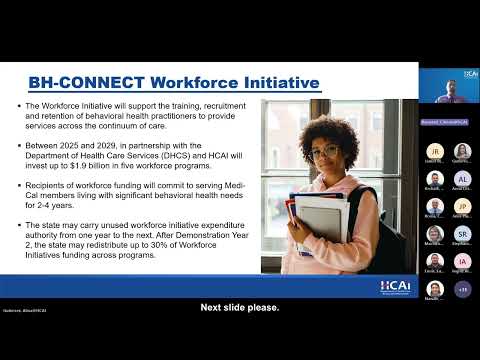
HCAI said BH Connect will allow the state, in partnership with DHCS, to invest up to $1.9 billion between 2025 and 2029 across five workforce programs, and that community‑based provider training is expected to be the primary funding vehicle for peer training. Under the BH Connect guidance described by HCAI, recipients may receive up to $10,000 per participant and participants would commit to serving Medi‑Cal members with significant behavioral health needs for two to four years; HCAI said the program may allow unused allocation to be carried forward and the state could reallocate up to 30% of funds across programs after year two.
Eligibility and placement rules described during the webinar include: training placements must be at eligible “safety net” sites such as Federally Qualified Health Centers (FQHCs) or FQHC look‑alikes, community mental health centers, rural clinics or hospitals that meet a Medi‑Cal payer mix threshold (HCAI cited a 40% threshold, with a lower threshold noted for some rural settings). HCAI also pointed attendees to an online geo lookup for FQHCs and rural clinics and said staff are exploring expanded functionality to identify additional eligible sites.
Payment mechanics: HCAI clarified that BH Connect payments are made to training programs, not to individual participants, and that organizations are responsible for monitoring participants and ensuring compliance with grant terms. For the current awards HCAI generally aligns contracts to a July 1 start; organizations must submit a quarterly certification covering the previous 90 days and are paid after submitting that certification. HCAI staff estimated that first payments for 2025 awardees would likely occur around October (after the first quarter of service has been certified).
Data and evaluation requirements: Ramstad said grant recipients will submit deidentified participant data to HCAI, including demographic information and DHCS certificate information; organizations will retain identifiable data while HCAI receives deidentified, aggregate reporting for evaluation and deliverable verification.
Outstanding questions and limits: Several participants asked about reasonable accommodations, part‑time service for participants with disabilities, and what happens if a participant cannot find or retain a peer position. Sharmell Shaw, branch chief for behavioral health and policy, said HCAI is “working to include job placement support as part of the BH Connect program,” and staff are coordinating with DHCS and CMS to understand allowable flexibility. Ramstad and Shaw repeatedly stressed that some issues — for example, how to handle service obligations when a participant loses employment or has a disability — are still under discussion and not yet resolved.
Applicants and attendees raised concerns that scoring and award size can favor proposals that propose large placement numbers; HCAI said awards are competitive and based on published scoring criteria and that tie‑breakers could consider geographic distribution or efficiency (for example, cost per participant). Mike, an attendee who commented from the field, cautioned that organizations sometimes overstate placement capacity, which can create downstream placement problems; Ramstad said HCAI can review past performance records and will share that concern with upper management but could not promise changes beyond the grant guide.
HCAI encouraged applicants to apply even if funding is limited so the agency can document legislative demand for the program. Staff also said BH Connect funds will be available to HCAI after July 1, 2025, that HCAI anticipates running the first BH Connect community‑based provider training cycle in early 2026, and that more detailed guidance (including the special terms and conditions and links to DHCS resources) will be posted on the HCAI website.
Ending: HCAI closed by providing links and an email for follow‑up (BHProgramShiai@hcai.ca.gov was given in the webinar transcript as the contact) and said the recorded webinar and slides will be posted to its website within 7–10 business days.