Get Full Government Meeting Transcripts, Videos, & Alerts Forever!
Get email alerts on the Homelessness Funding topic
No spam. Unsubscribe anytime.
Spokane County commissioners weigh shifts in homeless funding, emphasize prevention and accountability
Summary
County staff presented draft guidance for distributing reduced Consolidated Homeless Grant funds, recommending higher shares for homelessness prevention and transitional housing, stronger contract accountability, and outreach requirements linking rural residents to city services.
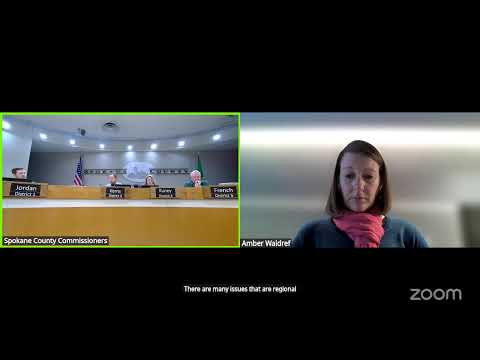
Spokane County commissioners on Feb. 24 reviewed draft guidance for how to allocate anticipated reductions in state Consolidated Homeless Grant (CHG) funding and signaled support for prioritizing homelessness prevention and measurable outcomes.
County staff presenter Chris Pranche told the Board that Commerce’s CHG award is expected to be “reduced at approximately 20%,” and proposed shifting funding percentages so prevention receives about 30% of local CHG dollars, transitional housing about 20%, rapid re-housing and long‑term housing smaller shares, and outreach roughly 5%.
That recommendation, Pranche said, aims to produce “projects with outcomes or accountability measures,” and he said the advisory committee would be asked to evaluate grant applications against those guardrails before the Board receives final funding recommendations. “We should contractually put in our expectations of the project and hold them accountable throughout the two‑year period of performance,” Pranche said.
Commissioners repeatedly framed prevention as cost‑effective. “If we can keep people in their home not being displaced, it saves dollars in the long run,” Commissioner Waldorf said. Several members said they favor increasing prevention shares if doing so does not sharply harm longer‑term housing interventions. Commissioner Kearns asked for clarity on scale: “That 30% looks like it’s going to be just under $3,000,000,” and asked whether that amount would be exhausted before the two‑year period ends; Pranche said contracts will include spend‑down requirements to attempt to sustain services for the entire performance window.
Pranche and commissioners discussed how the County’s grant priorities align with nearby jurisdictions. Pranche said the County expects to be able to sync funding cycles with the City of Spokane in two years and that some services funded by the County will geographically fall inside city limits; he recommended contract language requiring outreach projects to serve people in unincorporated areas and connect them to city resources. He noted that permanent supportive housing is largely funded by the City and recommended a 0% allocation to that specific intervention type in the County’s CHG guidance because the County historically has not funded that intervention at scale.
Commissioners flagged several operational items for the advisory committee and staff: require proposals to show leveraged funding, require surge bed capacity or an approach to inclement weather, and identify backup projects if the final CHG award is smaller than expected. Pranche said there is a $100,000 document‑recording‑fee set‑aside intended to support inclement‑weather surge capacity and that the County will select reserve projects and ranking lists in case award amounts change.
Timing and next steps: Pranche said the County will submit its consolidated homeless grant application this week without an award amount, expects a briefing for the Board in late March, and that the legislature’s decisions (he noted the legislative session finishes in April) and Commerce’s final award could change allocations. The advisory committee will review applications and return funding recommendations to the Board for approval.
The Board gave general direction to prioritize prevention and diversion, ask the advisory committee to emphasize measurable outcomes, and require contractual outreach to unincorporated areas. Staff will bring a draft funding package and backup project lists to the Board once advisory committee recommendations and final state award information are available.