Get Full Government Meeting Transcripts, Videos, & Alerts Forever!
Get email alerts on the Environment Pfas topic
No spam. Unsubscribe anytime.
Spokane County residents press commissioners for faster PFAS response on West Plains
Summary
Public commenters urged Spokane County commissioners to accelerate action on PFAS contamination in the West Plains, citing EPA testing, household exposure and stalled formation of a county task force; Commissioner French said a grant application for filtration systems is pending and work will continue while legal scope is finalized.
Craig Vollising, a West Plains resident who identified himself as speaking for other people affected by PFAS contamination, told the Spokane County Board of Commissioners on Feb. 25 that community members are frustrated at what he described as delays in forming a county clean safe water task force.
“Instead, it seems you have eased it into neutral and let it coast,” Vollising said, urging the board to start convening task-force members to set meeting schedules, reporting guidelines and goals while the county’s legal department completes paperwork.
The concern was echoed by John Hancock, a West Plains resident whose home he said is north of the Northern Quest Casino on Deep Creek. Hancock said an EPA team tested private wells in the area and that maps provided to commissioners show many homes with PFAS levels he described as “more than 20 times the legal limit now at the federal level.” He said about 50 households have received pitcher or under-sink filters from Ecology and the Department of Health, and that many others remain waiting for assistance.
“Neighborhood. So we're asking for your attention to keep this going forward,” Hancock said, urging the county to move from having one of the worst PFAS contaminations to “being the community that's in the lead on national solutions.”
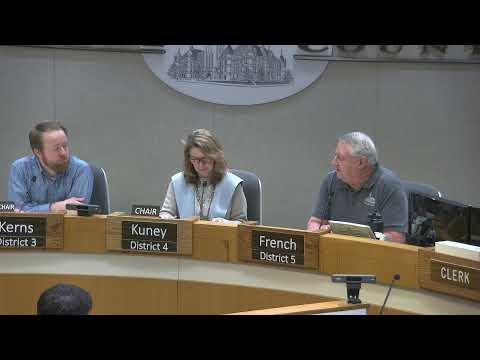
Commissioner French said the county has submitted a grant application for filtration systems and is pursuing two paths: the county’s grant submission and seeking allocation through the state Department of Health. French also described ongoing work with county counsel to define the task force’s scope and said she and Commissioner Jordan met with the county attorney about that scope roughly four weeks earlier.
“We are also working with members to try and if not have a separate, allocation to be part of the Department of Health's allocation for filtration systems,” Commissioner French said. She added that new cleanup technologies have been submitted to county staff for evaluation and that staff will follow up on whether the technologies are viable.
The public commenters and Commissioner French said concrete next steps remain pending: the task force scope is not finalized, the legal department was preparing the task-force resolution, and broader cleanup technology for aquifer-level PFAS removal has not been proven. No formal county action to form the task force was recorded during the meeting.
The board heard five public comments during the open forum; the PFAS discussion occupied several of those remarks and prompted questions from commissioners about enforcement and remedial options.
The county did not announce a new timetable for task-force formation during the meeting.