Get Full Government Meeting Transcripts, Videos, & Alerts Forever!
Get email alerts on the Wildlife Management topic
No spam. Unsubscribe anytime.
Fairfax supervisors debate whether wildlife program should remain with police or move to Park Authority
Summary
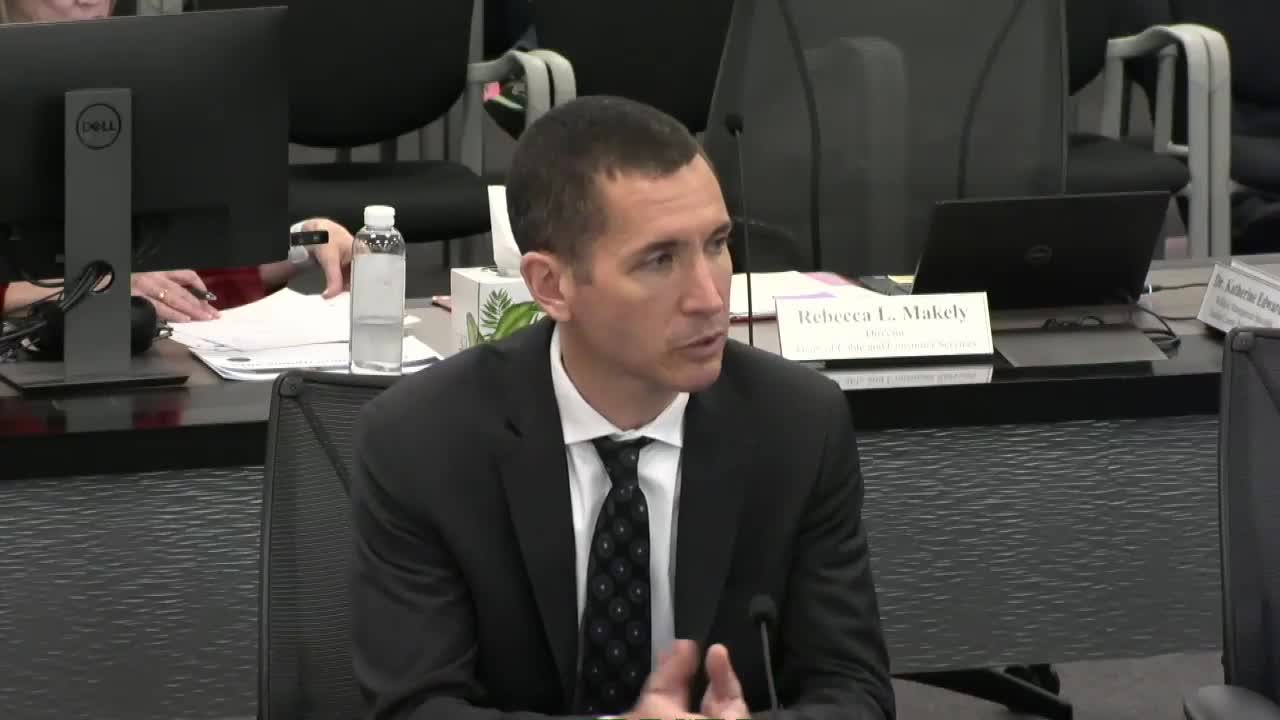
Assistant Chief of Police Bob Blakely and county staff briefed the Board of Supervisors Feb. 11 on the county—s wildlife management program and whether it should remain with the Fairfax County Police Department or move to the Fairfax County Park Authority.
Assistant Chief of Police Bob Blakely and county staff briefed the Fairfax County Board of Supervisors on Feb. 11 about the county—s wildlife management program and the question of whether the unit should remain in the Fairfax County Police Department or be transferred to the Fairfax County Park Authority.
The presentation, prepared by the county wildlife biologist Dr. Edwards (who was not present because she was ill), described the scope of the program: deer population control carried out since 1997 using archery, managed shotgun hunts and sharpshooter operations on more than 100 properties; a Canada goose management program that uses egg oiling under U.S. Fish and Wildlife Service registration; beaver coexistence and mitigation consultations; bat, bird and amphibian surveys done in partnership with the Park Authority and external conservation partners; and chronic wasting disease surveillance tied to the county—s deer management work. Blakely said the program—s work includes outreach to homeowners associations and coordination with state agencies on wildlife health issues such as chronic wasting disease, hemorrhagic disease, rabies and avian influenza.
Deputy County Executive Tom Arnold told supervisors the county has discussed the idea of transferring the wildlife functions to the Park Authority because the Authority already employs ecology‑series positions that align with the county—s wildlife roles. He said those classification differences — a —naturalist— classification in the police department versus an —ecologist— series at the Park Authority — are a practical reason administrators are considering the move and that the Park Authority has an established ecological program and existing working relationships with the county—s wildlife staff.
Supporters of a transfer pointed to potential benefits including closer alignment of ecology expertise and Park Authority capacity. Officials said the Park Authority director has recent experience running a similar program, which could make for a smoother transition. Those who favored keeping the program in the police department said doing so preserves direct Board of Supervisors oversight and keeps wildlife work within an agency tied closely to public safety operations.
Multiple supervisors said their constituents expect countywide coverage, not only parkland services, and raised concerns about perception and governance if the Park Authority — which is governed by its own fiduciary board — took responsibility for a countywide function. Several supervisors asked staff to present clear pros and cons and to avoid rushing a final decision. Supervisor comments emphasized the need for partnership among the police department, animal services and the Park Authority regardless of where the unit lands.
Officials described continuity commitments if the unit moves: Dr. Edwards would continue to lead wildlife work during any transition, existing collaborations with the Virginia Department of Wildlife Resources, Fairfax County Park Authority, stormwater and urban forestry staff would remain, and current protocols for public safety calls involving wildlife would be preserved. Blakely said archery remains the primary deer management method, with about 500–600 hunters participating annually, and that safety protocols and safety audits are central to current operations.
Staff confirmed no final decision has been made. They said county leaders plan to bring proposed code updates and retirement‑code revisions to the Board in March with public hearings in April, as part of the larger animal services consolidation discussions. Supervisors asked for additional information comparing challenges and benefits under each placement option and for clarification about training, response authority for dangerous animals, and how the county would preserve program quality over time.
Supervisors requested follow‑up materials and time to review a fuller set of pros and cons before any formal transfer. Several asked staff to ensure public messaging makes clear that wildlife management is a county program serving all of Fairfax County, not exclusively a Park Authority function, regardless of organizational placement.
Ending
County staff said they will continue discussions with the Park Authority and other stakeholders, compile comparative pros and cons for the Board, and bring necessary code updates to the Board for consideration in March with a public hearing in April. No formal vote or final action on the wildlife program—s placement occurred during the Feb. 11 meeting.