Get Full Government Meeting Transcripts, Videos, & Alerts Forever!
Get email alerts on the Battery Energy Storage Systems topic
No spam. Unsubscribe anytime.
County staff recommends zoning framework, safety planning and decommissioning rules for battery energy storage systems
Summary
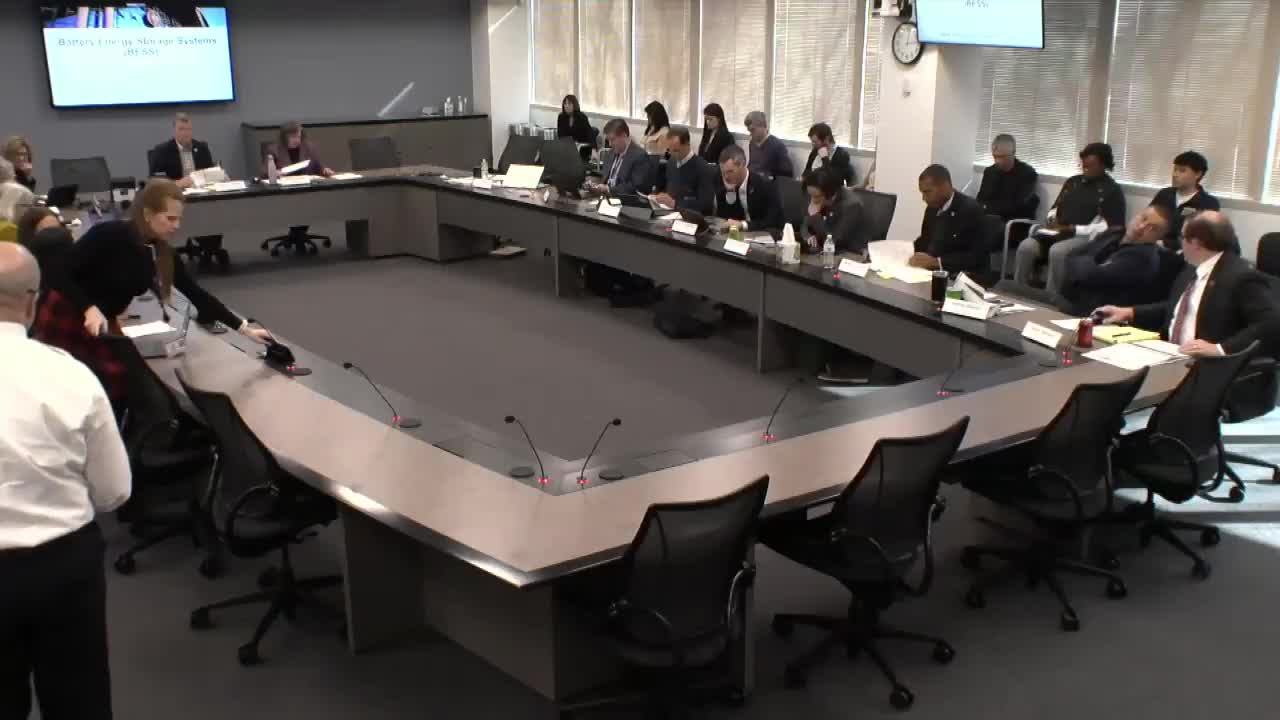
Staff briefed the committee on battery energy storage systems (BESS), proposing zoning distinctions by scale, setbacks, screening and safety plans; supervisors pressed for fire-safety measures, decommissioning bonds and clarity on effects to EV charging goals.
Fairfax County planning staff presented preliminary ideas for zoning and safety standards for battery energy storage systems (BESS), flagging safety, siting and decommissioning as primary issues to be resolved before any ordinance change.
Jackie Camp of the Zoning Administration Division said BESS are modular systems that can range from small accessory batteries for a single property to large, principal-use installations that charge from and discharge to the electrical grid. The county has seen one large-scale BESS pre-application in an R-1 district near Dominion's Occoquan substation; that project went through pre-application but has not submitted a full application, Camp said.
Camp described the regulatory context: federal funding and tax incentives (the Infrastructure Investment and Jobs Act and the Inflation Reduction Act), and Virginia law including the Virginia Clean Economy Act (VCEA), which sets renewable and storage targets and includes limits such as a 500-megawatt cap on single private projects (Dominion may procure up to 800 MW under limited conditions). Camp said Dominion's VCEA target for energy storage is about 2,700 megawatts, which may increase local demand for siting storage.
Staff outlined potential zoning approaches used elsewhere: limiting large-scale principal BESS by right to higher-intensity industrial districts (I-5, I-6) while allowing special exception review in other districts; differentiating accessory, mid-size and utility-scale systems; setbacks often ranging 25—00 feet, fencing of 6— feet and layered screening; noise studies to set performance limits; requirements for decommissioning plans and financial sureties; and involving local fire and emergency responders in pre-approval planning. "We should consider safety requirements such as hazard mitigation assessments and emergency response training and any other safety standards recommended by the Fire Marshal," Camp said.
Fire and rescue staff noted the practicalities of firefighting and emergency response. John Walzer of the Fire and Rescue Department said water is used to fight BESS fires and emphasized the need for coordination with local responders on response plans and site access. Supervisor Herrity described high-profile BESS fire incidents elsewhere and urged strong decommissioning and access standards; several supervisors asked staff to ensure zoning requirements would not unintentionally impede county clean-energy goals such as deployment of Level 3 EV charging.
Supervisors suggested policy directions: several supported by-right siting in high-intensity industrial districts (I-5/I-6) for utility-scale systems, while urging strict safety, notification and decommissioning rules; others recommended clear distinctions by size so that large accessory systems on the same property as a substation or data center would meet principal-use standards. Staff flagged that new state siting-agreement language for solar and storage and possible pending state legislation will be monitored and incorporated as appropriate.
Next steps: staff will continue research, prepare a white paper and draft ordinance text, meet with the Planning Commission infrastructure committee and conduct outreach in spring and summer, and target public hearings in fall 2025.