Get Full Government Meeting Transcripts, Videos, & Alerts Forever!
Get email alerts on the Substations Zoning topic
No spam. Unsubscribe anytime.
Staff outlines zoning amendment for substations, flags visual and noise impacts and new review options
Summary
County planners proposed changes to zoning permissions and standards for electrical substations, including limiting by-right locations, potential setbacks and screening standards and a consistent alternative-site review radius; staff and supervisors discussed how expansions of existing substations would be treated.
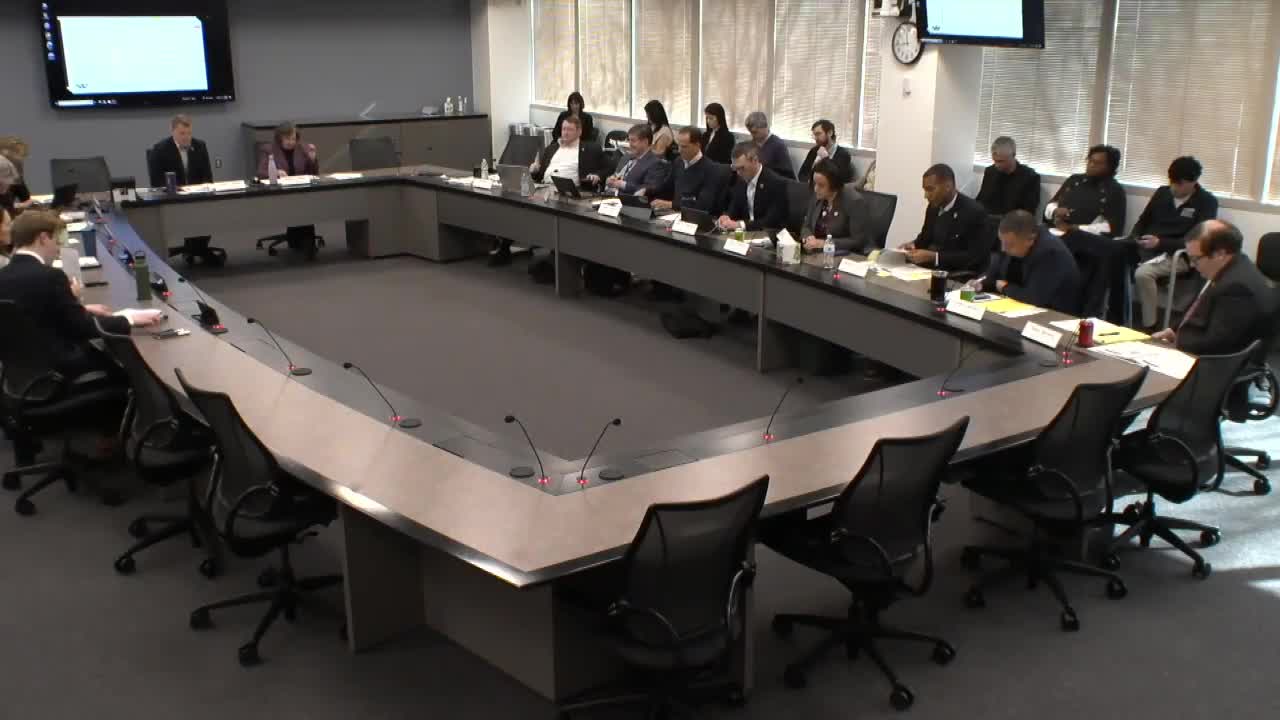
Fairfax County planning staff briefed the Land Use Policy Committee on a proposed zoning ordinance amendment for electrical substations that would revise where substations are permitted by right and add standards to mitigate visual and noise impacts.
Carmen Bishop of the Zoning Administration Division told the committee staff began working on the amendment after the Board's data-center discussion and a 2018 priority listing. "Based on a review of previous applications and other information, two main review topics have been identified: visual impacts and potentially noise," Bishop said. She described proposed changes to permissions and standards and said staff had met with Dominion Energy, NOVEC and other stakeholders.
Staff reported Dominion has about 76 substations in Fairfax County and NOVEC has eight. Substation parcel sizes vary widely: some are less than 5 acres, Dominion said they sometimes occupy 15'16 acres and can reach 30—0 acres in some instances. Equipment heights vary by project; staff cited past applications where circuit breakers were 15 feet high, transformers 29 feet and a static pole/backbone structure 75 feet; other applications added 95-foot transmission poles. Security fencing ranges from 10-foot chain-link with barbed wire to 16'0-foot masonry walls or decorative walls and building-type enclosures.
Under the current zoning ordinance, substations are allowed by right in I-3 through I-6 industrial districts and by special exception (SE) in most other conventional and planned districts (with some exceptions). Staff's preliminary proposal would limit by-right permissions to I-5 and I-6 only, require SE approval in some areas now allowed by right and add site-specific SE standards for screening, setbacks and possibly increased transitional buffers next to residential uses. Staff also suggested making the review for alternative sites consistent (for example, one uniform radius such as a half-mile) rather than the current varying distances used for distribution and transmission stations.
Noise was raised as an issue: staff noted transformers had been modeled at about 75 decibels at the source in one application while the county nighttime residential noise limit is 55 decibels. Bishop said staff hopes to engage an acoustical consultant to inform setback and barrier recommendations.
Committee members sought clarification. The chair asked how amendments would affect the planned continuing care (PCC) district; Leslie Johnson, Zoning Administrator, said the PCC district was created in 2018 for continuing-care facilities and is unlikely to see many substations, but staff would confirm consistency. Supervisors asked how expansions of existing substations would be treated; staff said the proposed concepts target new construction but that expansions that materially increase use or footprint would generally trigger SE review and applicable site standards. Several supervisors asked staff to clarify notification and timing protocols and to review past projects, such as the Idlewood and Pope's Head substations, as examples of mitigation practices that reduced community impacts.
Walkinshaw and others suggested the county should consider third-party technical review (e.g., acoustical or alternatives analysis) in some contested cases to build public confidence in technical assertions made by utilities. Bishop said staff plans outreach with the Planning Commission's Infrastructure Committee, additional research this spring, draft amendment text and a request for board authorization in May, followed by public hearings in June and July if authorized.
Next steps: staff will meet with the Planning Commission's Infrastructure Committee, prepare draft amendment text, conduct outreach and return to the board for authorization in May with public hearings to follow if authorized.