Get Full Government Meeting Transcripts, Videos, & Alerts Forever!
Get email alerts on the Land Use Zoning topic
No spam. Unsubscribe anytime.
Planning staff proposes new cluster-subdivision and farm-housing rules to preserve rural character
Summary
Planning staff presented two zoning ordinance amendments: one to restore and tighten rules for cluster (conservation) subdivisions, and one to reinsert a farm-housing provision removed in 2021. The proposals set conservation-area minimums, new lot-size tiers tied to utilities, and limits on farm-housing size and occupancy.
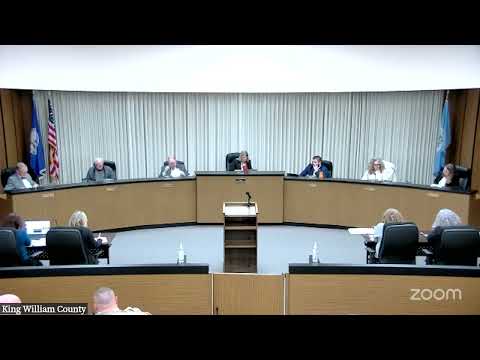
Joyce Volk, planning staff, told the King William County Board of Supervisors on Jan. 13 that state law requires the county to provide for cluster subdivisions and that staff is proposing changes to clarify and strengthen the county's rules.
Under the draft ordinance, a conservation lot would be placed under a permanent open-space easement held by an approved government or qualifying nonprofit easement holder rather than by the county. The ordinance would require that, to the maximum extent possible, sensitive environmental features and mature woodlands be protected; that public roads built for such subdivisions meet county public-road standards; and that one dwelling may be placed on a conservation lot. The drafts would remove prior density bonuses tied to public utilities or workforce housing. Proposed minimum lot sizes would vary by utility availability: with both public water and sewer, lots could be as small as 15,000 square feet; with either public water or public sewer, 20,000 square feet; and with private utilities, 40,000 square feet. The proposal sets the conservation area at 70% of the overall parcel, with density calculated at one dwelling per five acres as in the current AC district; planning staff said those figures increase the number of potential lots on a hypothetical 100-acre parcel from roughly seven (existing) to about 20 (proposed), subject to topography and environmental constraints.
On a separate amendment, staff moved to restore a farm-housing provision believed omitted during a 2021 code update. The draft would allow farm-housing only on farms of at least 50 acres unless the planning commission approves a smaller parcel in a particular case; it would limit farm housing to one structure per 50 acres, cap building area at 2,000 square feet (a single unit or split into up to five rooms), and limit occupancy to no more than 10 people. The use would be limited to workers and their families and would not allow market rental or short-term rental. For existing nonconforming farm dwellings, staff said those structures would remain nonconforming unless altered; new or expanded farm housing would require permits and building-code compliance. Planning staff said the planning commission recommended administrative approval by the planning commission or, alternatively, a variance process for a farm smaller than 50 acres.
Volk said the proposed clustering ordinance was modeled on Hanover County's approach and is intended to preserve rural character while accommodating housing demand.
Board members and members of the public asked technical questions about lot-size distinctions, separation requirements for wells and septic systems, and whether the county or outside entities would hold open-space easements. Volk said examples of potential easement holders include state or nonprofit conservation organizations and that the planning commission recommended removing the county as default easement-holder to avoid placing long-term monitoring and enforcement burdens on county staff.
The planning commission will hear related draft language tomorrow and will forward a recommendation to the board at its next meeting; staff asked the board to review the draft language and consider refinements, particularly on the farm-housing size threshold and the approval path for exceptions.