Get Full Government Meeting Transcripts, Videos, & Alerts Forever!
Get email alerts on the Housing Infrastructure topic
No spam. Unsubscribe anytime.
Lawmakers consider expanding housing infrastructure loan fund; proponents say it unlocks development, analysts seek metrics
Summary
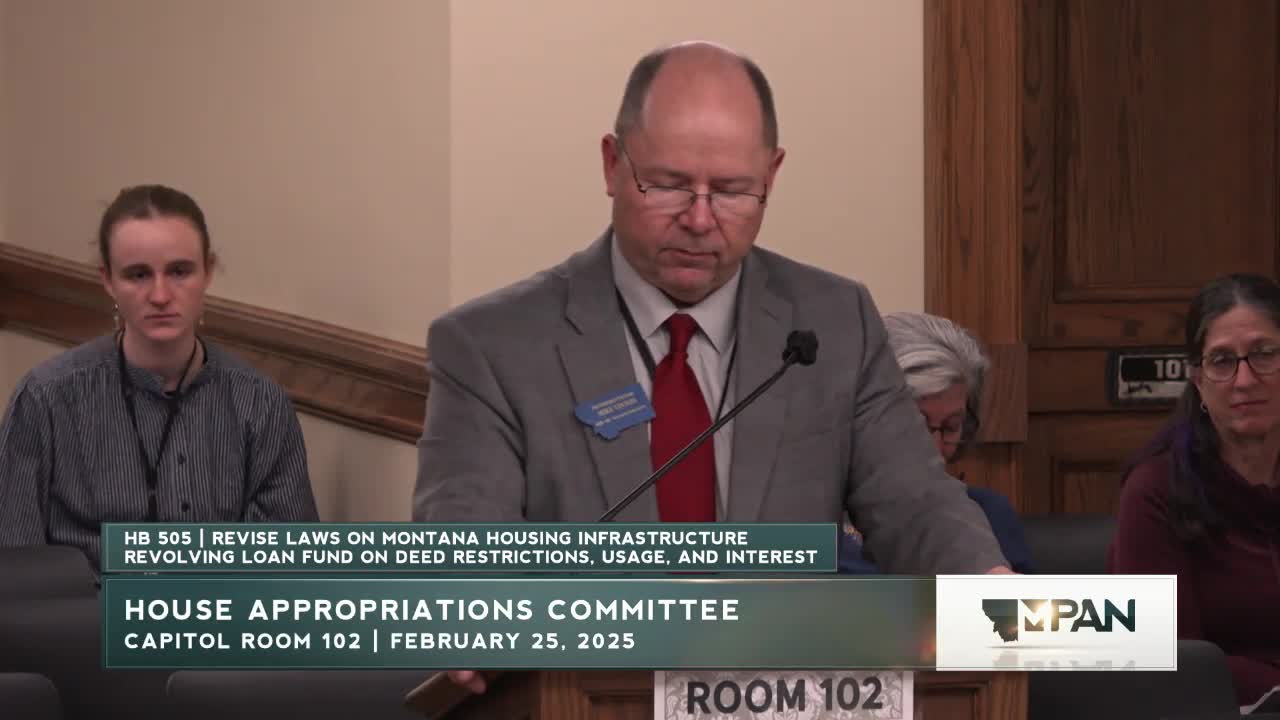
Representative Mike Vinton presented House Bill 505 to expand the Montana Housing Infrastructure Revolving Loan Fund by adding proposed transfers and broadening eligible uses to finance water, sewer and roads that unlock housing development.
Helena — House Bill 505, introduced by Representative Mike Vinton, would expand and broaden a state revolving loan and bond support program intended to finance infrastructure for new housing development across Montana.
Vinton told the committee the bill would increase the fund through transfers in 2025 and 2026 (a proposal to add $100 million and $50 million in the current bill), expand eligible uses to include loans, bonds and deposit support, and lower the residential density threshold in some program components from 10 lots per acre to four to encourage a wider range of housing types.
Proponents — including the Montana Bankers Association, the Montana League of Cities and Towns, the Montana Infrastructure Coalition, NeighborWorks Montana, the Montana Building Industry Association, Shelter Whitefish and the Montana Board of Investments — described the program as an effective tool to get infrastructure (water, sewer, roads) in place so private development can proceed. Dan Villa, executive director of the Board of Investments, told the committee BOI deployments from the original 2023 appropriation were quickly subscribed and credited the program with supporting approximately 969 housing units across several Montana communities.
"This bill leverages existing resources in a way that helps the private sector respond to our housing crisis," said Ashley Martinez of the Montana Building Industry Association. Supporters said the program had already been used for a range of projects, including both new construction and rehabilitation.
Committee members asked detailed questions about measurable impacts and how the state investment changes the developer financing stack. Vice Chair Mercer and Representative Gillette sought concrete examples of how the BOI interventions lowered financing costs and what the expected per-unit impact on affordability would be; BOI staff explained the program reduces construction financing costs by providing linked or subsidized deposits and lower-rate support that lenders treat as stable collateral for construction loans.
Witnesses and proponents also described program mechanics, including: linked-deposit arrangements where BOI deposits at a rate that lowers lending costs to developers, bond and loan partnerships with local governments, and expanded use of interest earnings to support resident-owned communities and cooperative financing. Proponents emphasized the fund's revolving nature and that loans are repaid into the account to be redeployed.
No committee vote was recorded during the hearing. Proponents urged the committee to advance the bill to increase a tool they say helps create both rental and homeownership opportunities, especially when private-sector development is otherwise blocked by up-front infrastructure costs.