Get Full Government Meeting Transcripts, Videos, & Alerts Forever!
Get email alerts on the State Budget topic
No spam. Unsubscribe anytime.
Appropriations subcommittee approves recruitment fund, advances contingent property‑tax funding and several agency DPs; blocks capital development transfer
Summary
The Montana Legislature appropriations subcommittee on Wednesday approved a reduced recruitment and retention contingency fund, advanced contingent funding tied to pending property‑tax bills and cleared multiple agency decision packages — while rejecting a proposed transfer to the Capital Development Authority.
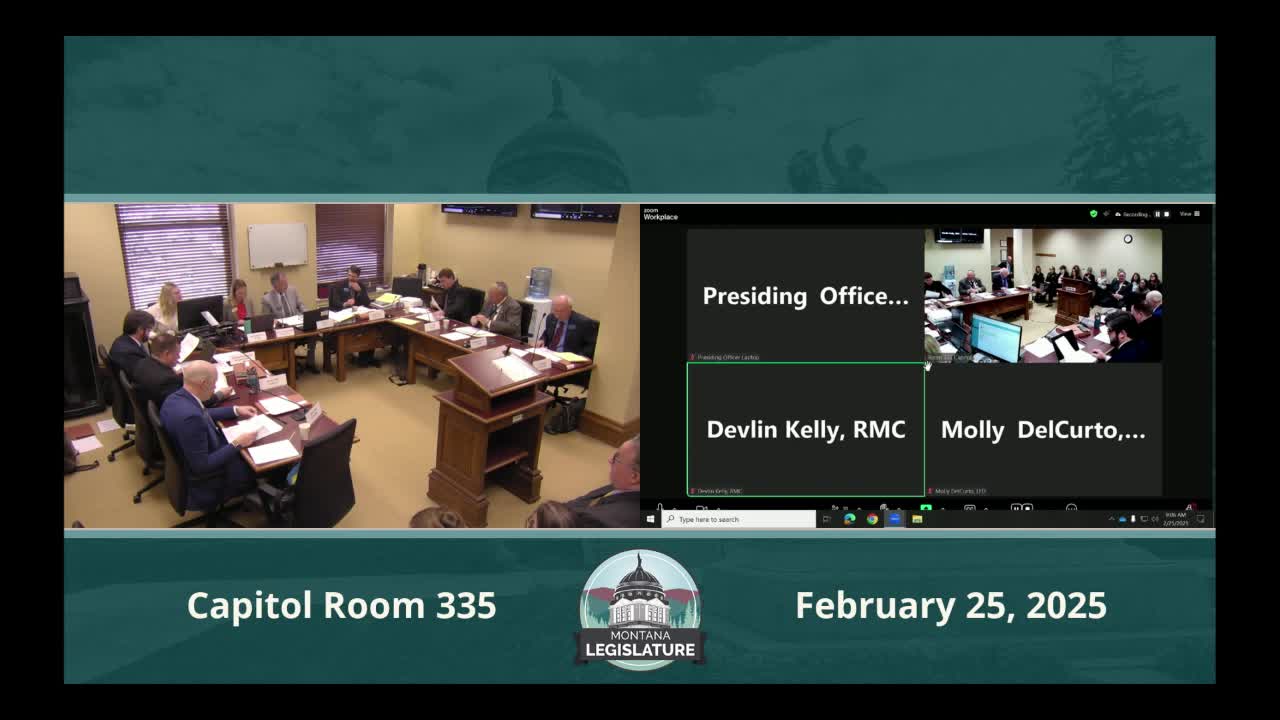
The Montana House and Senate appropriations subcommittee met in Helena to finish “cleanup” work on decision packages (DPs) carried over from prior days, advancing a series of budget adjustments and contingent appropriations while rejecting one transfer to the Capital Development Authority.
The panel moved quickly through a long list of technical and programmatic DPs. Lawmakers approved a smaller recruitment and retention contingency fund, advanced contingent funding tied to pending property‑tax bills, cleared several Department of Military Affairs and Department of Commerce requests, and approved an Office of Political Practices audit position to increase review of lobbyist filings. Members rejected a proposed general‑fund transfer to the Capital Development Authority after a roll call vote.
Why it matters: the subcommittee’s votes set the spending recommendations that will go to full appropriations and, ultimately, to the 2025 Legislature’s final budget. Several actions are contingent on separate bills (not yet enacted) and will only take effect if those bills pass. The committee’s decisions also reflect ongoing debate over centralizing recruitment money in a budget office versus leaving discretion with individual agencies.
Most important actions
- Transfer to Capital Development Authority (DP 103). The subcommittee voted on a motion from Senator Flowers to move DP 103 (general fund transfer to the Capital Development Authority). On a roll call the motion failed, 3 ayes, 5 noes. Recorded yes votes: Senator Harvey, Representative Muscovitch, Senator Flowers. No votes included Vice Chair Mandeville, Senator Cieszak, Representative Walsh, Senator Lammers and Chair Falk. Committee clerks announced the motion failed and the transfer was not adopted.
- Major maintenance transfer (DP 104). The companion transfer to the department’s major maintenance/repair account was moved and approved by voice vote during the same sequence after the committee divided the question.
- Recruitment and retention contingency (DP 403). Members approved a revised DP 403 — a recruitment and retention contingency fund run through the Office of Budget and Planning — by roll call. The budgeted amount was reduced from an earlier proposal (the dollar amount in committee discussion was described as moving from about $23 million down to roughly $12.9 million per year). The roll call recorded five yes votes and three no votes; the motion passed.
- Contingent property‑tax appropriations (DP 802 and DP 803). Representative Muscovitch moved DP 802 and DP 803 as contingent appropriations tied to pending property‑tax bills (referenced in committee as HB 154 and related measures). The committee approved the contingent appropriations by voice vote; the language ties the appropriations to passage of the underlying bills and to the fiscal notes for each bill.
- Department of Revenue appraisers (DP 805). A proposal to add recurring positions to help the Department of Revenue catch up on property appraisals and to fund new aerial imagery tools (discussed as DP 805) was split by the committee. A roll call produced a 4–4 result and the committee did not adopt the appropriation in that vote (the transcript shows a 4 ayes / 4 noes tie and no further action recorded at that time).
- Commissioner of Political Practices (DP 4). The committee approved an OTO, biennial line item to hire a compliance/auditor position to exercise audit authority over lobbyist filings, adopting restricted language that the position be used to audit lobbyist reports in line with the Legislative Audit Division recommendation. The item was approved by voice vote.
Other actions and notes
- Cannabis control inspectors. A DP to add staffing (three inspectors and one administrative position) for the Cannabis Control Program — with coordinating language making the appropriation contingent on the moratorium status — was approved by voice vote.
- Department of Military Affairs and Veterans Affairs. The committee advanced a number of DPs for military affairs (including units across the Army and Air National Guard, Starbase and disaster and emergency services) by voice or roll call votes. Committee members discussed Veterans Affairs decision packages in depth, including a larger request (DP 3101) that included personnel and cemetery‑related operating costs; the chair proposed trimming operating expense and then withdrew the motion to allow staff and the agency to provide a clearer breakdown before the committee completes action.
- Department of Commerce and housing programs. The committee moved multiple DPs across divisions in Commerce and approved a technical reclassification to treat some federal HOME and Housing Trust Fund allocations as grants rather than loans so the agency can obligate and spend federal allocations across biennia.
Key themes from debate
- Centralization vs. agency control. Several lawmakers expressed concern about centralizing recruitment money in the budget office versus allowing agencies to manage hiring and retention locally. Supporters said central administration would allow a clearer prioritization and guardrails; opponents said it could remove needed flexibility.
- Accuracy of property assessments. Members advancing the DOR appraiser staffing proposal framed the request as a means to improve the accuracy of property valuations (including by using aerial imagery to identify new construction). Some members said the Legislative Audit Division’s report justified additional resources; others asked the department to return with more detailed cost and vacancy‑rate information before approving recurring staff.
- Budget restraint and growth. One legislator said the general fund and some agency budgets had grown substantially since 2021 and promised to withhold or not move some routine DPs in the coming votes to restrain general‑fund growth. Several members said they were trying to balance that restraint with program needs, particularly for veterans and public‑safety programs.
Votes at a glance (selected, recorded in transcript)
- DP 103 (Capital Development Authority transfer) — Motion by Senator Flowers; roll call: 3 ayes, 5 noes; outcome: failed. - DP 104 (Major maintenance transfer) — voice vote; outcome: approved. - DP 403 (Recruitment and retention contingency fund; revised estimate) — roll call majority; outcome: approved. Committee discussion recorded a reduction from about $23 million to $12.9 million per year in the revised estimate. - DP 802 / DP 803 (DOR contingent appropriations tied to property‑tax bills) — voice vote; outcome: approved (contingent on passage of the referenced bills and fiscal notes). - DP 805 (DOR: additional appraisers / imagery and related PBs) — roll call: 4 ayes, 4 noes; outcome: not adopted at that time (tie recorded). - Commissioner of Political Practices, DP 4 (public access / audit authority for lobbyist filings) — voice vote; outcome: approved (OTO, biennial with restricted language). - Cannabis control DP (inspectors / 4 PBs) — voice vote; outcome: approved (language tied to moratorium status).
What the committee left open or deferred
- The committee paused action on Veterans Affairs DP 3101 while staff and the agency provide a clearer breakdown of the request’s operating expenses and how much of that would fund Veterans Service Officers versus cemetery equipment and maintenance. The chair withdrew a motion to amend operating expense levels and asked staff to return with more detail.
- The Department of Revenue’s request for 11 additional PBs (five appraisers and six valuation specialists were discussed as the agency’s estimate to work through a backlog) remains a topic for follow‑up; committee members asked for vacancy‑rate details and clearer cost estimates before final adoption of recurring spending.
Meeting context and next steps
The subcommittee completed dozens of votes and moved a large number of agency DPs forward to the full appropriations process. Several appropriations are contingent on separate bills; if those bills pass the items will be funded as described in the committee’s language. Committee members agreed to reconvene the following morning (tentatively 8:15 a.m.) if needed to finish remaining technical or accounting items.
Ending
The meeting adjourned after the chair said staff would circulate any outstanding materials and members should watch email for any possible reconvening. Several members stressed the need to preserve clarity around what appropriations are contingent on separate legislation versus what will become recurring base funding.