Get Full Government Meeting Transcripts, Videos, & Alerts Forever!
Get email alerts on the Employment Verification topic
No spam. Unsubscribe anytime.
Montana hearing: Sponsor seeks E‑Verify requirement for employers; debate centers on small‑business carve‑outs and enforcement
Summary
Sen. Forrest Mandeville introduced Senate Bill 329 to require employers to use the federal E‑Verify system for new hires, with opponents — including credit union and small‑business groups — urging exemptions and raising administrative and enforcement concerns. The sponsor said he will work on amendments to exempt smaller employers.
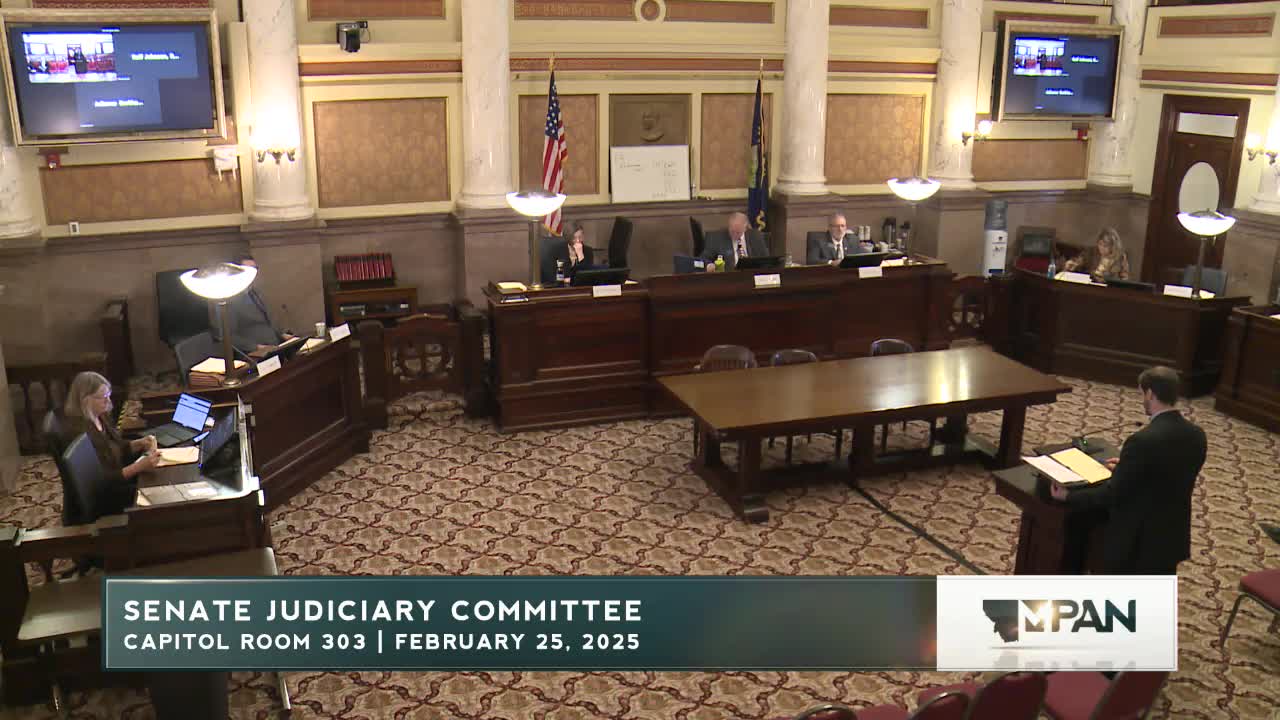
Senator Forrest Mandeville introduced Senate Bill 329 to the Senate Judiciary Committee, proposing a statewide requirement that employers use the federal E‑Verify system to verify work authorization for new hires, with an effective date the sponsor said would be Oct. 1 of the year of enactment.
The bill’s sponsor, Senator Forrest Mandeville, said the measure is intended to reduce hiring of undocumented workers and to promote hiring of legally authorized employees, and noted that a number of other states have enacted similar measures. “This bill will take steps to reduce that issue,” he said during opening remarks.
Supporters told the committee E‑Verify is a mature federal tool. Andrew Good, testifying in support, said the system is used widely and cited academic work he said showed large reductions in unauthorized populations where the system is required. “E‑Verify is that system, and it’s an excellent system,” Good said.
Opponents — led by representatives of credit unions, the Montana Chamber of Commerce and the National Federation of Independent Business (NFIB) — argued the bill would create disproportionate burdens for small employers, raise operational problems around provisional hiring while verification is pending, and leave ambiguous exemptions for employers already compliant with federal requirements. Jesse Luther, appearing for Montana credit unions, said the compliance and training burden would overwhelm small institutions with limited HR capacity and that provisional employment requirements could delay hires in a tight labor market.
NFIB representatives and others said most states that require E‑Verify limit the mandate to larger employers (typical thresholds discussed ranged from 25 to 100 employees). Senator Mandeville and witnesses discussed a likely carve‑out threshold “somewhere in the 50 to 100 range,” and the sponsor said he would consider amendments to address small‑employer concerns.
Witnesses also raised other issues: that signing up for E‑Verify subjects employers to federal audit authority; that E‑Verify can have processing delays for certain cases; and that complaint and enforcement language in the bill delegates investigation authority to the state attorney general. Senator Mandeville said Section 5 of the bill authorizes attorney general investigations and Section 10 limits local governments’ ability to exempt themselves.
Committee members asked practical questions about independent contractors, how employers might attempt to evade thresholds by dividing organizations, and whether state-level I‑9 enforcement proposals pending in the Legislature would affect this measure. Sponsor and witnesses discussed that the bill is written to operate on a complaint basis rather than through routine AG audits, and that carve‑out language and aggregation rules (for related businesses/DBAs) could be added by amendment.
Mandeville closed by urging the committee to keep the bill moving and saying he would work with opponents on amendments to set an employee threshold for exemptions.
No committee vote on the bill was recorded during the hearing.