Get Full Government Meeting Transcripts, Videos, & Alerts Forever!
Get email alerts on the Landfill topic
No spam. Unsubscribe anytime.
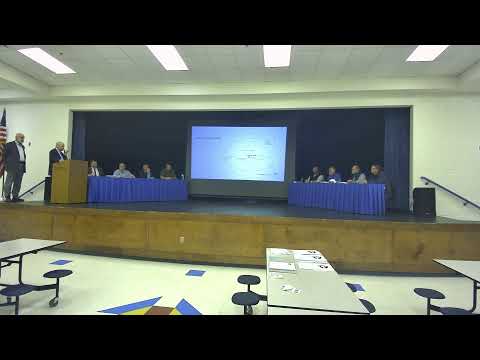
Cumberland hearing on proposed landfill centers on groundwater monitoring, truck caps and enforcement of permit conditions
Summary
A public hearing in Cumberland County on a proposed commercial landfill focused on technical safeguards — liners, leachate collection and gas control — as well as local concerns about truck traffic limits, how the county would enforce a conditional use permit and what the host agreement will require.
A public hearing in Cumberland County on a proposed commercial landfill featured a technical presentation by the applicant and extensive questioning from commissioners and residents about groundwater monitoring, truck limits and enforcement of permit conditions.
The applicant’s representatives described modern landfill design elements they say will limit environmental risk, including multiple liners and a leachate collection system, quarterly groundwater monitoring during operation and a requirement to continue monitoring for a minimum of 30 years after closure. Commissioners and members of the public pressed the applicant on enforcement of a conditional use permit (CUP), how “unreasonable congestion” on local roads would be defined and who would pay for independent testing if neighbors request it.
Why it matters: The project would concentrate large volumes of regional waste in Cumberland County and carries long-term monitoring and traffic impacts that residents and local officials said require clear, enforceable conditions. Several commissioners sought firm language on inspection frequency, traffic caps, host-agreement terms and the county’s ability to require corrective action.
Applicant presentation and engineering details The applicant’s technical team described the planned containment system for the landfill. The design includes a compacted or prepared subgrade, a geosynthetic clay liner (GCL) with reported permeability on the order of 10^-9 to 10^-11 cm/sec, and a high-density polyethylene (HDPE) flexible membrane liner. Above the primary liner the team said there would be a drainage layer, a leachate collection pipe and pumps that route leachate to on-site tanks for treatment or off-site disposal. A landfill gas collection system is proposed to manage odors and gases produced by decomposition. The applicant also said third‑party oversight would be used during construction for quality control.
Monitoring and post‑closure care The applicant said groundwater would be monitored quarterly during operation and for at least 30 years after closure under the post‑closure care plan discussed at the hearing. Presenters said the site would be instrumented with monitoring points around the facility and that baseline hydrogeologic data already collected supports design and placement decisions. The leachate tanks were described as sited internal to the property; specific tank heights and final sizing were not yet determined at the hearing.
Waste types, acceptance limits and operations The applicant indicated it would not accept certain waste streams—specifically plant sludge and process wallboard were cited as excluded from the waste stream—and described a planned separation of softer, less angular materials into a “fluff” layer. The operation was described as intended to serve existing customers; operator representatives said most incoming waste would arrive by tractor‑trailer.
Traffic, tonnage and operational caps Speakers repeatedly returned to traffic and capacity limits. The applicant and staff cited current permit limits and planning conditions in two ways: a tonnage cap of 1,500 tons per day under the existing permit and a limit of up to 75 tractor‑trailers on certain local roads. The presenters said a larger expansion could be possible under future permitting that would require additional state or federal approvals and separate DEQ filings; the transcript noted a potential higher cap (3,500 tons per day) could be allowed only after further permit amendments. A Virginia Department of Transportation (VDOT) traffic analysis referenced in the hearing was completed in November 2023, according to presenters.
Enforcement, inspections and truck screening Commissioners and residents asked how the county could enforce CUP conditions and who would pay for independent testing. The applicant reiterated commitments to provide an on‑site, full‑time employee to assist with monitoring and that DEQ would have access for inspections. The hearing record shows the applicant relied on regulatory safeguards (DEQ oversight, construction quality control, third‑party inspectors) and on permit conditions; several commissioners said the county attorney or county staff would need to interpret broad phrases such as “unreasonable congestion.”
Speakers also described operational screening at transfer stations and the use of radiological detectors at transfer stations and transfer operations; presenters noted the regulatory standard cited in the hearing that typically at least 1% of incoming trucks are inspected, but different facilities may choose higher inspection rates. Presenters said every truck to the landfill would be weighed.
Host agreement, revenue share and other conditions The applicant told the hearing that a host agreement was under negotiation and would not come through the land‑use body; presenters confirmed the planning review would proceed before the final host agreement was complete. The presentation included a referenced 10% revenue share of energy produced as part of potential future development related to the site; the hearing did not include a fully executed host agreement or specific caps tied to that revenue share.
Other concerns raised Residents and commissioners pressed for clarity on: (1) how “unreasonable congestion” would be measured and enforced; (2) whether the county would see the host agreement before operations begin; (3) how often trucks and loads would be inspected; (4) whether fly ash could be used in cover (the applicant said that was not their intent and that they would accept a restriction); (5) predator and vector control measures; and (6) road‑upgrade plans and whether eminent domain would be required for improvements (applicants said eminent domain was not part of their plan and that VDOT would govern road upgrade approvals).
Next steps and meeting action Presenters said they planned to file a Part B permit application with the Virginia Department of Environmental Quality (DEQ) within about 30–45 days and to pursue Part D following Part B activities. Negotiations over the host agreement were ongoing and, according to the applicant, would follow separate processes. The hearing closed after commissioners asked final questions and a motion to adjourn passed during roll call.
Votes at a glance - Motion to adjourn: outcome approved (roll call recorded several commissioners voting "yes").
Ending The record from the hearing shows detailed technical claims from the applicant and numerous unresolved questions from county officials and residents about enforceable permit language, traffic definitions and independent testing. County staff, legal counsel and the applicant indicated additional documents and filings (host agreement negotiations, DEQ Part B/Part D filings, and traffic studies) will follow as the review continues.