Get Full Government Meeting Transcripts, Videos, & Alerts Forever!
House Corporations committee holds 10 bills for further study after hearings on physician licensing, wheelchair repairs, vape rules and medical debt
Summary
The House Committee on Corporations met Feb. 25 in Room 101 and voted to hold 10 bills for further study after multi-hour testimony on physician licensing, wheelchair repair timelines, pharmacy audits, vape sales and medical-debt protections.
The House Committee on Corporations met Tuesday, Feb. 25, 2025, in Room 101 of the State House and voted to hold the 10 bills on its calendar for further study while taking testimony on each measure.
The committee’s procedural motion to “hold all bills for further study” passed without roll-call detail; the chair described the motion as procedural only and not a statement on the merits. The committee then heard more than two hours of witnesses representing state agencies, health-care providers, patient advocates, small-business owners and disability advocates.
The most substantive policy discussions included: creating licensing pathways for internationally trained physicians; expanding repair rights and faster insurance approvals for complex rehab wheelchairs and scooters; limiting pharmacy audits by pharmacy benefit managers (PBMs); a “right-to-repair” bill for mobility devices; a veterinary client-information requirement tied to medication side effects (known in testimony as "Bella’s Law"); a proposal to allow licensed vape shops to sell flavored products to adults 21 and older; a single-payer health proposal; and a bill to cap interest on medical debt. Lawmakers also heard a short safety bill to require athletic trainers to carry epinephrine auto-injectors.
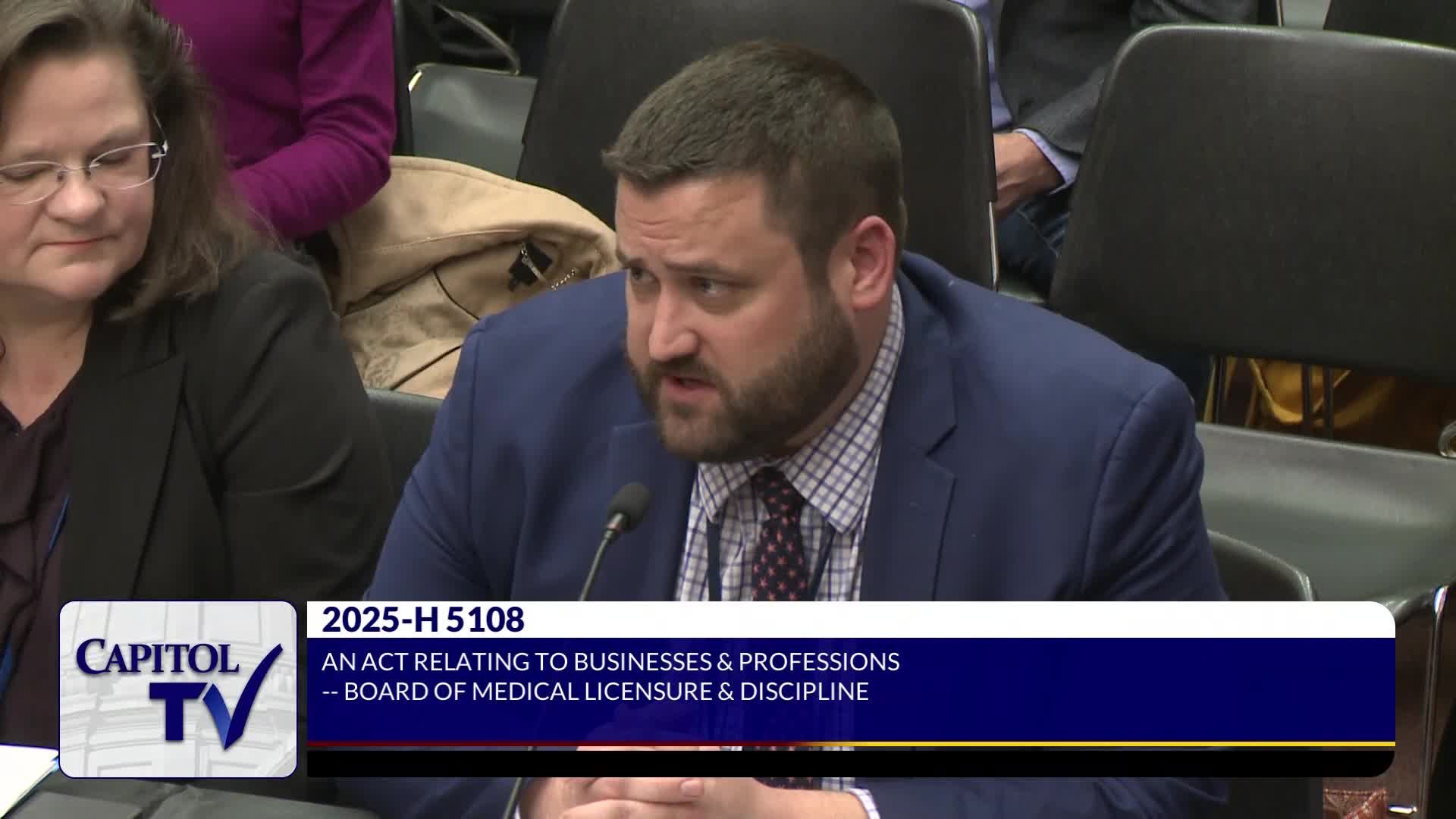
Internationally trained physicians (H 5108) Neil Hinton of the Rhode Island Department of Health and Dr. Stacy Fisher, who leads the state Board of Medical Licensure and Discipline, told the committee the board has been studying interstate models and accreditation organizations that might permit credentialing of internationally trained physicians. "There is an implementation concern," Hinton said, noting that "as of December, none of them have been actually been able to license internationally trained physicians through this pathway" because state boards must determine whether foreign training is substantially equivalent and that work has required external accreditation sources.
Christopher Malgieri, program director of the anesthesiology residency at Brown, and Jocelyn Antonio of the Hassenfeld Institute at Brown supported the bill as a way to recruit primary-care and psychiatric physicians. Malgieri called the bill "a safe, reasonable, and a low cost…
Already have an account? Log in
Subscribe to keep reading
Unlock the rest of this article — and every article on Citizen Portal.
- Unlimited articles
- AI-powered breakdowns of topics, speakers, decisions, and budgets
- Instant alerts when your location has a new meeting
- Follow topics and more locations
- 1,000 AI Insights / month, plus AI Chat