Get Full Government Meeting Transcripts, Videos, & Alerts Forever!
Get email alerts on the Committee Hearings topic
No spam. Unsubscribe anytime.
House Corporations committee holds 10 bills for further study after hearings on physician licensing, wheelchair repairs, vape rules and medical debt
Summary
The House Committee on Corporations met Feb. 25 in Room 101 and voted to hold 10 bills for further study after multi-hour testimony on physician licensing, wheelchair repair timelines, pharmacy audits, vape sales and medical-debt protections.
The House Committee on Corporations met Tuesday, Feb. 25, 2025, in Room 101 of the State House and voted to hold the 10 bills on its calendar for further study while taking testimony on each measure.
The committee’s procedural motion to “hold all bills for further study” passed without roll-call detail; the chair described the motion as procedural only and not a statement on the merits. The committee then heard more than two hours of witnesses representing state agencies, health-care providers, patient advocates, small-business owners and disability advocates.
The most substantive policy discussions included: creating licensing pathways for internationally trained physicians; expanding repair rights and faster insurance approvals for complex rehab wheelchairs and scooters; limiting pharmacy audits by pharmacy benefit managers (PBMs); a “right-to-repair” bill for mobility devices; a veterinary client-information requirement tied to medication side effects (known in testimony as "Bella’s Law"); a proposal to allow licensed vape shops to sell flavored products to adults 21 and older; a single-payer health proposal; and a bill to cap interest on medical debt. Lawmakers also heard a short safety bill to require athletic trainers to carry epinephrine auto-injectors.
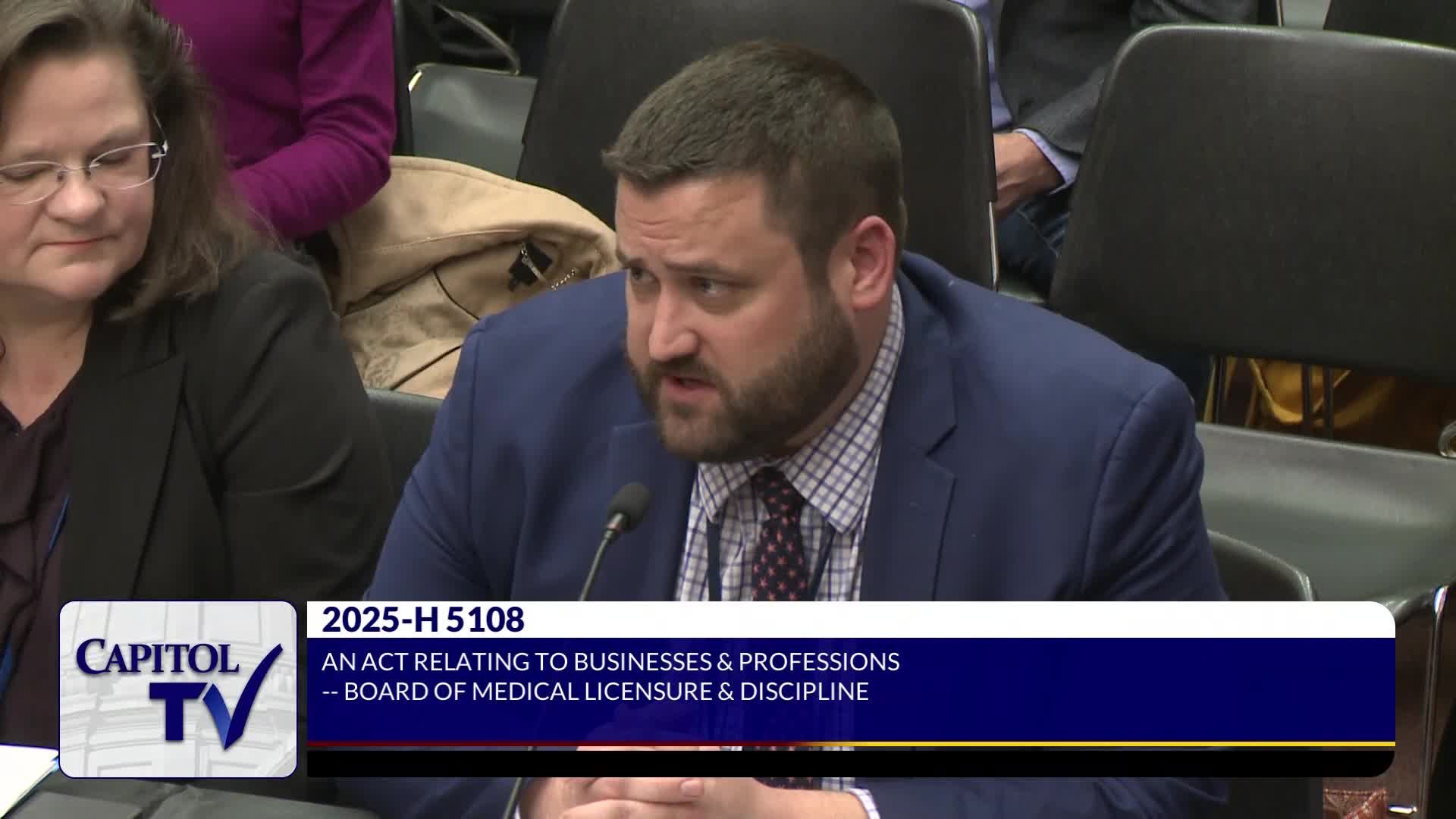
Internationally trained physicians (H 5108) Neil Hinton of the Rhode Island Department of Health and Dr. Stacy Fisher, who leads the state Board of Medical Licensure and Discipline, told the committee the board has been studying interstate models and accreditation organizations that might permit credentialing of internationally trained physicians. "There is an implementation concern," Hinton said, noting that "as of December, none of them have been actually been able to license internationally trained physicians through this pathway" because state boards must determine whether foreign training is substantially equivalent and that work has required external accreditation sources.
Christopher Malgieri, program director of the anesthesiology residency at Brown, and Jocelyn Antonio of the Hassenfeld Institute at Brown supported the bill as a way to recruit primary-care and psychiatric physicians. Malgieri called the bill "a safe, reasonable, and a low cost method to attract doctors to Rhode Island," while Antonio emphasized workforce diversity and said research shows many internationally trained clinicians already work in U.S. health systems but do not practice as physicians because of licensing barriers.
Wheelchair and mobility-device repair / right-to-repair (H 5017) Multiple witnesses pressed for faster repair timelines and fewer administrative barriers for complex rehab technology (CRT). Wayne Grau, executive director of the National Coalition for Assistive and Rehab Technology, said regulators and insurers slow repairs by requiring prior authorization for parts and by limiting reimbursement; he described CRT as "not ordinary consumer products" and said, "Power wheelchairs are not ordinary consumer products. They are regulated by the Food and Drug Administration. They're considered a class 2 medical device." He told the committee that eliminating prior authorization for repairs in some states shortened turnaround times.
Users and advocates described real harms from long waits. Zachary Garcia told lawmakers he had to send a wheelchair out of state and went a month without it; Elizabeth Hubbard, executive secretary for the Governor's Commission on Disability, cautioned that lack of timely repairs "can put people at risk of institutionalization" and urged adding a Medicaid prior-authorization fix to the bill. Testimony referenced Colorado’s 2022 consumer wheelchair-repair law and task-force reports from Connecticut as models for parts-of the bill’s approach.
Pharmacy audits and PBMs (Representative Kislak, H 5248) Independent pharmacists and owners described frequent, detailed audits by pharmacy benefit managers. An independent pharmacy owner who said he operates Atwood Pharmacy in Johnston testified that PBM audits focus on high-cost prescriptions, are time-consuming, and sometimes produce large recoupments; he and other witnesses said the audit process is uneven and hard for small pharmacies to contest. Committee members asked whether existing regulators — the Attorney General and the Office of the Health Insurance Commissioner — have enforcement authority; pharmacists said they have sought help but that regulators' tools are limited.
Pediatric and consumer advocates and several members urged stronger transparency and audit-limits to protect small pharmacies and preserve access to local pharmacy services.
Veterinary client information sheet (H 5334, “Bella’s Law”) Representative Cruz introduced a bill that would require veterinarians to give clients a medication information sheet and a verbal consultation describing common side effects and how to respond. Glenn Dufall, who testified about the death of his service dog Bella and identified himself as a disabled veteran, said the one-paragraph handout could have helped his family recognize adverse effects sooner. "It's 20¢ worth of paper," Dufall said, arguing that a basic client sheet is common-sense safety information and is recommended by the Food and Drug Administration and drug manufacturers.
Vape-shop sales and flavored products (H 5329) Chair O'Brien sponsored legislation to allow licensed, age-restricted vape shops to sell flavored vaping products to customers 21 and older. Owners of Rhode Island vape shops said the 2024–25 restrictions on flavored e-cigarettes have devastated in-state businesses and driven purchases across state lines and to online vendors; Darren Tripoli, owner of Sunshine Vape, said, "Our Connecticut store has grown exponentially. While our 3 Rhode Island locations have lost the majority of their business." Supporters argued regulation inside licensed retail outlets is better for public health than an unregulated market.
Public-health groups — including the American Cancer Society Cancer Action Network and the American Heart Association — opposed the bill. Ryan Strick of ACS CAN argued flavorings are a marketing tool that increases youth uptake and urged the committee to instead ban flavored tobacco products statewide. Rick McAuliffe of the American Heart Association said Massachusetts and New York have stronger restrictions and warned the committee that loosening the state ban risks youth access.
Single-payer health proposal (H 5465) Representative David Morales presented a wide-ranging single-payer bill — the Rhode Island Comprehensive Health Insurance Program (R I CHIP) — that would phase in higher Medicaid reimbursement rates, expand public facilities and pursue a federal waiver to combine federal reimbursement streams. Morales called health care a human right and said the transition would be phased over years and include bond funding for facilities and a proposed medical school expansion. Several members noted the fiscal complexity and federal-waiver dependence of such a plan.
Medical-debt interest cap (H 5235) Representatives of patient-advocacy organizations and the treasurer’s office urged passage of a bill to cap interest and fees on medical debt. Robert (Rob) Craven, on behalf of the state treasurer’s office, said Rhode Island’s current usury rules can let medical debt carry very high rates and noted that other states, including Maine and Connecticut, have enacted caps. Ryan Strick (American Cancer Society Cancer Action Network) and Ernie Davis (Leukemia & Lymphoma Society) framed the bill as a consumer-protection measure tied to health outcomes: medical debt correlates with delayed care and worse outcomes for patients with serious illness.
Athletic trainers and epinephrine (H 5486) A short safety bill supported by the Rhode Island Athletic Trainers Association would require certified athletic trainers to be trained in and equipped with epinephrine auto-injectors while performing professional activities. A representative of the association described the measure as a straightforward safety requirement: "It's a simple piece of equipment, but it's life-saving in some cases," the association witness said.
Committee procedure and next steps The committee took no final substantive votes on any of the bills; the initial procedural motion to hold the calendar gives members more time to review written and oral testimony. Several members asked staff to work with sponsors and interested parties on targeted amendments: advocates for mobility-device users urged a Medicaid prior-authorization fix; independent pharmacists asked for clearer statutory limits on audit frequency and more regulatory tools for state oversight; public-health groups urged maintaining strict limits on flavored products to protect youth.
Ending The committee adjourned after the hearing; sponsors and stakeholders left written testimony and asked members to use follow-up legislative language to address outstanding technical and enforcement concerns.