Get Full Government Meeting Transcripts, Videos, & Alerts Forever!
Get email alerts on the Land Use Data Center topic
No spam. Unsubscribe anytime.
Residents voice widespread opposition to proposed data center rezoning in Charles City
Summary
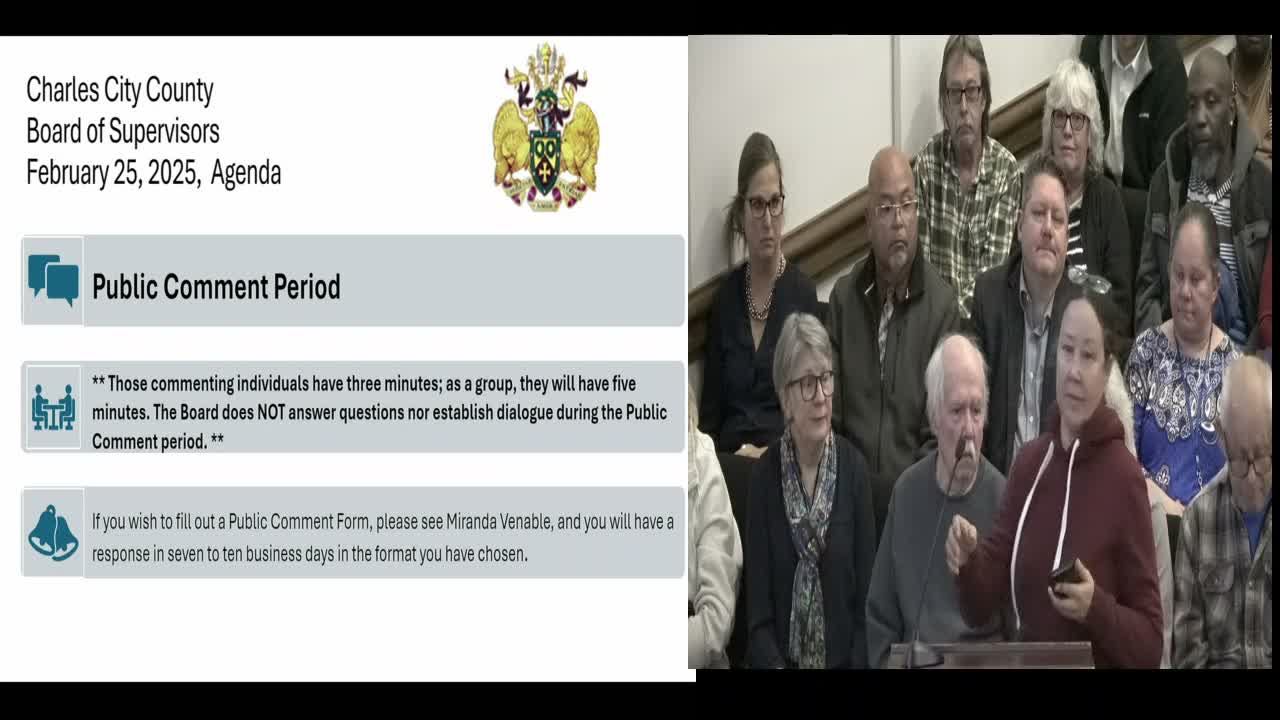
Dozens of residents spoke at a public comment period opposing a proposed Diodes (Roxbury) data center rezoning, citing noise, power and water use, property values, traffic, and lack of transparency; citizens also raised separate concerns about county finances and records.
Dozens of residents used the Board of Supervisors’ public-comment period to oppose a proposed rezoning and planned data center development near Roxbury, saying the project would threaten the county’s rural character, strain infrastructure and reduce property values.
Speakers urged the board to deny rezoning or slow the process while officials answer questions about power draw, water use, noise and traffic. “Charles City County is my home, my heritage, and my community,” said Georgia Pulliam, identifying herself as a real estate broker, who warned that data centers “threaten the peaceful environment that we cherish.”
Luke Aaron Miller, a nurse and a recent county resident, cited state-level power trends and said a data center’s electricity demand could push peak costs onto residents. “The average data center operates at 100 to 200 kilowatt hours per hour,” Miller said, and he warned that increased peak demand could raise household bills for people already living in poverty.
Multiple speakers described expected noise from cooling systems and generators, including concerns about low-frequency sounds that are difficult to dampen. Jared Klein, a recent resident, said a typical large data center building is many times the size of local buildings and warned that cooling noise can reach 80 to 90 decibels in warm weather. Theresa Walker said she feared health and sleep impacts and suggested the county might be seeking a “quick buck.”
Speakers also questioned transparency and county process. Wanda Roberts and other speakers asked for updates on several county financial matters raised at prior meetings — including a roughly $5,090,000 emergency financing referenced by residents — and requested an audit. “The board should recognize we see you,” Roberts said, urging the supervisors to address both the data center proposal and other governance questions.
Several speakers noted potential environmental impacts, including large water consumption and habitat loss. Martha Harris, speaking for Citizens Demanding Accountability and Transparency, cited a December JLARC (Joint Legislative Audit and Review Commission) study on data centers and asked whether the board had evaluated water and DEQ implications and whether any energy costs would be contractually borne by the company rather than by ratepayers.
Board members said they would review research and the county’s comprehensive plan language regarding industrial uses, and several members asked staff for follow-up. The board did not act on rezoning at the meeting; the planning commission and Economic Development Authority meetings on March dates were noted as next opportunities for more technical discussion and review.