Get Full Government Meeting Transcripts, Videos, & Alerts Forever!
Get email alerts on the Bridge Financing topic
No spam. Unsubscribe anytime.
Interstate Bridge replacement: committee hears bond‑authorization bill and competing views on tolling, cost and light rail
Summary
Senate Bill 5734 would authorize up to $1.6 billion in bond authority for Washington’s share of the Interstate Bridge Replacement project; proponents stressed seismic risk, freight impacts and job creation while opponents questioned cost estimates, light rail inclusion and tolling assumptions.
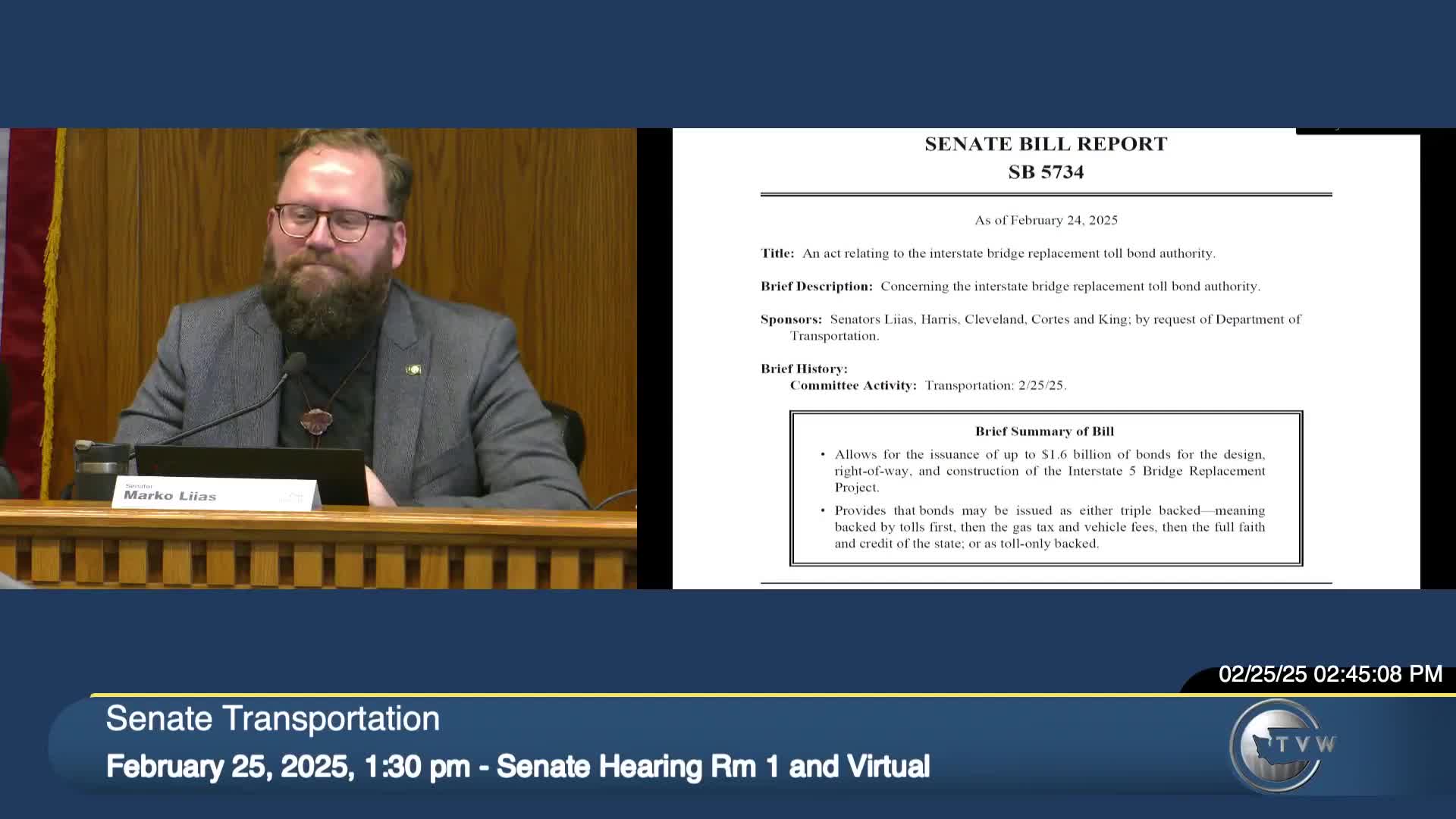
Senate Bill 5734, an agency‑request bill authorizing up to $1.6 billion in bond authority for the Interstate Bridge Replacement (IBR) project, received testimony and spirited public comment on Feb. 25.
Haley Gamble, committee staff, described the bill as an authorization for the state to issue bonds (subject to the State Finance Committee and later legislative appropriation of net bond proceeds) to fund the design, right of way and construction of the I‑5 bridge replacement. The staff report emphasized that the bill authorizes bonding authority rather than immediate bond issuance and that toll revenues are assumed in finance plans to pay debt service; tolling authority and certain preconditions remain part of the bi‑state project governance and federal funding plan.
Doug Vaughn, principal financial officer at WSDOT, said the $1.6 billion is an upper authorization ceiling that would allow Washington to participate in a TIFIA federal credit application if that financing approach is chosen. He emphasized that the financing form was still under review and that cost‑sharing with Oregon and federal funding remain core elements of the plan.
Supporters from local government, labor and ports framed the project as essential for freight mobility and seismic resilience. Mike Beaumar of the Port of Vancouver said 60 percent of trucks serving the port rely on the I‑5 crossing and highlighted the bridge’s age, safety and freight disruptions. Heather Kurtenbach of the Building and Construction Trades Council called bonding against toll revenue a way to “provide funding sooner than pay as you go, ensuring that we replace this failing infrastructure,” and Vancouver Mayor Anne McElroy (for the record) urged the committee to authorize bonding to secure the local match for federal funds.
Opponents and skeptical testifiers raised cost and governance concerns. Douglas Tweed, a Clark County resident, called $1.6 billion “premature” until federal approvals and questioned ridership and the addition of light rail, citing prior local votes opposing light rail expansion. Bob Ortblad, a civil engineer, contended that the current project design is a large freeway widening with multiple interchanges and warned cost estimates could double, referencing cost escalations on other Washington projects. Public commenters also criticized projected traffic modeling and urged re‑examination of alternatives such as immersed tunnel options.
No bond issuance was authorized during the hearing; staff and WSDOT encouraged further coordination with the state treasurer and Oregon counterparts. The bill will proceed through committee consideration with further fiscal and financing details to be developed.