Get Full Government Meeting Transcripts, Videos, & Alerts Forever!
Get email alerts on the Roadside Technology topic
No spam. Unsubscribe anytime.
Committee reviews roadside technology study; WSDOT proposes smartphone occupancy pilot for express toll lanes
Summary
The Senate Transportation Committee reviewed an advanced roadside technology study and a WSDOT proposal to pilot a smartphone-based occupancy verification app in express toll lanes.
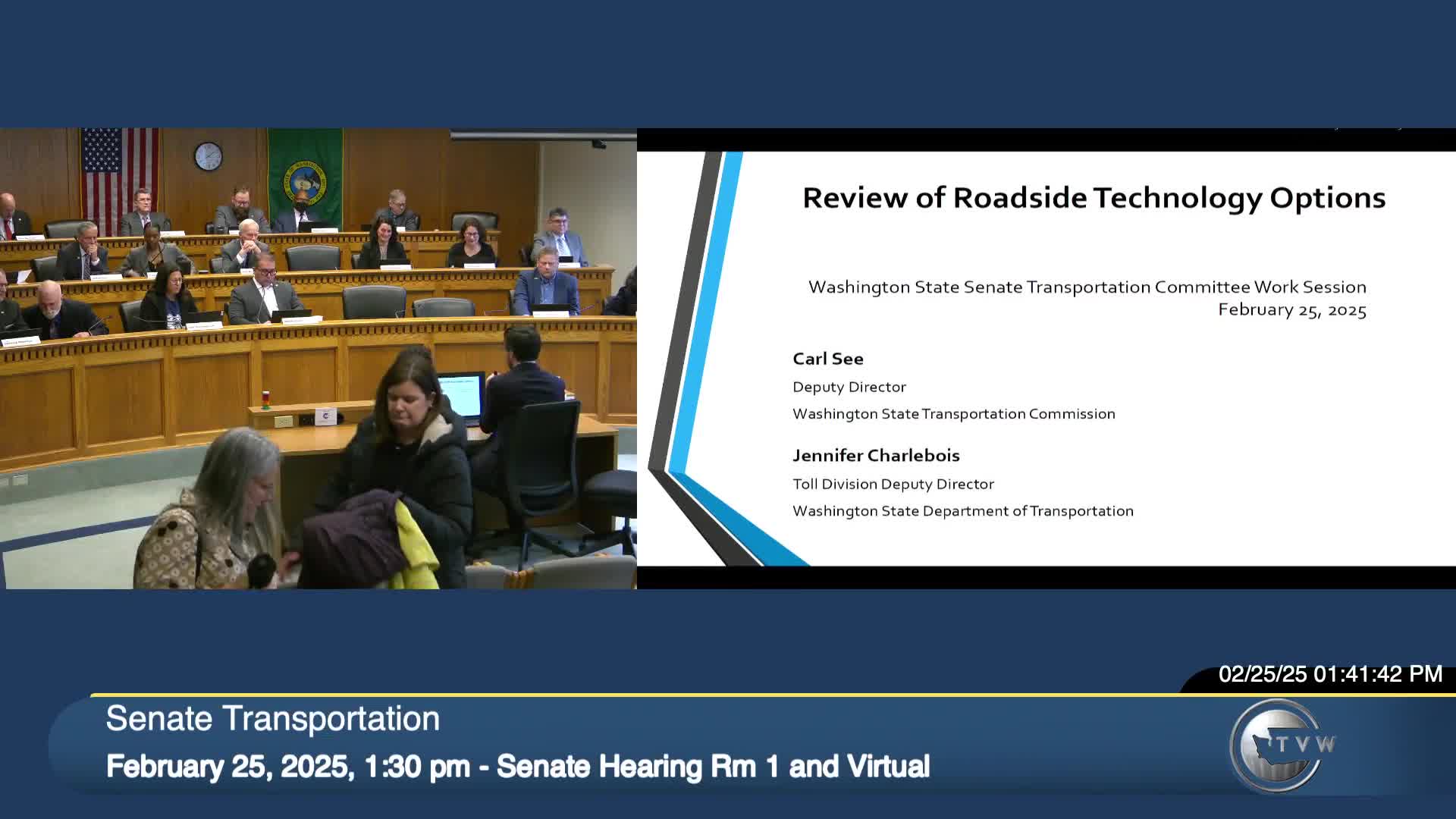
The Senate Transportation Committee on Feb. 25 heard results of a commission-led assessment of roadside technologies and a WSDOT proposal to pilot smartphone-based vehicle-occupancy verification in express toll lanes.
Carl C., deputy director for the Washington State Transportation Commission, summarized a study directed by the 2023 Legislature. The commission scanned the market and evaluated 18 vendors between August 2023 and June 2024, narrowing the field to four top vendors. The study evaluated capabilities such as embedded communications and power, a limited roadside footprint and license-plate reading accuracy greater than 95 percent. It concluded that a range of technologies could support HOV detection, toll entry/exit detection, speed detection and wrong-way-driver detection, but that implementing them in Washington may require statutory definitions and limits for those technologies.
“Revenues generated by penalties, fines, and fees from toll collections and violations can be used to pay for the system's capital or operating costs,” Carl told the committee, and he said pilots could identify operational impacts and public acceptance before wider deployment.
Jennifer Charlebois, deputy director of WSDOT’s Toll Division, outlined a proposed pilot to test smartphone-based occupancy verification on the I‑405 or SR‑167 express toll lanes. The proposed pilot would recruit volunteer participants who would use an app during their trip; nonparticipants would continue using toll lanes as usual. Charlebois described one example of operation: riders “open our application, click the start carpool button, and then in this example, utilize the cell phone's camera feature to determine the number of human faces in the vehicle. No photograph is taken. No photograph is stored or shared.”
Charlebois said the pilot would run roughly 18 months: three months for contracting, six months for deployment and participant recruitment, six months of operation and three months for evaluation and reporting. She noted other agencies have piloted or deployed similar approaches in the Bay Area and Atlanta.
Committee members asked about out‑of‑state plate processing and enforcement. Charlebois said current toll systems can read license plates from all 50 states and use a license‑plate lookup service that works with other states’ departments of licensing. Responding to a question about what happens if occupancy is misdeclared, Charlebois said that in a full deployment “if this technology were to find that you were trying to declare that you had 3 people in your car, but you didn't, there's no violation issued. The person the driver just pays the toll that they were supposed to pay in the first place.”
WSDOT staff also told the committee the department is beginning procurement work for the statewide roadway toll system (next procurement advertised in late 2026) and wants contracts that can accommodate advanced technologies to reduce roadside infrastructure needs and shorten implementation timelines.
Committee members asked about privacy, accuracy and accessibility; Charlebois said privacy and data security would be evaluated during the pilot and that fairness and accessibility would be explicit pilot objectives.
No formal action or vote was taken; staff recommended further study and pilot design work to report back at the end of 2026 if a pilot were to begin mid‑2025.