Get Full Government Meeting Transcripts, Videos, & Alerts Forever!
Get email alerts on the Tax Policy Self Storage topic
No spam. Unsubscribe anytime.
Debate over taxing self‑storage rentals: proprietors warn of harm to small customers, advocates point to housing preservation uses
Summary
House Bill 19‑07 would change the tax treatment of self‑storage rentals and dedicate the revenue to affordable-housing preservation programs; the bill drew intense public testimony from both small operators and housing advocates.
A bill that would subject self-storage space rentals to retailing business-and-occupation tax and retail sales tax drew strong opposition from owners and trade groups, and support from housing advocates who want to use the revenue for affordable-home preservation.
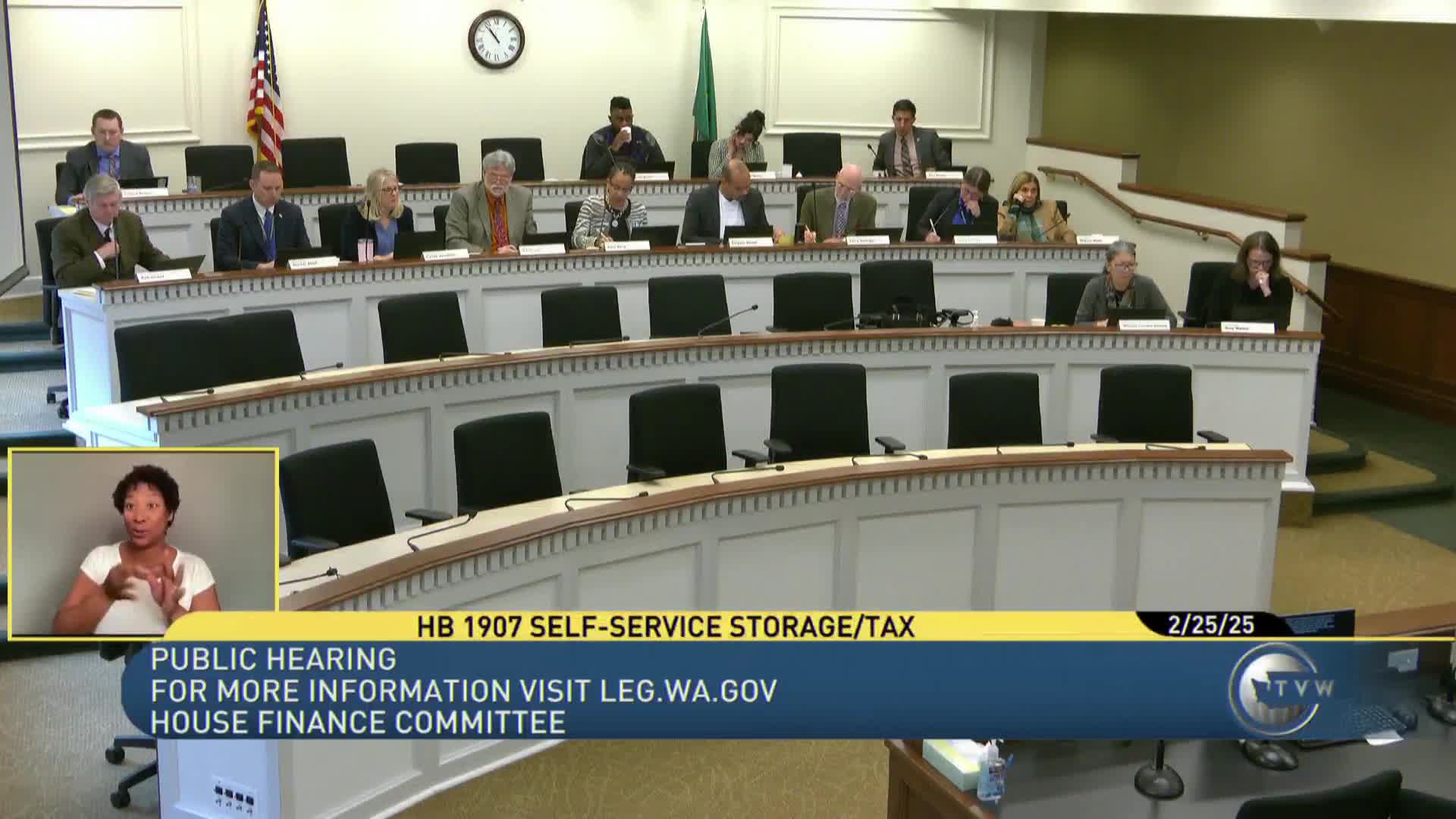
Under current law the rental of individual self-storage spaces is treated as a rental of real property and is not subject to the retailing B&O or retail sales tax when customers have direct access and rentals last 30 days or longer. House Bill 19-07, introduced by Representative Strom Peterson, would define rental of self-storage space as a retail sale regardless of duration and subject such transactions to retail B&O and sales tax beginning Jan. 1, 2026. Committee staff presented a Department of Revenue fiscal estimate that projects state revenue increases of roughly $16.2 million for five months of collections in fiscal 2026 and $41.4 million in fiscal 2027, with additional local tax increases estimated.
Supporters of the measure — including advocates for cooperatively owned manufactured-home communities and community land trusts — told the committee revenue should be dedicated to preserving and establishing permanently affordable homeownership and community land trusts. The Northwest Cooperative Development Center urged the committee to use proceeds to preserve manufactured-home parks and support resident ownership.
Opponents — including the Washington Self Storage Association, the National Self Storage Association and dozens of individual owners and managers — said the change would disproportionately hit low-income renters, people in transition, military families, small businesses that use storage for tools and inventory, and people who store belongings during life changes such as divorce or loss of housing. Trade witnesses also argued the proposal risks constitutional challenges because taxing rental real estate is treated differently in state law and that nearly all other states exempt long-term storage rentals.
Why it matters: The committee heard sharply competing claims: advocates said revenue would be a targeted resource for housing preservation; owners said the tax would be a regressive hit to customers who use storage during transitions and that many facilities are small, family-run businesses.
What happens next: The bill received public testimony and will require further committee consideration; members asked for constitutional and implementation guidance from Department of Revenue and legal staff before advancing any proposal.
Speakers included Representative Strom Peterson (prime sponsor), self-storage trade groups and dozens of small operators and residents, the Northwest Cooperative Development Center, and housing advocates.