Get Full Government Meeting Transcripts, Videos, & Alerts Forever!
Get email alerts on the Distributed Energy topic
No spam. Unsubscribe anytime.
Committee hears competing views on residential battery incentive program; utilities and solar industry seek design changes
Summary
House substitute bill 18-71 would create a 10-year residential battery incentive program administered by WSU Extension Energy Program, cap incentives and allow public utility tax credits. Utilities and the solar industry support the concept but raised concerns about prescribed rate language and compensation design.
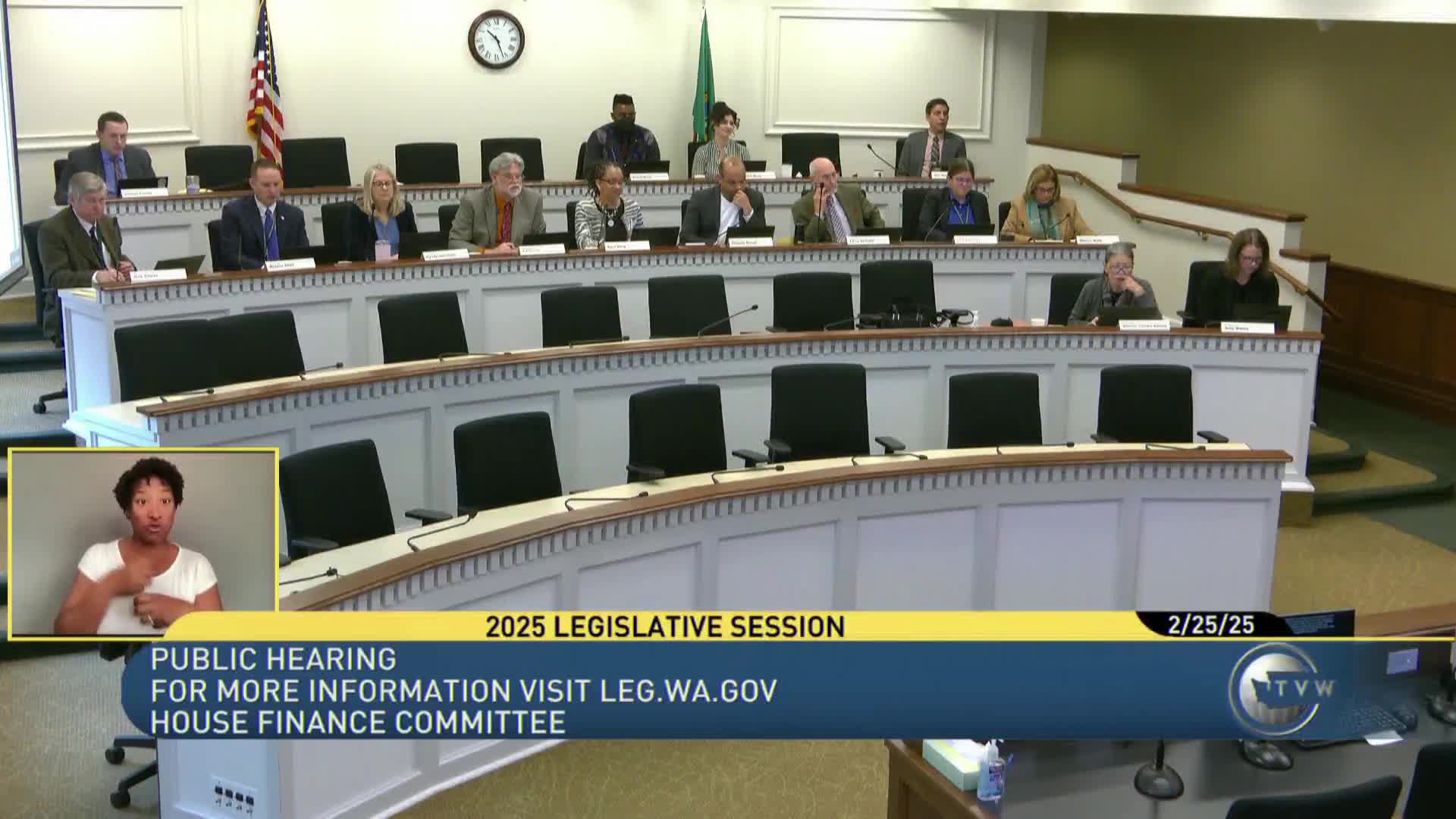
A bill to establish a 10-year residential battery incentive program was the subject of detailed technical and fiscal discussion in the House Finance Committee on Feb. 25.
Substitute House Bill 18-71 would require the Washington State University Extension Energy Program to administer a residential battery incentive program, set per-customer incentive caps (up to 18 kilowatt-hours per installation), and allow electric utilities that participate to claim a public utility tax credit equal to incentive payments and associated costs. The draft caps in the bill set maximum incentives at $765 per kilowatt-hour for low- and moderate-income customers and $450 per kilowatt-hour for other customers; utilities with more than 100,000 retail customers would be required to participate and at least 40% of program benefits must reach low- and moderate-income households, low-income service providers, housing authorities or tribal governments. Utilities would be required to submit plans that either pair batteries with time-of-use rates or aggregate them as a virtual power plant (VPP).
Industry and utilities said they support the intent — expanding energy storage to increase grid resilience and reduce peak costs — but flagged specific design problems. The Washington Solar Energy Industries Association said batteries on the customer side reduce grid costs and provide backup power. The Utilities and Transportation Commission (staff witness) and Avista testified they opposed prescriptive language forcing a specific time-of-use structure and said that reimbursement design should avoid overcompensating customers or unfairly subsidizing participants at the expense of non-participants. Avista and other utilities asked for more time to work on payment design, plans to ensure utility cost recovery and stronger safeguards that low-income customers are enrolled.
Committee staff presented a draft fiscal note that projects a reduction in state revenues (public utility tax credits reduce tax collections) estimated at $18 million in the first 9 months of fiscal 2027 and $26 million in fiscal 2028 (first full year) under current assumptions; Department of Revenue administrative costs and JLARC audit costs were also outlined in the staff materials.
Why it matters: distributed residential batteries can provide resilience during outages and potentially lower system costs when combined with utility programs, but policy design affects who benefits, how ratepayers are charged, and how much revenue is foregone as tax credits.
What comes next: Sponsors and stakeholders agreed to continue negotiations on implementation details including incentives, eligibility, compensation and the metrics that will govern VPP participation and TOU design.
Speakers included Rep. Victoria Hunt (prime sponsor), WSU staff, the Washington Solar Energy Industries Association, Public Utility Commission staff, Avista and other sector representatives.