Get Full Government Meeting Transcripts, Videos, & Alerts Forever!
Get email alerts on the Higher Education Funding topic
No spam. Unsubscribe anytime.
Bill to lift cap on advanced-computing surcharge draws split response from industry and education advocates
Summary
Representative Julia Reed told the House Finance Committee removing the $9 million-per-taxpayer cap on the advanced-computing surcharge would raise revenue for the Workforce Education and Investment Account to expand college access and workforce training.
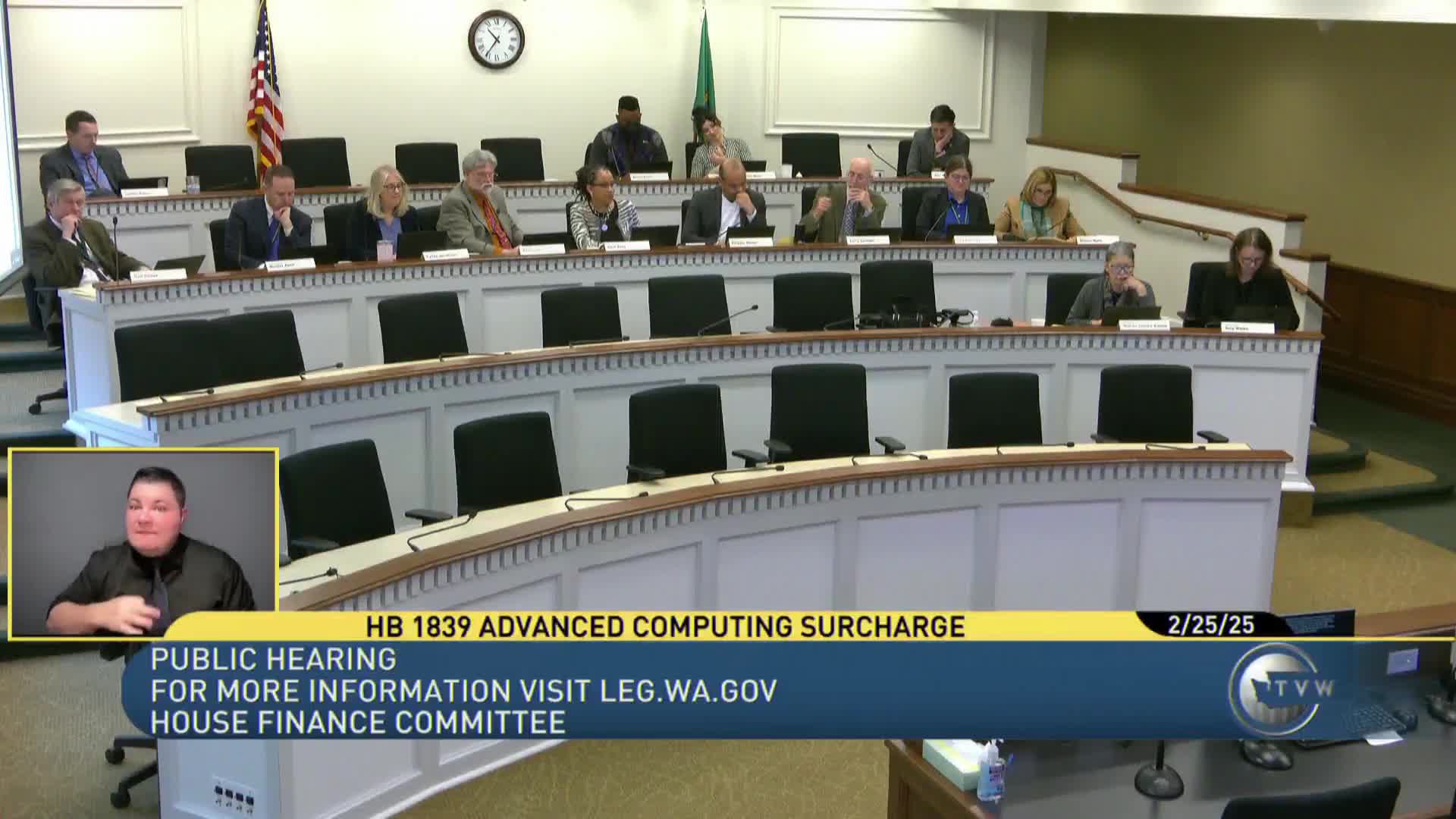
A bill to remove the per-taxpayer cap on Washington’s advanced-computing surcharge drew sharply divided testimony at the House Finance Committee on Feb. 25.
Representative Julia Reed, the bill sponsor, told the committee the surcharge funds the Workforce Education and Investment Account (WEIA), which supports the Washington College Grant and other higher-education programs. Reed said the state faces a shortage of workers with postsecondary credentials and that lifting the current per-taxpayer cap — a $9 million annual limit now applied to companies defined as “advanced computing” taxpayers — would generate additional revenue to expand access to higher education and training used by industry and communities. “We are leaving talent on the table,” Reed said, describing projected job openings in computing and technology and the share that require bachelor’s degrees.
Supporters included student groups, community and technical college officials, nursing and faculty unions and advocates for the Washington College Grant. Testimony described the grant as a critical tool that lowers student costs, improves access and supports workforce development; student speakers described how grants made college possible and argued funding declines would reduce enrollment and program capacity. Several higher-education witnesses asked the committee to direct new revenue specifically toward financial aid, teacher training for STEM fields and expanding degree seats.
Industry groups opposed the bill or urged changes. The Association of Washington Business and TechNet said the state has already collected substantial WEIA revenue since 2019 and argued there are concerns that the companies subject to the surcharge did not receive prior consultation about raising the effective tax burden. TechNet also said the bill could send a negative signal to firms already facing layoffs and uncertainty. Both business groups recommended careful design and safeguards to ensure the money is used for the stated higher-education purposes.
Why it matters: The advanced-computing surcharge was created in 2019 to fund the WEIA; proceeds pay the Washington College Grant and other workforce-education investments. Removing the per-taxpayer cap would increase revenues by hundreds of millions in legislative fiscal estimates and is likely to be a high-profile revenue source in budget negotiations.
What was in the room: college presidents and students, faculty representatives, the Economic Opportunity Institute, business trade groups and the bill sponsor.
What happens next: The bill was heard in committee and will be subject to further amendments and fiscal analysis if it moves forward.
Sources: committee staff briefing, sponsor remarks, testimony from Washington Student Association and Association of Washington Business.