Get Full Government Meeting Transcripts, Videos, & Alerts Forever!
Get email alerts on the Property Tax Homestead topic
No spam. Unsubscribe anytime.
Madison County holds final public hearing on state homestead changes; public majority signals support to opt out
Summary
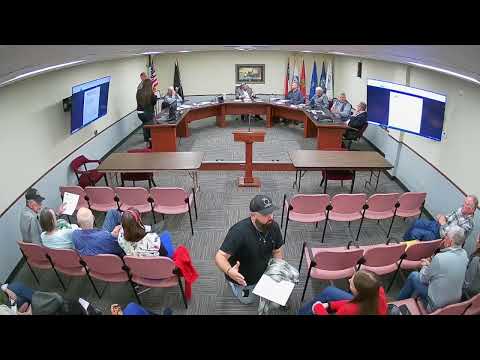
MADISON COUNTY, Ga. — Madison County held its third and final public hearing on Monday, Feb. 24, 2025, about House Bill 581, the statewide homestead-exemption measure, and related legislation that would change how homestead and personal property exemptions affect local tax rolls.
MADISON COUNTY, Ga. — Madison County held its third and final public hearing on Monday, Feb. 24, 2025, about House Bill 581, the statewide homestead-exemption measure, and related legislation that would change how homestead and personal property exemptions affect local tax rolls. County staff presented impact studies, answered questions for about an hour, and then opened the floor to public comment. No final decision by the Board of Commissioners was made at the hearing.
Gary Cavalier, deputy chief of advisors, summarized the bills and potential local effects and cautioned that his presentation was informational, not a recommendation. “It’s not really pros and cons because I’m not recommending one way or another. It’s just a statement of what’s in it and the possible impacts on counties,” Cavalier said.
The nut graf: The hearing reviewed several state bills that alter homestead protections, personal property exemptions and procedural deadlines and that could reduce county property-tax revenue. County staff presented estimates of revenue loss and described how the changes would shift tax burdens among property classes; staff repeatedly said the decision about opting out remains with local taxing authorities and that the hearing was held to preserve the county’s option within the state deadline.
County staff described key provisions and estimated impacts. Presenters said the law would remove the estimated-tax line from annual assessment notices and replace it with a millage-rate rollback calculation; remove a one-year “sales hold” on newly purchased property values; require county appraisals on a three-year cycle; and allow the board of assessors to appeal the state’s sales ratio. The presentation also described House Bill 808, which raises the personal-property exemption from $7,500 to $20,000, and cited an estimated county personal-property revenue loss of about $17,004.22. Staff gave an estimated county revenue loss from homestead changes of roughly $935,000 in the first year of the impact study presented to the board.
Todd, a member of the property valuation office staff who ran the county impact numbers, emphasized the limits of projection and the primacy of historical data for the study. “Math is the only true statement in the room,” Todd said, explaining that staff used the previous three years of actual new-homes and sales data because there is no reliable way to predict future building or sales patterns.
Presenters noted other provisions under consideration at the state level. One bill discussed would reduce the maximum acreage eligible for homestead protection to five acres; another bill (described as introduced in the House) would extend the county opt-out deadline but — as staff said — had not cleared the state senate at the time of the hearing. Staff stressed those measures were pending actions of the General Assembly and not guaranteed.
Speakers described how a homestead cap could shift taxes to non-homesteaded parcels (commercial, industrial and rental) and how county budgets rely heavily on property tax revenue. Staff said property taxes account for roughly half of the county’s revenue in the years shown in the presentation and that about $11.3 million of roughly $12.6 million collected from the county digest in a recent year were state-mandated expenditures. The county’s overall annual budget was described in the meeting as roughly $24 million to $26 million.
Members of the public questioned staff about specifics: the opt-out deadline, how the estimates were calculated, whether new housing would offset losses, and what local programs might be cut if revenue fell. One attendee, Tatlina Kovac, spoke during the record-keeping portion to give her name; several other residents asked questions and later signaled their preferences at the show-of-hands portion.
During public comment, multiple residents warned that the measure could make county taxes diverge from neighboring counties and affect the local housing market and commercial recruitment. Staff answered that counties that opt in or out could see different millage-rate paths and that differences in millage rates could influence buyers and businesses when comparing counties. Staff repeatedly said the hearing was intended to preserve the county’s legal right to opt out by the statutory deadline, not to indicate a final board decision.
After the public-comment portion, meeting organizers asked for a show of hands. According to the transcript of the session, “everybody raised their hand in favor of the board of commissioners opting out of HB 581.” The board itself did not take a formal vote on an opt-out at the hearing. The chairman and staff noted that the advertising language required for these public hearings may give the impression the county had already decided; staff clarified the board had not yet made a formal decision.
Formal minutes and routine business: After the hearing, the board reconvened for regular business at about 6:16 p.m. The board approved several sets of minutes by motion: “Motion by Commissioner Chandler and a second by Commissioner May” to approve minutes from meetings in January and February was recorded and passed. The board also took a motion to adjourn the public hearing and reconvene the normal business meeting; that motion and its second were recorded and carried.
What’s next: No formal opt-out ordinance or vote was recorded at the Feb. 24 hearing. County staff and commissioners repeatedly said the hearings were held because state deadlines are strict; the board still must decide whether to opt out after considering the public input and the impact numbers. Staff also advised residents who have not applied for local homestead exemptions to contact county staff (Lamar Dawson was named as a county contact during the hearing).
The record: This article is based on the county’s Feb. 24, 2025 public hearing on House Bill 581 and related measures; county staff presentations; public comments; and the subsequent reconvening of the Board of Commissioners for regular business on the same evening. No county ordinance adopting an opt-out was adopted at that meeting.