Get Full Government Meeting Transcripts, Videos, & Alerts Forever!
Get email alerts on the Economic Development Technology Incubator topic
No spam. Unsubscribe anytime.
Hilliard expands CityLab incubator, keeps student internet program after federal funds end
Summary
City officials and the Hilliard CityLab described how municipal fiber, private cellular service and a local commercialization incubator have supported startups, internships and public-safety prototypes — and why the city kept its student internet hardware running after federal COVID relief funding waned.
HILLIARD, Ohio — Hilliard officials described growth in the city’s CityLab commercialization incubator and related digital infrastructure, saying the initiative now supports more than 33 companies, paid internships and several public-safety and prototype projects that rely on city-owned fiber and locally controlled wireless networks.
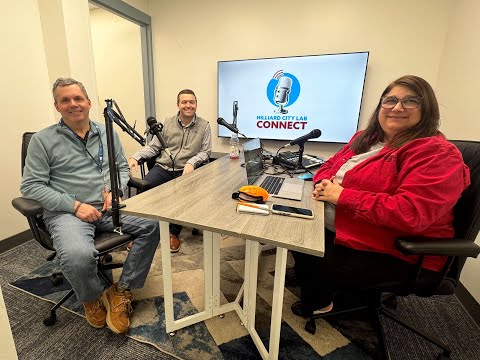
“The premise, around back in 02/2019 … was fiber was very important for business, for economic development,” said Dwayne Powell, Hilliard chief information officer and IT director, describing the municipal fiber that underpins the CityLab network. Powell appeared on Hilliard CityLab Connect, a city podcast hosted by Michelle Gadschel.
City leaders said the fiber network became the basis for several programs that accelerated during the COVID-19 pandemic. Instead of paying commercial cellular providers to distribute home hotspots, the city purchased hardware and set up a private cellular (CBRS) network to provide internet access to students identified by local schools as lacking reliable home service. Officials said that hardware remains in use after federal COVID relief funding ended.
Why it matters: CityLab and the related network infrastructure are presented as economic-development tools that also support residents’ internet access and give startups a low-cost place to prototype hardware and software. Officials described private investment, internships tied to local schools, and public-safety pilots that rely on the lab’s systems.
Powell said Hilliard’s approach prioritized in-house infrastructure over short-term, provider-driven hotspot programs. “We bought the hardware, [and] is still operational, and we’re still expanding it,” Powell said of the student connectivity effort. He said the city partnered with schools to identify students who needed equipment.
Hilliard officials also discussed a set of resources CityLab provides to startups: an "AI sandbox" for prototyping models with capped compute costs, on-site electronics manufacturing (OMIC) that supports rapid circuit-board prototyping and paid internships with the Hilliard City School District, and access to specialized fleet, sewer and camera data for product testing.
CityLab leaders said they also work with private partners to deliver retail internet service over city fiber. Powell named the city’s commercial partners as BreshCo Broadband, CNI, 3Lanterns, Lanier1 and newly added Glo Fiber; customers choose between those providers, he said, and the city does not favor any one vendor.
Public-safety projects described include an anomaly-detection partnership with UV Vision and Big Kitty Labs that looks for unusual camera events (for example, a vehicle crash) without performing facial recognition, and a drone program developed with Lighthouse Avionics and Converge Technologies intended to put a trained responder’s view on scene quickly. Powell said the city has a waiver filed with the Federal Aviation Administration to allow operations beyond the visual line of sight and hoped for approval following a recent completion of the waiver paperwork.
Officials provided several numeric details about CityLab’s local economic impact: the incubator’s payroll within the CityLab corridor rose from about $2.3 million before 2019 to more than $3 million in 2023; city grants totaling just under $1 million have supported projects that Powell said leveraged roughly $80 million in private investment along the I-270 corridor; and the CityLab currently lists more than 33 active companies, with six more in the grant pipeline.
Powell described other planned infrastructure builds, including a LoRaWAN (long-range wide-area network) intended for low-bandwidth Internet of Things uses; he said a LoRaWAN deployment can be put in place for under $10,000 and support device communication up to roughly seven miles for telemetry and sensors.
On commercialization strategy, Powell said CityLab does not take equity stakes in startups that accept city grants and that the city’s barometer for success is jobs and local payroll. “We want them located in Hilliard,” Powell said. He encouraged interested entrepreneurs to contact Hilliard CityLab for tours or information.
The conversation also referenced several named firms and personnel who have partnered with CityLab, including Converge Technologies (John Baer/John Barrett was referenced in the interview), UV Vision and Big Kitty Labs, Lighthouse Avionics (also referenced as Lighthouse Technologies), OMIC (on-site electronics manufacturing), HydroSmart, and August20 (a firm that worked on splash-pad controls). Some firm names and spellings appeared inconsistently in the recording; Hilliard officials should be consulted for official corporate spellings before publication.
No formal votes or city council actions were recorded in the podcast conversation. The discussion focused on program descriptions, operational details and invitations for entrepreneurs, students and partners to engage with CityLab.