Get Full Government Meeting Transcripts, Videos, & Alerts Forever!
Get email alerts on the Conditional Use Conditions topic
No spam. Unsubscribe anytime.
Zoning staff and committee debate standard conditions for conditional-use permits
Summary
The agency reviewed a long list of standard conditions applied to conditional-use permits, discussed site-specific exceptions, enforcement and the three-year active-use rule for permits that are not exercised.
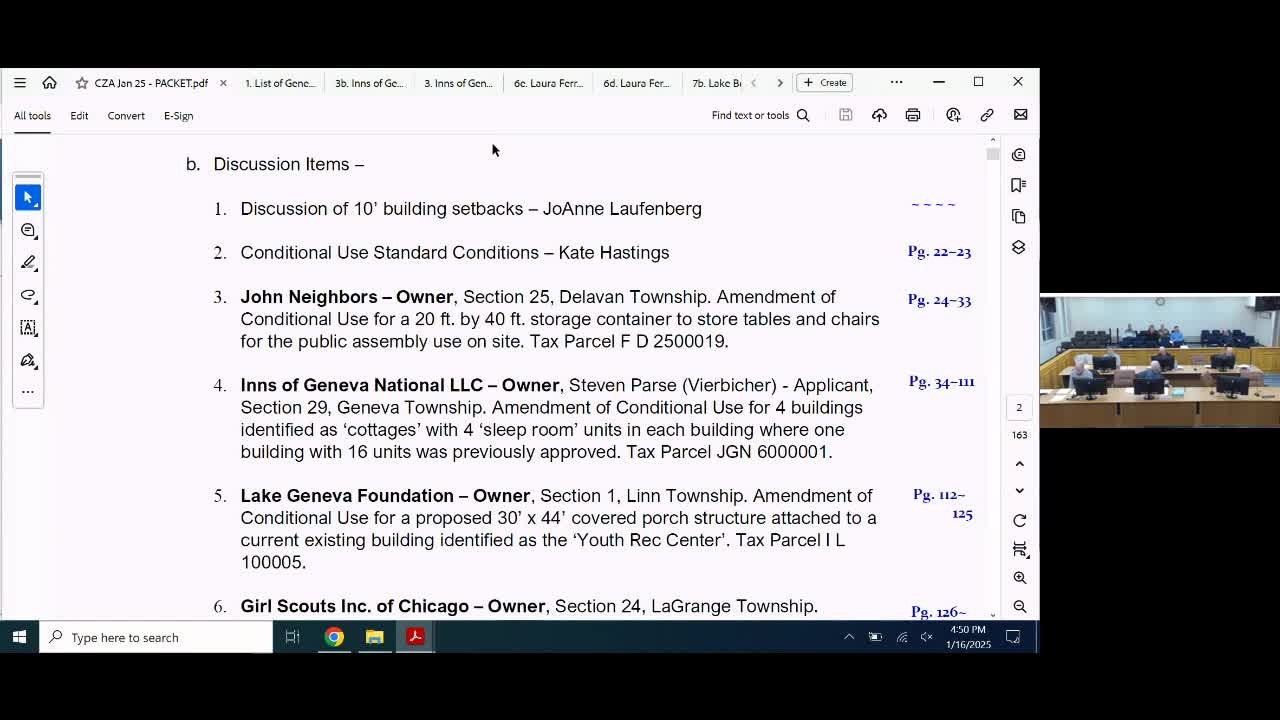
The Walworth County Zoning Agency spent much of its Jan. 16 meeting reviewing the list of standard conditions routinely attached to conditional-use permits and discussing how and when those conditions should apply.
Kate, planning staff, presented the list and told the committee that it includes many more conditions than she initially indicated at a prior meeting; some appear on most permits, others only in particular cases. Committee members asked staff to identify items that should be applied case-by-case and items that should remain on the standard checklist.
Discussion highlights included: whether landscaping plans should be required for all conditional uses (staff suggested “if required by the County Conservation Office” for some items), how to treat storage of chemicals and petroleum (move to specific-condition language rather than blanket prohibition), and the meaning of the rule that a conditional use must be “actively exercised” within three years or be dismissed without prejudice. Kate told the committee the three-year automatic-dismissal rule was added in recent years in response to long-dormant conditional uses; staff said extensions are routinely granted when applicants show progress.
Committee members and staff repeatedly noted the process is complaint-driven: the department does not routinely inspect every conditional-use site but will follow up on complaints, and towns are often the first to report problems. Members said they want clearer, more standardized language to help applicants and neighbors understand expectations, but also asked staff to avoid overly burdensome requirements for small-scale operations. Staff offered to provide a printed booklet of the standard conditions and to move certain items (for example, chemical storage or landscaping) into “specific conditions” applied only when appropriate.
Next steps: staff will provide the committee with printed copies of the standard conditions, will refine language for items 8 (landscaping), 12 (storage of chemicals/petroleum) and 17 (active-exercise/three-year rule) to clarify when each applies, and will bring recommended edits back to the committee.