Get Full Government Meeting Transcripts, Videos, & Alerts Forever!
Get email alerts on the Zoning Setbacks topic
No spam. Unsubscribe anytime.
Walworth County zoning agency directs staff to draft larger setbacks, height limits for businesses next to homes
Summary
The Walworth County Zoning Agency voted to direct staff to draft ordinance amendments that would increase setbacks and limit building height where business uses abut residential properties, and asked staff to return with options.
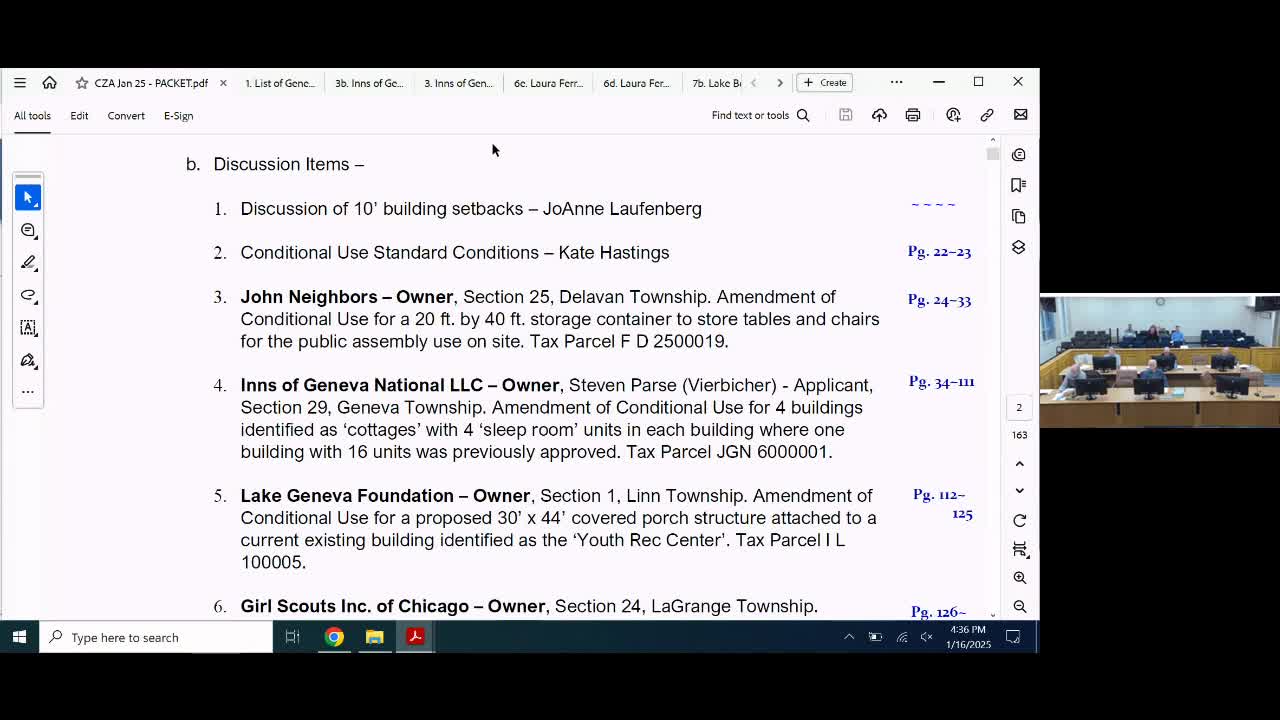
The Walworth County Zoning Agency on Jan. 16 directed staff to prepare ordinance language that would increase setbacks and impose graduated height limits for businesses sited adjacent to existing residences.
The motion, moved by Joanne Loffenberg, a member of the Zoning Agency, and seconded by Dennis (last name not specified in the record), asked staff to draft a graduated setback tied to building stories (for example, 25 feet for one story, larger setbacks for two and three stories) and to return with options for committee review. The motion carried.
Agency members and staff framed the discussion as a response to a recent application in which a multi-story commercial building was proposed immediately next to long-standing homes on small lots. Kate (Planning staff) told the committee that many towns designate small parcels as commercial under local comprehensive plans and that those local decisions can create “patchwork quilt” situations when small residential lots abut commercial uses. She noted existing ordinance provisions that already set different setbacks depending on adjoining uses and district type, and she described possible approaches to tie permitted height to setback distance.
Members said the problem is most acute where small commercial lots (the B-2 district allows minimum lots as small as about 7,500 square feet where sewer is available) abut R-1/R-2 residential lots and houses were built assuming no commercial development would occur. Several members emphasized height and privacy concerns, noting a three-story structure overlooking neighboring yards was the catalyst for the discussion.
Staff agreed to return with draft options within a “handful of months,” and to bundle the setback/height language with other ordinance amendments they are preparing. The committee asked staff to include examples and to show how amendments would interact with existing zoning provisions such as parking setbacks and height/setback formulas already used in some districts.
Next steps: staff will draft specific language and examples, bring them back to the committee for review, and then — if the committee directs — refer proposed amendments to affected towns and the public-review process.