Get Full Government Meeting Transcripts, Videos, & Alerts Forever!
Get email alerts on the Children Services Budget topic
No spam. Unsubscribe anytime.
Walworth County shifts children's long-term support funding to state, approves residential-placement budget amendment
Summary
The Walworth County Board voted unanimously Feb. 11 to remove local 2024–25 appropriations for children's long‑term support services and to amend the 2024 budget for children and youth residential placements; county staff said the change reflects state-directed funding and local case management remains handled by Lutheran Social Services.
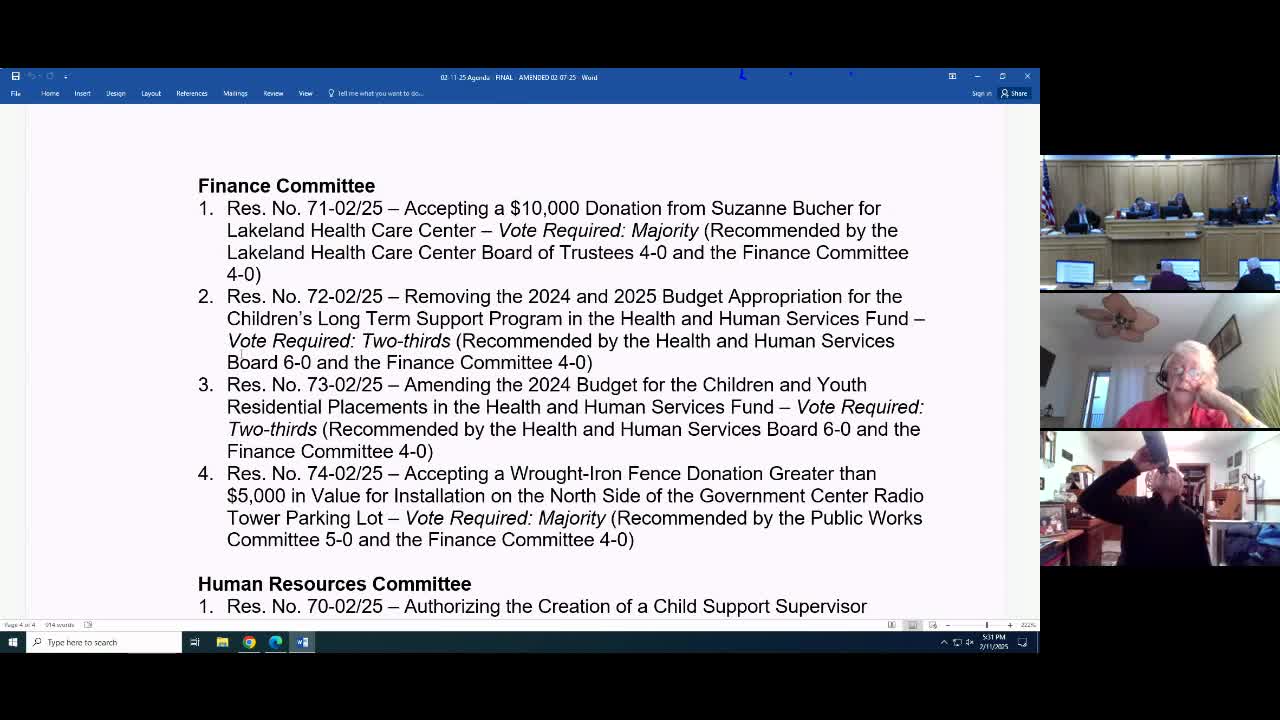
Walworth County Board of Supervisors on Feb. 11 unanimously approved removing 2024 and 2025 budget appropriations for children in the county Health and Human Services fund and separately amended the 2024 budget for children and youth residential placements.
The two votes were taken as separate resolutions: the removal of the appropriations (resolution number noted on the agenda as 72‑o2‑2025) passed by roll call after discussion; the amendment to the 2024 residential‑placement budget (resolution number shown as 73‑2‑2025 on the agenda) also passed 10‑0.
County staff and board members said the actions formalize that certain children's services funding flows through state programs rather than being carried as local county disbursements. An unidentified supervisor who spoke during debate said she supported removing the appropriation but raised concerns about oversight, saying, “I voted yes on this thinking that, you know, getting it out of our budget is a good thing. However, it occurred to me later, maybe there's less oversight… I am just a little concerned about having it go directly through the state and not have it go through Walworth County so that we have somebody, like Carlo, knowing what's happening with the kids.”
A county staff member identified in the meeting transcript as Carlo clarified how the program works: “CLTS is children's long term support services. It's not CPS. So, this is a program, primarily for kids with developmental disabilities, usually living in their homes. We don't get a choice about whether or not the money flows to us. We are really just the front door for this state mandated program. How this works is a family will come to us. We'll screen for eligibility. Does the child have an eligible disability or diagnosis? If the answer is yes, then we coordinate. We get them to the case management agency. It's Lutheran Social Services is the agency that handles the case management in our county. And then LSS will work with various vendors, so respite providers or mentorship providers, who then bill the state. The state reimburses them.”
Carlo told the board the county’s role remains as an initial eligibility screener and coordinator; case management and vendor payments are handled by Lutheran Social Services (LSS) and the state. He said the county lacks the staffing to perform direct, routine follow‑up for all children served by the program, noting the county’s client count for CLTS is about 400 children.
Board members asked for clarification about oversight and reporting. Carlo stated that LSS “has an obligation to report back to us who they serve and how many units of a service are provided,” but he said the county does not have capacity to monitor each individual case beyond that reporting requirement.
The board recorded the votes after some technical difficulty with remote voting for one supervisor. The minutes show both measures passed unanimously with 10 votes in favor, and the chair declared the motions carried.
The measures were presented by the Health and Human Services Board and recommended to the County Board by the Health and Human Services Board and Finance Committee per the agenda. The transcript shows the resolutions required a two‑thirds vote; the county board approved them.
The board did not adopt additional oversight measures at the meeting. Follow‑up actions or requests for additional reporting from LSS were not specified on the record.