Get Full Government Meeting Transcripts, Videos, & Alerts Forever!
Get email alerts on the Constructive Dialogue topic
No spam. Unsubscribe anytime.
Hinckley forum teaches constructive-dialogue skills to University of Utah students
Summary
At a Hinckley Institute forum, Josh Schollroof of the Bennion Center led a workshop on the Constructive Dialogue Institute’s Perspectives program, citing campus survey data, presenting moral-foundations theory, running an in-room perception-gap exercise and encouraging students to sign up for further training and a campus support team.
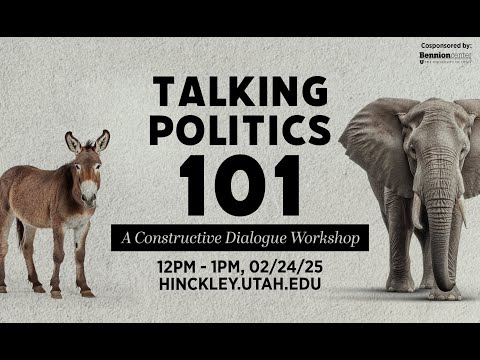
Josh Schollroof, campus dialogue program manager at the Bennion Center for Community Engagement, led a “Talking Politics 101” constructive-dialogue workshop at the Hinckley Institute of Politics at the University of Utah. Schollroof described the Constructive Dialogue Institute’s Perspectives program, ran a perception-gap exercise, and guided students through question-framing techniques intended to reduce polarization in political conversation.
Schollroof said the Perspectives curriculum is mostly online, with “six 30-minute asynchronous lessons” and three short in-person conversations, and urged attendees who found the session useful to sign up for the full program. He cited CDI research showing that 45% of students reported being “somewhat or very often afraid to share their views” in classroom settings and that “94% of college students agree that we should listen to others with an open mind, including those with whom we disagree.” He described how those perception gaps are larger for some groups and noted averages of a 19% perception gap for Democrats and 27% for Republicans in the CDI data Schollroof presented.
Why it matters: Schollroof framed the workshop as a campus response to high political polarization that, he said, has consequences beyond disagreement. He warned that distorted perceptions of opponents are associated with support for anti-democratic actions, and he encouraged students to practice curiosity, invite stories, and “let go of winning” to reduce dehumanization and improve civic discourse.
During the hourlong session, Schollroof explained CDI’s working definition of constructive dialogue: “A form of conversation where people with different perspectives try to understand each other without giving up their own beliefs in order to live, learn, and work together.” He introduced moral foundations theory to help attendees listen for underlying values such as care, fairness, liberty, loyalty, authority and sanctity, and led a short video excerpt and a facilitated discussion to identify those moral signals in conversational examples.
Participants completed a short perception-gap quiz and were asked to stand if their gap exceeded set thresholds; Schollroof used the anonymous exercise to show how common divergence is between how people see themselves and how they think others see them. He then had students pair up to draft open-ended, curiosity-driven questions to ask people with whom they disagree. Students suggested questions such as “What does fairness mean to you?” and prompts that invite stories about life experience rather than yes/no positions.
Schollroof also presented results from social-psychology research on moral reframing, saying that persuasive appeals that connect policy arguments to an audience’s moral values can increase receptivity. He cited an experiment in which conservative readers were more likely to support environmental protection after reading an essay that framed the issue in terms of moral purity rather than standard liberal care-based arguments.
The presentation closed with a campus call to action: Schollroof encouraged attendees to sign up for Perspectives via a poster at the event, and to join the Demonstration and Activity Resource Team (DART), a campus group Schollroof described as supporting student organizers “before, during, and after their actions.” He also offered to share slides and references with attendees.
The session combined lecture, video excerpt, a short in-room exercise, and small-group practice. There were multiple audience questions and contributions about student debt, generational differences, and how lived experience shapes political views; Schollroof redirected those into exercises on listening and question design rather than policy debate. The event ended with a reminder about sign-up information and informal announcements about food on-site.