Get Full Government Meeting Transcripts, Videos, & Alerts Forever!
Get email alerts on the Traffic Calming topic
No spam. Unsubscribe anytime.
NDOT proposes speed cushions and two radar feedback signs for Amelie Drive; residents warned ballots require two-thirds approval
Summary
David Grieves, an engineer with the Nashville Department of Transportation, presented final construction plans Feb. 20 for traffic calming on Amelie Drive, proposing modular speed cushions at several locations along the corridor and two uphill‑facing radar feedback signs.
David Grieves, an engineer with the Nashville Department of Transportation, presented final construction plans Feb. 20 for traffic calming on Amelie Drive, proposing modular speed cushions at several locations along the corridor and two radar feedback signs facing uphill. Grieves said the ballot will be open for six weeks to property owners whose parcels touch the affected right of way; two-thirds of returned ballots must be “yes” for the vertical measures (the speed cushions) to proceed.
The project is part of NDOT's Neighborhood Street Traffic Calming (NSTC) program, which focuses on residential streets and uses engineering, education and enforcement to reduce vehicle speeds. "Of the three, NDOT has the greatest ability to affect engineering," Grieves said, adding that the program prefers corridor-length treatments over one-block fixes. He said Amelie Drive was selected in August 2024 from about 575 candidate streets and is in the design phase.
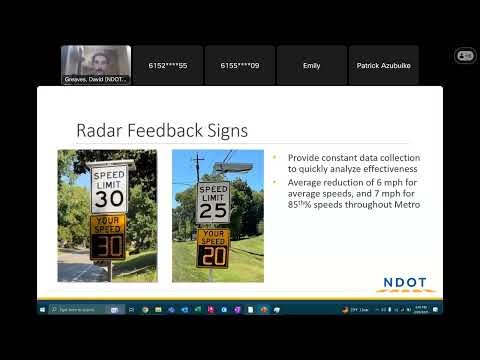
Nut graf: The proposed measures target a hill on Amelie Drive where NDOT recorded an 85th-percentile speed just north of 40 mph, well above the typical 25 mph neighborhood limit. NDOT’s limited before-and-after study of comparable treatments showed average speeds dropping from 31 to 22 mph and an 85th-percentile fall from 37 to 25 mph; Grieves said radar feedback signs have produced average reductions of about 6–7 mph in similar applications.
Grieves described the primary device as modular rubber speed cushions roughly 3 inches high and available in lengths of about 7, 10.5 or 14 feet; each cushion is about 6 feet wide with intentional gaps to permit larger‑wheelbase emergency vehicles to straddle them. NDOT proposes a set of cushions near the low point of a drainage dip, a radar feedback sign facing uphill below the steep grade, cushions spaced through a flatter midsection (target spacing about 305 feet where feasible), and a second uphill-facing radar sign approaching the north crest at Huntingdon Ridge Place. A series of three cushion sets is shown before McMurray Drive in the plans presented.
Grieves told residents the steep hill limits NDOT’s vertical‑measure options at the crest and said a previously suggested electronic driveway-warning device was vetted with NDOT signals staff and rejected because a failure of the device could give drivers a false sense of security. "We did look into it pretty thoroughly, but we are confident in the decision that it should not be installed here," he said.
Residents asked about solutions specifically for driveways at the crest. One resident noted limited sight lines and said the hill made turning in and out uncomfortable; another asked whether speed cushions would prevent drivers from quickly regaining speed before the crest. Grieves said available research shows speeds dip at cushions and then climb, and the NSTC target spacing (roughly 300–500 feet) is intended to place another device before speeds return to undesirable levels, but he cautioned that much of the research was not done on terrain as steep as some Nashville streets.
On enforcement, Grieves said Metro Nashville Police Department (MNPD) may rotate targeted speed enforcement to streets that report speeding but that statewide limits make automated enforcement (speed cameras with citations) effectively unavailable in Tennessee. "Short of having a police officer there to take speeds and write tickets, options are pretty limited," Grieves said, and he encouraged residents to submit Hub Nashville (311) requests if they want MNPD enforcement attention.
Several residents suggested non-electronic measures that would not fail if power or electronics did, such as large convex (bubble) mirrors at driveways. Grieves said NDOT has not implemented mirrors in the NSTC program but will research the idea and look into whether a mirror existed previously at the site.
Grieves outlined the next steps: staff will refine any design changes raised by meeting feedback, post final construction plans on NDOT’s traffic calming tracker and trafficcalming.nashville.gov, and mail ballot packets to parcel owners touching the affected right of way (each packet will include a unique ID and six-week online ballot). He said construction sits behind an 8–10 month backlog after approval but that installation proceeds quickly once a job reaches the top of the queue. "The mailer that you'll receive will have instructions on how to access the ballots ... you'll want to vote with the ID that was on the ballot sent to you," he said.
Ending: NDOT will finalize plans, post them online, send ballots to adjacent parcel owners and follow up by email when the materials are available. Grieves provided an NDOT project email and asked residents to report remaining questions through Hub Nashville or via the traffic calming webpage.