Get Full Government Meeting Transcripts, Videos, & Alerts Forever!
Get email alerts on the Traffic Calming topic
No spam. Unsubscribe anytime.
NDOT proposes speed cushions, studies speed tables for Harpeth Bend Drive after 85th‑percentile speed measured at 43 mph
Summary
NDOT staff presented a traffic calming concept for Harpeth Bend Drive on a segment between Highway 100 and McPherson Drive and outlined next steps toward a neighborhood ballot and construction if the vote succeeds.
NDOT staff presented a traffic calming concept for Harpeth Bend Drive on a segment between Highway 100 and McPherson Drive and outlined next steps toward a neighborhood ballot and construction if the vote succeeds.
Amy Burch, a traffic engineer and consultant working with NDOT, told residents that data collection showed an 85th‑percentile speed of 43 miles per hour on Harpeth Bend Drive where the posted speed limit is 25 mph. “So 85% of the traffic on Harpeth Bend Drive is going 43 miles per hour or below,” Burch said, adding that 15% of vehicles were measured going above 43 mph. She also said measured average daily volume for the segment is about 1,392 vehicles per day in both directions and that the corridor has 10‑foot lanes, bike lanes and no sidewalks.
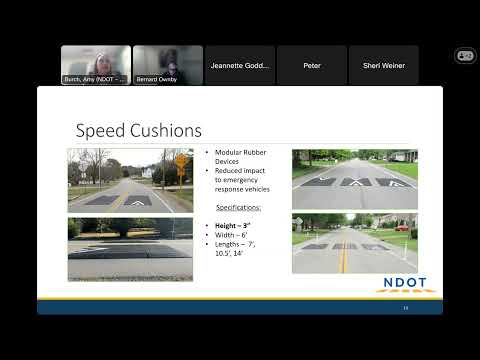
The concept plan presented by NDOT calls for eight sets of vertical devices—typically speed cushions—spaced about 530 feet apart along the project limits. Burch said the cushions proposed for Harpeth Bend would be 14 feet long to be smoother for drivers and that flexible delineator posts would be placed to discourage drivers from moving into the bike lane to avoid devices. She explained NDOT’s typical spacing guidance: “As we place them in spacing of around 500 feet, then drivers will have to essentially stay the same speed consistently along the length of the street without picking up speed and slowing that down real fast.”
NDOT staff described the agency’s toolbox of countermeasures, including speed cushions, speed tables, radar feedback signs, pavement markings, neckdowns and chicanes. Burch said cushions are the agency’s most frequently used device and noted constraints for any vertical device: they are not installed at steep grades, sharp curves or immediately adjacent to driveway locations. She summarized program results from prior installs, saying average speeds on streets with vertical devices fell from about 31 mph to 22 mph and 85th‑percentile speeds fell from about 37 mph to 25 mph in NDOT before‑and‑after studies.
Resident Bernard Ombie, who lives in the White Heath area adjacent to Harpeth Bend, urged NDOT to consider speed tables instead of cushions for the first several devices near Highway 100 because of repeated drag racing and high motorcycle speeds there. “We see motorcycles drag racing. We see cars drag racing. We’ll see 70, 80, 90 miles an hour go by our house,” Ombie said, and argued that cushions would not sufficiently slow some motorcycles. Several other residents described the stretch as especially dangerous and said police were already aware of complaints. Jeanette Goddard, a Devon Park resident, said: “This is way past a traffic calming situation. It's like a dangerous sport that's happening out there.”
Burch said NDOT primarily uses cushions but will check whether speed tables are appropriate for the straight segment that residents flagged and will include that determination in the detailed design. She reiterated installation constraints and tradeoffs: tables are a single hump across the roadway while cushions leave wheel gaps, and cushions can be configured with gaps to reduce response impacts to emergency vehicles.
NDOT walked through the traffic calming program process and timeline. Harpeth Bend was selected in the fall 2024 selection round from roughly 480 applications; the agency collects field data and scores candidate streets on a 100‑point scale using criteria weighted for speed (45%), volume (25%), non‑driver accommodations such as sidewalks and bus routes (15%), crash history (10%) and trip destinations (5%). Burch said the project will move to a detailed design (with exact device locations and dimensions) and then to an online ballot unless the design changes substantially and a second community meeting is needed.
NDOT described the ballot rules for the program: postcards with unique IDs will be mailed to eligible properties; the validating period is six weeks; ballots are counted by property with one vote per residential property, church or school abutting the affected right of way; vacant properties and businesses are not eligible to vote. Burch said NDOT identified 58 eligible properties for the Harpeth Bend segment and that the ballot requirement to advance construction is approval by at least 66% of respondents. If a ballot passes, NDOT orders materials and schedules construction; Burch said construction typically occurs about eight to ten months after the ballot closes.
Council members and residents requested additional outreach before balloting to maximize participation. The council member present asked NDOT to prepare an updated design and hold a second meeting before the ballot to increase neighborhood turnout and ensure affected residents can review any changes. NDOT agreed to complete field design work, consider whether tables are warranted in the flagged straightaway near Highway 100, and coordinate a follow‑up meeting and materials for voter outreach.
What happens next: NDOT will complete a detailed design package, confirm whether cushions, tables or a combination will be used for the Highway 100 straightaway, and either schedule a second neighborhood meeting or proceed to the six‑week online ballot. If the neighborhood ballot (eligible voters only) returns at least 66% yes, NDOT will proceed to order materials and plan construction, which the agency estimates would begin roughly eight to ten months after ballot close.
Votes at a glance: No formal motions or votes were taken at this meeting. The key administrative status items are (1) Harpeth Bend Drive was selected in NDOT’s fall 2024 traffic calming round and (2) NDOT will proceed to a detailed design and neighborhood ballot per program rules.