Get Full Government Meeting Transcripts, Videos, & Alerts Forever!
Get email alerts on the Scott Dam Decommissioning topic
No spam. Unsubscribe anytime.
Lake County urges fuller review of PG&E’s Scott Dam surrender plan, approves comment letters to PG&E, governor and federal agencies
Summary
After extended public comment and technical briefings, Lake County approved letters responding to PG&E’s draft surrender application for Scott Dam and called for fuller analysis of risks to water supply, public safety and tribal interests.
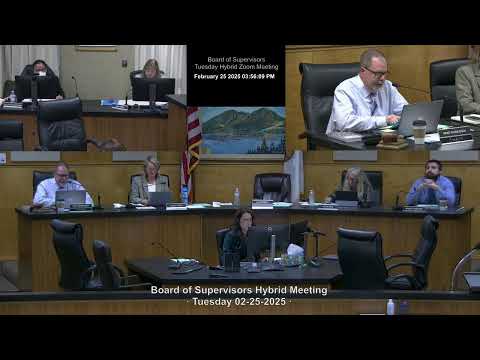
The Lake County Board of Supervisors voted on Feb. 25 to approve three separate letters: comments to Pacific Gas & Electric Company on its draft surrender application for Scott Dam, a letter to California Gov. Gavin Newsom addressing questions raised by the state’s executive order, and a letter to federal agencies regarding Scott Dam decommissioning. The board also authorized the chair to sign each letter.
Supervisors framed the action as a step to secure the county’s place at the table as Federal Energy Regulatory Commission (FERC) review and related planning proceed. County officials said PG&E filed a draft surrender application and related materials; the county contracted SLR International Corporation to review PG&E’s materials and provide technical comments that were incorporated in the county’s response.
County staff and consultants highlighted multiple technical and community concerns: slope stability and landslide risk during staged dam removal, the absence of a County-specific restoration plan for the Lake Pillsbury basin, potential effects on water supply during droughts, the use of Lake Pillsbury as a firefighting resource, sediment and contaminant mobilization (including legacy mining contamination), and impacts to local recreation and the community’s way of life. SLR recommended PG&E consult with Lake County to obtain correct tax and community-impact information and to identify compensation and mitigation for affected residents.
Multiple supervisors and public commenters urged the county to press for fuller mitigation and for a seat in downstream and statewide discussions. Several tribal speakers urged the board to reflect tribal cultural ties to the headwaters and to note recent legal precedents recognizing tribal trust responsibilities in similar proceedings.
Presentations and public comments included: Matthew Rothstein (chief deputy CAO) and Patrick Sullivan (county staff), an SLR technical team, PG&E’s government-affairs representative Jason Tarmino, tribal representatives speaking about Round Valley and other tribes’ cultural and water rights concerns, the Lake County Chamber of Commerce, Lake Pillsbury Alliance and local residents and landowners. County staff said PG&E set public comment deadlines tied to the FERC schedule and noted a public-comment window on some PG&E materials closing in early March.
Board action: The board approved (1) the county comment letter responding to PG&E’s draft surrender application and authorized the chair to sign; (2) a letter to Governor Newsom asking for clarification on executive orders and the need to consider Lake County impacts, and authorized the chair to sign; and (3) a letter to federal agencies regarding the decommissioning and executive-order implications, and authorized the chair to sign. Each motion passed without recorded roll-call tallies in the minutes. The board directed staff to continue technical review and coordinate county comments with consultants and partners as FERC’s review proceeds.
Public testimony at length followed the presentations. Concerns raised included risks from sediment and legacy mining contamination, uncertain restoration plans and costs (county staff and public speakers cited an order-of-magnitude decommissioning estimate on the order of hundreds of millions of dollars), fire-mitigation impacts of removing a local water storage resource, and the need for the county to be fully represented in multi‑agency negotiations.