Get Full Government Meeting Transcripts, Videos, & Alerts Forever!
Get email alerts on the Director Evaluation topic
No spam. Unsubscribe anytime.
Metro Schools committee reviews midyear director evaluation, highlights tutoring pilots and SEL supports
Summary
The Metropolitan Nashville Public Schools evaluation committee reviewed its semiannual evaluation of the district director covering literacy, numeracy, social-emotional learning and transitions, and noted pilot tutoring results, attendance gains and funding concerns as ESSER support winds down.
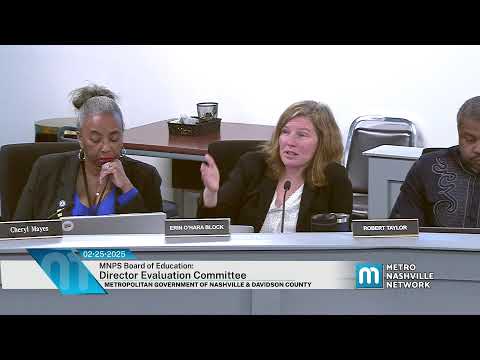
Board Member O'Hara Block led the Metropolitan Nashville Public Schools (MNPS) evaluation committee's semiannual review of the director's performance on midyear measures, saying the committee was assessing progress through the end of the first semester and providing formative feedback to the director.
The review covered four focused outcomes — literacy, numeracy, social-emotional learning (SEL) and transitions — and summarized work on programs and pilot initiatives that the director reported to the committee. The committee noted several program-level results and raised questions about future funding as federal ESSER support phases out.
The committee's report said Doctor Battle, the district director, completes a self-evaluation and supplies the available data; the midyear assessment reviewed progress through December and did not include benchmark data that the committee expected to receive later. "We're reviewing quarter 1 and quarter 2, which means everything that happened up until the end of the first semester," the presenter said.
On literacy, the director's report highlighted the district's Literacy Reimagined work, including a peer rapid-response study on tiered interventions and special education practices that has informed changes in early-grade interventions. The committee also noted updates to the "Every Student Known" personalized student dashboard and a pilot program that expands family-access tutoring.
The Paloma Learning pilot operated at seven elementary schools; the committee's materials show 72% of eligible families participated, and 32% of participants completed three or more sessions. The committee described Paloma Learning as additional tutoring layered on top of the district's Accelerating Scholars program, which the report said continues to run weekly in schools.
Enriching Scholars ran at 19 sites this year, the committee reported, with participants recording three sessions and 650 students served; Promising Scholars programming is under revision for next summer based on staff and student feedback. The committee also noted a partnership with Learning Forward and that "coaching and content days" are being implemented at every school, with particular attention to fifth-grade supports.
On SEL, the report summarized expanded navigator reports and tools for administrators, growth in preventive supports through advocacy centers, and a second-year weekend behavior support program for students early in behavioral intervention. The committee recorded improvements in attendance metrics compared with the previous school year — citing gains in overall attendance, chronic absence, satisfactory attendance and perfect attendance — and attributed some classroom return rates to coordinated school health and school nurses.
The committee discussed transitions under the Metro Schools reimagined work, highlighting focused conversations about grade configurations in MLK and Head communities and continuing attention to fifth- to sixth-grade transitions. The director's report also noted district scholarship programs with Belmont, Fisk, Lipscomb, Tennessee State University (TSU) and Vanderbilt; the committee said it will track admissions and financial-aid outcomes in the spring.
Board members underscored sustainability and funding concerns as ESSER federal funds decline. The presenter told the committee that feedback often appears later in director updates and that the evaluation process can surface items that later reach the full board. "Well, hopefully, everybody sees their feedback included in here. That is one of the goals of these presentations," Board Member O'Hara Block said.
Doctor Debau McKinney thanked O'Hara Block for organizing the evaluation materials and for synthesizing the committee's perspectives. "I just wanna thank board member O'Hara Block for taking the lead on evaluation and really working hard to reflect all of our viewpoints," Doctor Debau McKinney said.
No formal votes were taken during the evaluation committee presentation; the meeting closed after committee discussion and the chair called the adjournment.