Get Full Government Meeting Transcripts, Videos, & Alerts Forever!
Get email alerts on the Committee Votes topic
No spam. Unsubscribe anytime.
Committee advances multiple bills, veterans protections and two agency budgets to finance
Summary
The Tennessee Senate State and Local Government Committee on Thursday advanced multiple bills and two departmental budgets to other committees, including an increase for development-district funding, a rise in the property-value threshold for disabled-veteran tax relief, the Save Act for veteran consumer protections, and two agency budget packages.
The Tennessee Senate State and Local Government Committee on Thursday voted to advance a series of bills to other committees and moved two departmental budgets to the finance committee after a full-day session that combined a consent calendar, multiple bill presentations, and budget hearings.
Among the measures the committee approved were legislation to increase state support for development districts, expand property-tax relief thresholds for disabled veterans, permit a Comptroller exception for municipal contracted financial officers (CMFOs), clarify fee-waiver eligibility for General Assembly employees, extend a Davidson County local tax, and a constitutional-protection bill that bars suspension of the Tennessee Constitution during emergencies. The committee also approved the "Save Act," a consumer-protection bill for veterans seeking VA disability assistance, and advanced a comprehensive hemp-derived cannabinoid bill to finance after a separate, lengthy hearing.
Key outcomes and vote totals
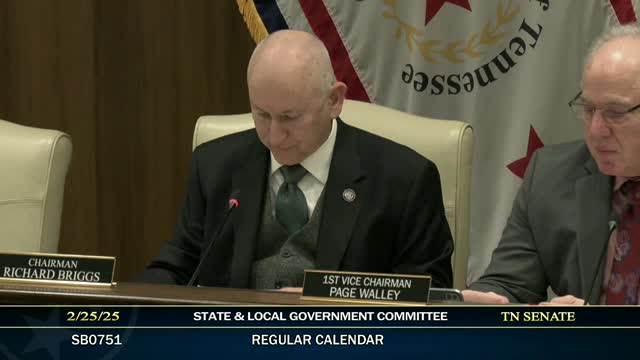
- Senate Bill 751 (increase to funding formula for development districts): Sponsor Senator Yeager presented the bill explaining the districts were formed in 1965 and help counties access grants and administer regional programs. The committee approved the measure and sent it to the finance committee (vote reported as 9 ayes in committee).
- Senate Bill 681 (increase property-value threshold for disabled-veteran tax relief): Sponsor Senator White said the bill raises the market-value cap used to calculate reimbursement from $175,000 to $250,000. The committee approved the bill and moved it to finance (vote recorded as 9 ayes in committee); members noted significant budget implications to be considered in finance.
- Senate Bill 797 (clarifies higher-education fee-waiver for General Assembly employees): Sponsor Senator Hale said the bill clarifies an existing exception so General Assembly employees may use tuition waivers for more than one course at a time if they meet eligibility. The committee passed the bill and it moves to the floor calendar (vote recorded as 9 ayes in committee).
- Senate Bill 109 (allows Comptroller to approve CMFO fewer-than-16-hour contracts for small municipalities): Sponsor Senator Seals said some small municipalities do not need the statutorily required 16 hours per month from contracted CMFOs; the bill allows annual requests to the Comptroller to reduce that requirement. The committee approved the bill and sent it to the calendar (vote recorded as 9 ayes in committee).
- Senate Bill 734 (local tax extension for Davidson County): Sponsor Senator Potty said the bill extends a current local tax for Davidson County for six years. The committee approved the bill and sent it to finance (vote reported as 9 ayes).
- Senate Bill 27 (limits emergency authorities and clarifies no branch may suspend the Constitution): Sponsor Senator Pote said the measure clarifies the General Assembly can grant emergency executive authority but that no one can suspend the Tennessee Constitution; the committee approved the bill and it moves to the calendar on an 8–1 vote (Senator Yarbrough voted no).
- Senate Bill 362 (the "Save Act" — consumer protections for veterans using paid claims agents): Senator Briggs summarized the bill's consumer protections, including banning upfront fees, capping contingent fees, requiring HIPAA-compliant handling, and adding civil and criminal penalties for bad actors. The committee adopted an amendment to exclude university counselors funded by campuses and approved the bill as amended (vote recorded as 9 ayes); witnesses included Peter O'Rourke, president of the National Association for Veterans Rights, and Mark Christensen, chief of staff at Veterans Guardian.
Budget items and administrative approvals
- Department of General Services (DGS) budget: Commissioner Matt Van Epps presented several requested cost increases, including $5,566,600 to accelerate vehicle replacements (roughly to buy ~124 additional fleet vehicles at an average price the department cited of ~$42,000 each), $1,121,900 to expand telematics and begin electric-vehicle infrastructure planning, recurring funding for reclassifications and an employee retention package ($1,424,000 to implement flex classifications across the department), and ongoing support for a West Tennessee megasite's water/wastewater operations. The committee approved the DGS budget and forwarded it to finance (vote recorded at 6 ayes in committee for that item as read at vote time).
- Tennessee Military Department budget: Adjutant General (General Ross) and staff described eight request items and capital needs, including flood-monitoring upgrades, regional response vehicles, and replacement radiological monitoring equipment. The committee approved the military department's budget package and moved it to finance (vote recorded as 7 ayes in committee).
Committee process and next steps
Chairman Briggs said the committee used a consent calendar for a small group of low-discussion items, then prioritized bills with out-of-town witnesses. Several members asked that technical or potentially disruptive items be examined further in finance or by separate bills to avoid unintentionally harming small businesses or farmers. Many sponsors noted fiscal impacts would be handled in the finance committee; members generally voted to advance bills to allow fuller review.
Ending note: The committee's actions forward multiple policy changes and budget requests for more detailed review in Senate finance or the Senate calendar. Where the committee recorded unanimous or near-unanimous committee approval, senators still signaled interest in deeper follow-up in the next stages of the legislative process.