Get Full Government Meeting Transcripts, Videos, & Alerts Forever!
Get email alerts on the Hemp Regulation topic
No spam. Unsubscribe anytime.
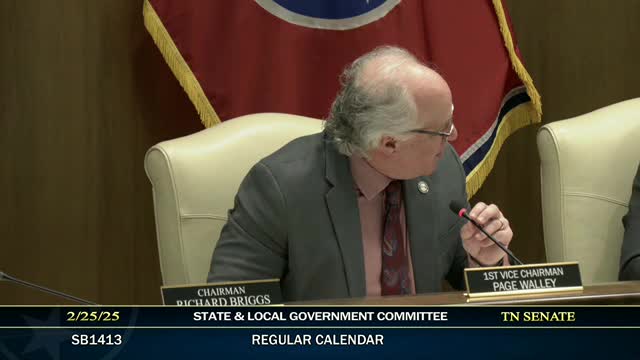
Senate committee advances sweeping hemp regulation bill after hours of debate
Summary
The State and Local Government Committee voted to send Senate Bill 1413, a broad rewrite of hemp-derived cannabinoid rules that would move most enforcement to the Tennessee Alcoholic Beverage Commission and bar some THCA products, to the finance committee after a lengthy hearing that split lawmakers and drew industry and regulator testimony.
The State and Local Government Committee on Thursday voted to send Senate Bill 1413 as amended to the Senate finance committee, advancing a package that would shift licensing and enforcement of many hemp-derived cannabinoid products to the Tennessee Alcoholic Beverage Commission (TABC), add lab-testing and packaging requirements, and ban certain THCA products that sponsors and some federal agencies say convert to marijuana when heated.
The bill drew more than two hours of public testimony and extended floor-level debate among senators concerned about public-safety gaps, enforcement, and economic effects on farms and small businesses.
Why it matters: The measure would change how the state treats a category of hemp-derived products that has proliferated in recent years. Sponsors said the patchwork market currently exposes children and the public to intoxicating products sold in candy-like packaging and that enforcement by the Department of Agriculture has been insufficient. Opponents said new definitions and restrictions — in particular a provision treating THCA derivatives as marijuana — would effectively wipe out a legal hemp industry and harm farmers and small retailers who invested in the product under earlier state rules.
Committee Chair Senator Briggs said the legislation is intended to bring a licensing-and-inspection model similar to the alcohol system to products he described as intoxicating: "This looks like some sort of candy the kids would eat," Briggs said while showing committee members packaging he said lacked required labeling. He told the committee that the bill moves compliance and enforcement away from the Department of Agriculture — which he said has focused on field compliance and lacks retail enforcement capacity — and assigns licensing and on-site inspections to the alcoholic beverage commission.
Business owners and industry representatives offered sharply divergent views. Devin Aracena, founder of Canvas (a Tennessee hemp business), told the committee the bill "unfairly targets small businesses, farmers, and consumers by banning federally legal hemp products and imposing an inconsistent, unworkable regulatory framework." She said recent state rules adopted in 2024 already address packaging, sales to under-21 customers and other safety issues, and that the state should focus on enforcing existing law rather than banning broadly used raw hemp materials.
Rob Eichard, president of the Tennessee Grocers and Convenience Store Association, urged lawmakers to preserve grocers' ability to sell compliant hemp-derived products, warning that excluding grocery and convenience stores from the licensing system would "degrade the public safety objectives of this legislation" by driving sales into unregulated channels.
Russell Thomas, director of the Tennessee Alcoholic Beverage Commission, told the committee the TABC has experience enforcing intoxicating-product rules and that a single agency could provide consistent oversight: "An effective regulator isn't just about the rules, but it's also making sure that everybody plays by the same rules," Thomas said. He also said the bill does not require a retail licensee to also sell alcohol.
Several senators urged splitting the bill. Senator Roberts said the committee might win broader consensus by separating the institutional change (moving enforcement to TABC) from detailed redefinitions of hemp and THCA. Senator Roberts: "If the bill strictly focused on moving things from Department of Agriculture to ABC, but left all of the redefining of things to maybe a separate bill, would you object to that?"
Sponsor's view: Senator Briggs and bill supporters argued that THCA is a precursor to delta-9 THC and cited federal guidance and an opinion from the U.S. Department of Justice in arguing some THCA products are effectively marijuana when smoked or heated. Chairman Briggs said, "THCA is marijuana. As soon as you smoke it, heat it, or cook it, you have a conversion of the THCA into Delta 9." He told colleagues that if the committee does not act to restrict THCA products, it would be enabling de facto recreational marijuana sales.
Opponents disputed the reach of that approach and warned of economic disruption. Michael Solomon, a Tennessee hemp business owner, said the licensing structure as written would transfer control of a plant-based agricultural industry to an alcohol regulator and "completely wipe out our industry." He told the committee that in his business THCa products represented a majority of sales and that some fiscal assumptions in the bill's analysis were incorrect.
Vote and next steps: The committee adopted a 30-page amendment and voted to send SB 1413, as amended, to the finance committee by a 6–2–1 margin (six ayes, two no votes, one present not voting). Senators Wally and Yarbrough recorded no votes; other members voted aye or were recorded as present; Chairman Briggs cast an aye vote and said he had concerns but favored sending the measure forward.
Ending note: Lawmakers said the matter raises trade-offs between public-safety enforcement and economic disruption. Multiple senators urged further study or bifurcation so the committee could act quickly on enforcement capacity without upending a nascent agricultural industry. The bill will receive additional review in the finance committee, where revenue and fiscal impacts will be examined further.