Get Full Government Meeting Transcripts, Videos, & Alerts Forever!
Get email alerts on the Medicaid topic
No spam. Unsubscribe anytime.
TennCare outlines waiver savings, long-term care investments and workforce plans in FY25–26 budget pitch
Summary
TennCare officials told the Senate Commerce & Labor Committee they plan to use shared-savings from the TennCare 3 waiver to expand home- and community-based services, bolster long-term-care workforce support and fund nursing-facility grants while reporting a larger pharmacy cost driven by GLP‑1 drugs.
TennCare Director Steven Smith on behalf of the agency presented the department’s proposed fiscal priorities and budget drivers to the Senate Commerce & Labor Committee, saying the program seeks to use recent shared savings under the TennCare 3 waiver to expand long-term care supports and invest in workforce retention.
The presentation summarized why the budget matters: TennCare provides Medicaid coverage in Tennessee and has been using a 10‑year waiver (TennCare 3) that shares savings with the state when the program controls cost growth. Smith said shared‑savings dollars produced by TennCare 3 have funded prior expansions and that the agency is proposing further investments for home- and community‑based services (HCBS), nursing facilities and workforce incentives.
TennCare framed the spending plan as fiscally responsible reinvestment. Smith told senators the waiver has produced “nearly $1,000,000,000” of shared savings in the first three years of the agreement and that the agency used $100,000,000 of year‑three savings for immediate disaster relief earlier this year. He said the agency proposes to deploy the remainder of the year‑three dollars toward long‑term care priorities: reducing the Choices wait list for people with intellectual and developmental disabilities and expanding Choices 3 (home‑and‑community supports for seniors and people with physical disabilities). Smith said the department is proposing to serve an additional 2,000 people in Choices 3 and to continue using shared savings to offset recurring costs where possible.
TennCare officials emphasized workforce as a central constraint to expanding HCBS. Smith said the budget proposes $50,000,000 — structured as $10,000,000 per year over five years — for provider workforce and retention in the communities affected by the planned HCBS expansions. He also said the department proposes a separate $50,000,000 nursing facility grant program to address infrastructure and workforce needs; those grants, he said, would run through the Department of Health and follow the model used for prior rural health resiliency grants.
The budget briefing also highlighted rising pharmacy costs driven by expanded use of GLP‑1 class medications (for diabetes and other approved indications). Victor Wu, TennCare’s chief medical officer, told the committee the agency covers GLP‑1s for FDA‑approved indications (initially diabetes and selective cardiovascular indications) and that broader FDA approvals and higher utilization are increasing pharmacy trend costs; Smith described Ozempic as a notably large single‑drug spend.
On offsets and savings, Smith described Choices 3 as a program that has delayed higher‑cost placements into institutional care and said newly enrolled Choices 3 members produced an estimated $60,000,000 per year in ongoing savings by delaying higher‑cost placements (the agency reported 1,750 new Choices 3 members with an average delay to higher‑cost categories of 13 months). Smith said the department proposes returning a portion of those savings to the general fund as part of this budget cycle.
Other policy and technical items discussed included: the program’s decreasing federal match (FMAP) and a $64,000,000 recurring request to cover the FY impact of that lower federal share; the rebase calculation in the TennCare 3 waiver (an agreed‑upon recalculation of the waiver’s budget neutrality cap, which will reflect FY24 expenses trended forward for the midpoint rebase); and active litigation and mediation related to a prior federal judge’s finding about some disenrollments following the eligibility system rollout (Smith said the matter remains in mediation and that TennCare believes its redetermination performance compared favorably to most other states).
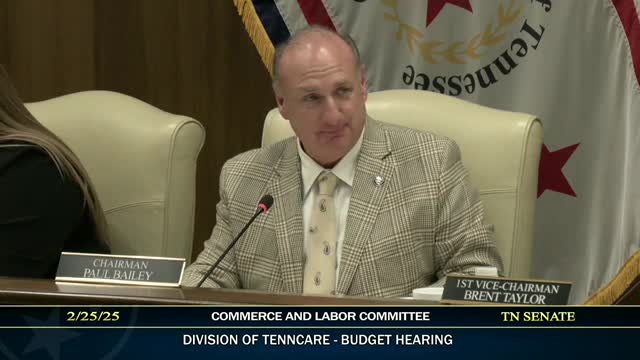
Committee action: Chairman Bailey moved to send TennCare’s budget to the Senate Health Committee; Vice Chair Taylor seconded. The committee voted 8–0 to move the budget forward.
Ending: Smith told the committee TennCare will provide further details on particular investments and said the department remains available to brief members on program design as the budget progresses through the legislative process.