Get Full Government Meeting Transcripts, Videos, & Alerts Forever!
Get email alerts on the State Budget Finance topic
No spam. Unsubscribe anytime.
Senate Finance panel approves Finance and Administration budget, hears plan for violent‑crime grants and tech upgrades
Summary
The Senate Finance, Ways and Means Committee voted 11‑0 to approve the Department of Finance and Administration's FY 2026 budget after presentations on the Violent Crime Intervention Fund, VINE victim‑notification expansion, and a multi‑year technology modernization plan including a North Data Center relocation and ERP replacement.
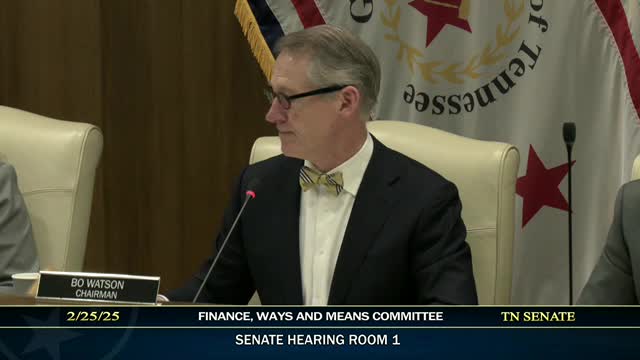
The Senate Finance, Ways and Means Committee approved the Department of Finance and Administration’s FY 2026 budget in an 11‑0 roll‑call vote after hearing department officials outline grant spending, violent‑crime intervention funding and a multi‑year technology plan.
The budget presentation focused on three priorities: continued grant support and administration for local law enforcement through the Violent Crime Intervention Fund (VCIF) and related grant programs run by the Office of Criminal Justice Programs (OCJP); expansion of the Victim Information Notification System (VINE) into additional counties; and investments in department technology including a proposed $40 million nonrecurring appropriation to relocate the North Data Center, a $5 million start for enterprise resource planning evaluation, $5 million for ADA compliance, and security enhancements.
“My name is Jim Bridal, and I’m the commissioner of finance and administration,” Commissioner Jim Bridal told the committee as he and senior staff summarized the department’s FY 2026 requests. Deputy Commissioner Eugene Neubert, OCJP Director Jennifer Brinkman and State Chief Information Officer Stephanie Dedmon joined the presentation.
On public‑safety grants, OCJP officials described VCIF as an active program that has already obligated $150 million through more than 300 contracts and reached more than 250 law‑enforcement agencies. “To date, OCJP has obligated the entire 150,000,000 over 300 contracts, reaching over 250 different law enforcement agencies,” Jennifer Brinkman said, noting the grants have targeted “673 different crime hot spots” and opened over 28,000 investigations. The governor’s FY 2026 proposal includes an additional $30 million nonrecurring for VCIF.
Senators pressed department staff on spending pace and obstacles to local drawdowns. Senator Yarbrough asked why counties had not fully used prior allocations; department staff cited procurement and supply‑chain delays and hiring challenges in local agencies. The department said much of an earlier $150 million allocation has been obligated and that expenditures continued to roll out, with the Memphis and Nashville second‑round allocations still outstanding.
Brinkman also described equipment purchases funded by the grants, including more than 3,100 P25 radios and investments in digital forensic tools and a regional digital forensic center in Jefferson County. The committee packet included a grants list the department said detailed prior allocations.
On victim‑notification systems, staff reported the existing VINE victim notification system is deployed in 86 counties and work is underway to connect nine additional counties. OCJP staff noted that larger counties with separate court systems require extra technical work to integrate court notification upgrades.
The department described a broad technology budget that includes three categories: operations and modernization, innovative service delivery (including AI tools), and customer‑driven requests. Highlights included a $5 million request to begin replacement of an aging enterprise resource planning (ERP) system, $5 million for ADA accessibility upgrades to public web interfaces, about $4.8 million for security enhancements, and a $40 million nonrecurring request to relocate the North Data Center. The department estimated the data center move would take about 2½ years from July 1 if funded; the $40 million would not cover demolition of the current site.
Committee members asked about reversion history, staffing, and the department’s strategy for moving applications to the cloud. Commissioner Bridal said the department is prioritizing software‑as‑a‑service and cloud migration while managing security and vendor risk and that some modernization spending would be offset by efficiencies and reappropriating vacant positions rather than new headcount.
The committee approved the Finance and Administration budget on a roll call. Hale, Hensley, Johnson, Lamar, Powers, Rose, Stevens, Wally, Yeager, Yarbrough and Chairman Watson voted aye.