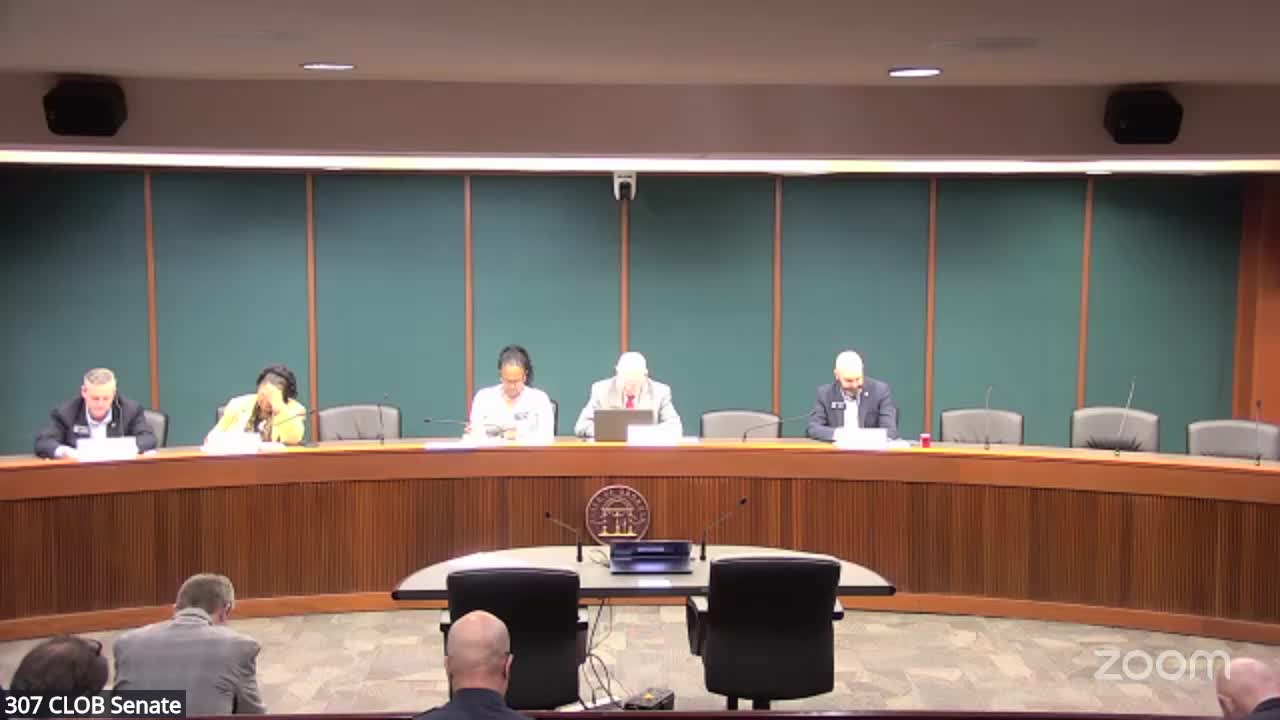
Senate committee sends bill to actuarial study to loosen return-to-work rules for retired teachers
Loading...
Summary
A Georgia Senate committee voted to send Senate Bill 150 to actuarial study after a hearing in which sponsors and stakeholders said the change would help fill teacher shortages by allowing more retired educators to return to the classroom under looser rules.
Senate Bill 150, sponsored by Sen. Gary Hickman, was sent to actuarial study after a committee hearing in which lawmakers and education stakeholders debated lowering retirement eligibility and shortening the required break in service for retired teachers who return to work.
At the hearing, Senator Gary Hickman, sponsor of SB 150, said the proposal responds to statewide staffing shortages: “We got a teacher shortage, a huge teacher shortage.” Hickman described the bill as a temporary measure and said it includes a sunset: “The sunset provision is 06/30/2034.”
The bill would lower the service-years eligibility for retirement-based return-to-work from 30 years to 25 years, and reduce the required break in service before a retiree may return from 12 months to 60 days. The bill explicitly excludes athletic/coaching positions: retirees could be rehired for classroom academic instruction only, not to serve primarily as coaches. Hickman said the change to 60 days was a compromise reached in consultation with retirement-system staff: “In working with Mr. Evans, I said, well, why don't we do 30 days? He said, well, why don't we do 90? I said, Well, let's compromise on 60.”
Buster Evans, representing the Teachers Retirement System during the hearing, described the current program's experience and the administration perspective. Evans said the program has enabled retired educators to return in high-need areas, and provided a usage figure: “Currently, we have about 450 retirees working full time under this provision.” He also reiterated guardrails intended to limit actuarial cost: returning retirees generally continue to have employer TRS contributions paid but do not earn additional service credit for retirement purposes.
Margaret Ciccarelli of the Professional Association of Georgia Educators (PAGE) told the committee PAGE supports the bill as one of two return-to-work proposals moving through the legislature. Ciccarelli said the majority of returning educators under the current program work in special education, math and science: “To date, more than 400 educators in high needs areas around the state have come back to work under this bill. The majority of them have come back to work in high needs areas such as special education and then for second and third math and science.”
Committee members pressed on policy trade-offs. Senator Sandra McLaren asked whether the change risks “double-dipping” and whether it trades off opportunities for early-career teachers; Hickman and Evans framed the bill as a stopgap for a demonstrated shortage. Several senators noted nonpay factors in teacher attrition: Ciccarelli cited survey data showing working conditions, student behavior and leadership as major retention factors and said “Money is only part of the answer.”
The committee explicitly limited the bill’s scope to academic classroom instruction and included a sunset date. A motion was made on the floor to send SB 150 to actuarial study. The committee approved the motion by voice vote; no recorded roll-call tally of individual members was taken.
The bill’s next step is the actuarial study requested by the committee. If the study proceeds, it will be returned to the committee in a later session for further consideration and possible amendments.