Get Full Government Meeting Transcripts, Videos, & Alerts Forever!
Get email alerts on the Utility Easements topic
No spam. Unsubscribe anytime.
Senate committee approves HR 98, clearing dozens of utility easements and describing state real‑estate portfolio
Summary
The committee passed House Resolution 98, which authorizes multiple easements and leases—many for nominal consideration—to allow utilities and local governments to serve state facilities; State Properties Commission described the state portfolio and answered members’ questions.
The Georgia Senate Committee on State Institutions and Property approved House Resolution 98 as a substitute, a package of easements and related real‑estate approvals to allow utility and local‑government service to state facilities and adjacent properties.
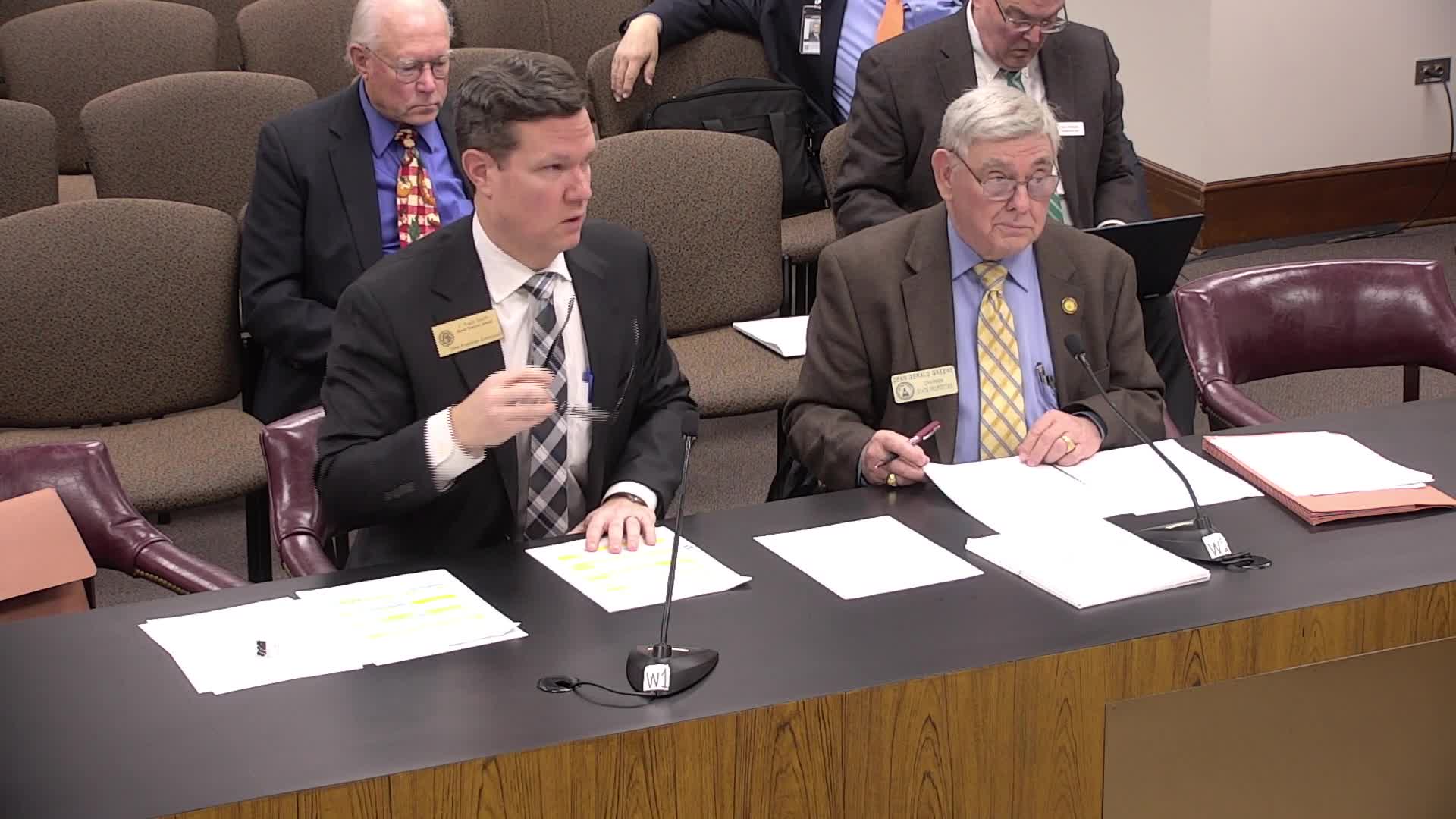
Frank Smith of the State Properties Commission presented the items and described the types of easements included: power and underground distribution lines for technical colleges and parks, fiber‑optic lines for park communications, sewer and water easements for municipal service upgrades, and leases for telecommunications towers. Many items in the package used nominal consideration (commonly recorded in the package as $10) when the easement directly serves a state facility; where no state facility benefited, the commission said it would seek fair market value.
Smith offered a summary of the commission’s portfolio when asked for context: “We oversee the state owns about 800,000 acres of land. Typically that’s forest land or wildlife management land. We have about 12,000 buildings that the state owns all over. And we also have about 2,000 leases where we are the tenant leasing from a private entity.” He added the commission’s mission is to support state agencies’ real‑estate needs, not private interests.
Selected easements Smith highlighted included: an easement to Georgia Power at Fort Yargo (Bryan County) to serve day‑use areas; a roughly 2.3‑acre easement to Georgia Power for a Quick Start training center in Bryan County; an easement to Georgia Power at McGraw Ford Wildlife Management Area to tie into a battery storage station (noted as fair market value, described in the package as “not less than $650” in the transcript); a fiber easement to Spectrum at Chattahoochee Bend to improve park communications; and an easement in Fulton County for the Central Avenue bridge replacement project (noted in the package at $96,000). The package also included several long‑term telecommunications tower leases requested by Southern Link and others.
A motion to pass HR 98 as a substitute was moved and seconded and passed by voice vote; the transcript records the substitute as approved. Committee members asked standard clarifying questions about valuation, public benefit and typical consideration practices for technical college buildings and other facilities.
Why it matters: the resolution clears utility and access easements that permit state facilities and certain local‑government projects to receive power, fiber and water service; many are routine but several require appraisal and fair‑market negotiation because they do not directly serve existing state facilities.
The committee adjourned after completing its business.