Get Full Government Meeting Transcripts, Videos, & Alerts Forever!
Get email alerts on the Libraries Obscenity Law topic
No spam. Unsubscribe anytime.
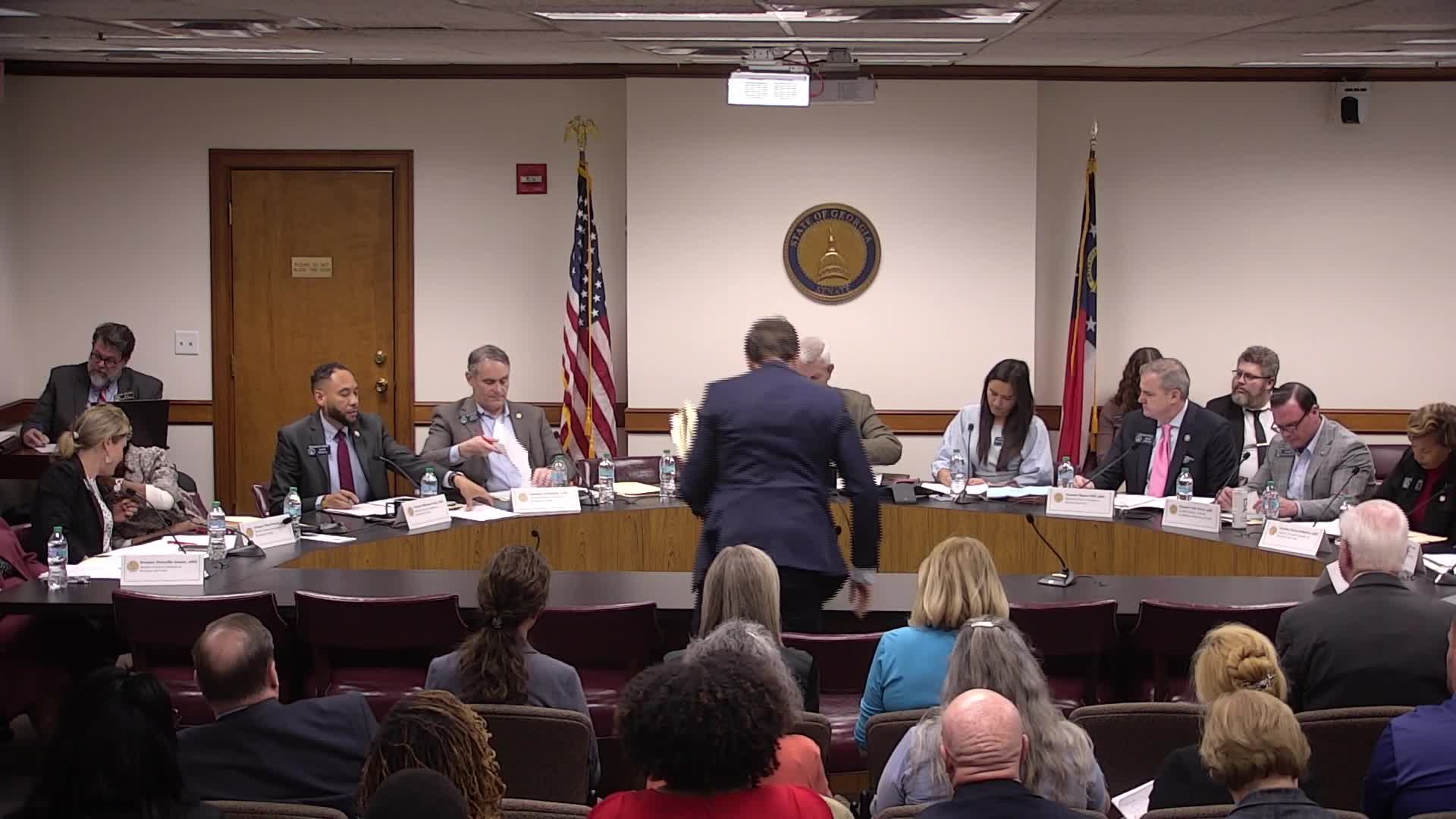
Senate panel restores obscenity law coverage for libraries, adds affirmative defense for staff
Summary
Committee approved Senate Bill 74 to remove a long-standing exemption that shielded libraries from a state law on harmful material for minors; the bill also adds an affirmative-defense clause for library employees who show a good-faith effort to restrict access to harmful material.
The Senate Education and Youth Committee approved a committee substitute of Senate Bill 74 after debate about how libraries classify and manage age-appropriate material.
Senator Burns, the bill author, said the measure strikes a decades-old exception that had excluded libraries from Georgia Code section 16-12-103, which prohibits selling or providing harmful material to minors. "For unknown reasons to me, librarians were exempted from following Georgia law," Burns told the committee, noting the bill preserves adult access while ensuring minors do not have access to material defined by the statute. The bill also adds an affirmative defense for a person charged if they can show they "demonstrate a good faith attempt to identify and remove from access to minors all physical [or] electronic harmful material," language Burns said makes clear the bill is not intended to remove material from adult access.
Committee members discussed operational questions such as who qualifies for the affirmative defense and how libraries classify materials for children, young adults and adults. Several senators suggested broadening protection from licensed librarians to any person employed to work in a public library; the amendment replacing "as a librarian" with wording covering "a person employed to work in a public library" was adopted as part of the committee substitute. Senator Burns and other members emphasized the bill uses the existing statutory standard for harmful material and provides an affirmative defense if library staff show good-faith efforts to comply.
Witnesses and committee members described existing local-level selection processes. A media specialist who spoke to the committee said acquisition and funding decisions are usually made locally and that some older holdings are not fully cataloged, which can make exact inventories difficult; the committee heard that classification and shelving commonly separate children, youth/young-adult, and adult material.
After discussion and a brief vote on a member-drafted amendment, the committee substitute for SB 74 (LC492167) passed by voice/hand vote and the bill will move forward in the Senate.
The committee did not direct further immediate action but several senators said they expected continued discussion about implementation details such as classification standards and local library processes.