Get Full Government Meeting Transcripts, Videos, & Alerts Forever!
Get email alerts on the Energy topic
No spam. Unsubscribe anytime.
Senate panel backs bill to require large electric customers to bear their own costs; amendment to extend rule to co-ops fails
Summary
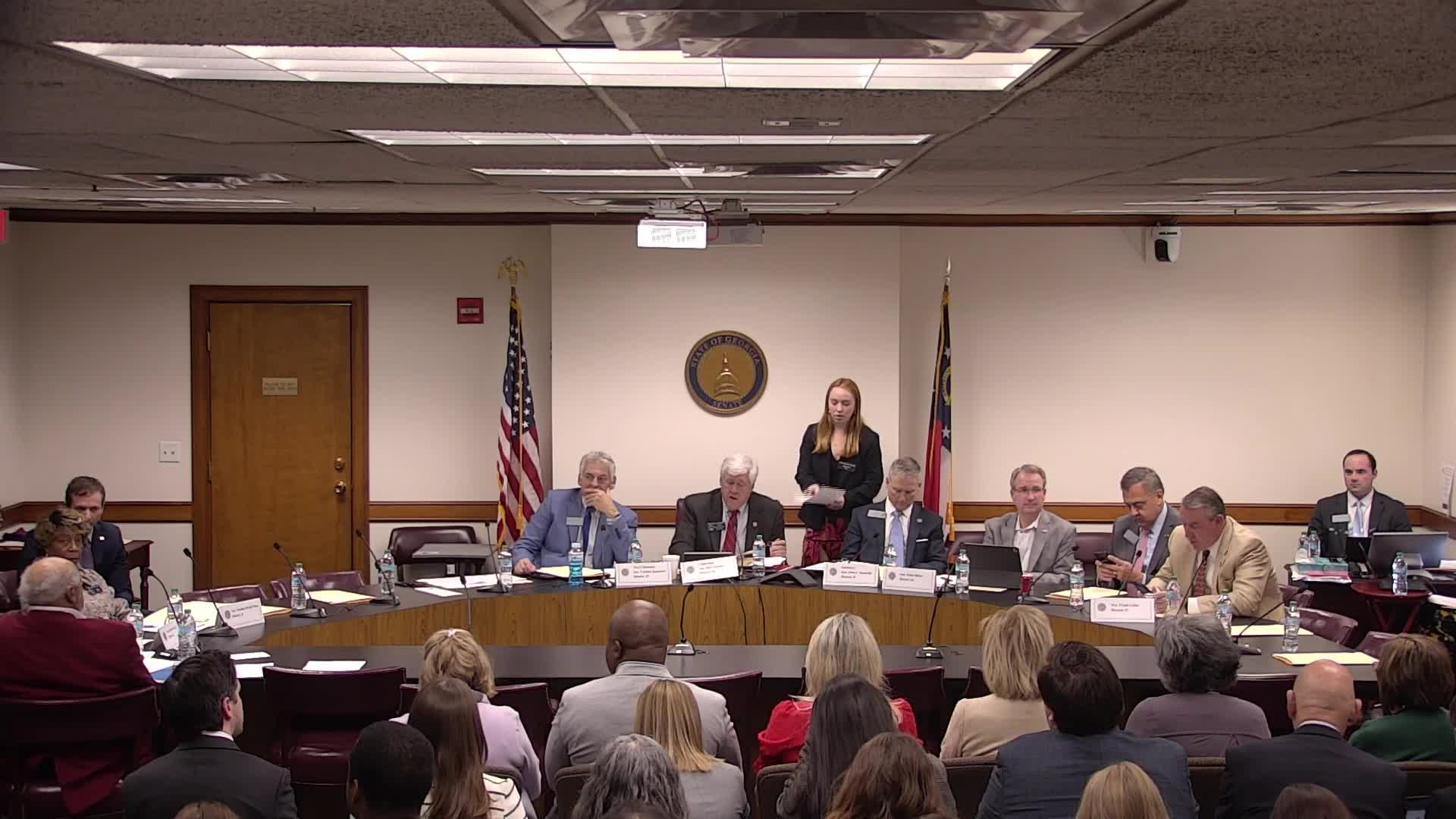
Senator Hufstedler, chair of the Senate Regulated Industries Committee, opened debate on Senate Bill 34, saying the bill would ‘‘codify the law that those responsible for the cost will pay for the cost’’ of electricity used by large new customers such as data centers and would stop those costs from being shifted to residential and small-business ratepayers.
Senator Hufstedler, chair of the Senate Regulated Industries Committee, opened debate on Senate Bill 34, saying the bill would ‘‘codify the law that those responsible for the cost will pay for the cost’’ of electricity used by large new customers such as data centers and would stop those costs from being shifted to residential and small-business ratepayers.
The bill’s author and multiple witnesses framed the issue around recent rule changes adopted by the Georgia Public Service Commission and the growth in demand from data centers. Robert "Bobby" Baker, a former Public Service Commission member who testified in favor of SB 34, told the committee the PSC’s January 23, 2025 rule changes give utilities ‘‘complete discretion’’ and contain ‘‘numerous loopholes’’ that leave existing customers unprotected. He said the rules allow a utility to require additional contract terms for customers with expected peak demand of 100 megawatts or more but do not mandate recovery from the large customer.
Georgia Power told the committee the company’s approach will protect existing customers. Aaron Mitchell, vice president of pricing and planning for Georgia Power, said the utility is building roughly 3,300 megawatts of new capacity that it expects to bring online by the winter of 2028 and that the company has committed that ‘‘residential customers will pay nothing, in excess to, account for those 3,300 megawatts of new generating resources.’’ Mitchell said Georgia Power requires 100% upfront payment for on-site substations or local transmission built solely to serve a large customer so those specific costs do not enter rate base.
Tom Bond, director of utilities at the Public Service Commission, said the PSC supports the bill’s goal to protect ratepayers but cautioned that embedding rules in statute could reduce the commission’s flexibility to handle unique cases in evidentiary proceedings; he added the PSC ‘‘defers to the will of the legislature.’’
Consumer advocates and policy groups urged the committee to act. Liz Coyle, executive director of Georgia Watch, said residents are struggling to pay power bills and urged lawmakers to adopt the bill and the amendment extending coverage to electric membership corporations (EMCs) and municipal utilities. Patty Duran of Cool Planet Solutions presented bill-level evidence showing residential bills have risen substantially in recent years and highlighted fuel cost riders and other charges that are not always included in advertised rate comparisons.
Committee discussion touched on the Territorial Service Act (the state statute that allows large customers to shop for electric service), the timeline for new generation to be built, and the mechanics of how costs are recovered and allocated. Witnesses differed about how much of the new generation costs would be borne by data centers versus shared across customers; former PSC member Baker said data centers are a ‘‘continuous load’’ that can create large capital needs, while Georgia Power emphasized commitments to recover costs from those customers and to require collateral.
Senator Summers offered an amendment (Amendment 1) to place the bill’s language into a code section that would make the same requirements applicable to ‘‘all electric suppliers’’ — meaning Georgia Power, EMCs and municipal systems. Committee legal counsel explained the amendment would insert the language into a different chapter so it would apply broadly. The amendment did not receive a second and was not considered.
The committee later took formal action. Senator Albers moved that the committee give SB 34 a favorable report by substitute; Senator Sims seconded. The committee voted to report the bill favorably by substitute and move it to the Rules Committee. The vote was recorded as 8 in favor and 5 opposed.
Supporters said the bill would protect residential ratepayers from bearing costs tied to new large loads; opponents and some utility witnesses cautioned about unintended consequences and urged careful drafting so that customers who cause incremental, pro rata system changes are not required to absorb disproportionate shares of shared assets. Several committee members asked for specifics on pro rata allocation and for clearer drafting to avoid creating disincentives for necessary system upgrades.
The committee’s action advances SB 34 to the next stage of the legislative process; an amendment to broaden the statute to EMCs and municipal utilities was proposed but failed to gain consideration in committee.
Votes at a glance: SB 34 — motion to report favorably by substitute passed 8–5; Amendment 1 (to extend applicability to all electric suppliers) did not receive a second and was not adopted.