Get Full Government Meeting Transcripts, Videos, & Alerts Forever!
Get email alerts on the Peo Workers Comp topic
No spam. Unsubscribe anytime.
Committee hears competing views on PEO bill; workers’ compensation concerns pause action
Summary
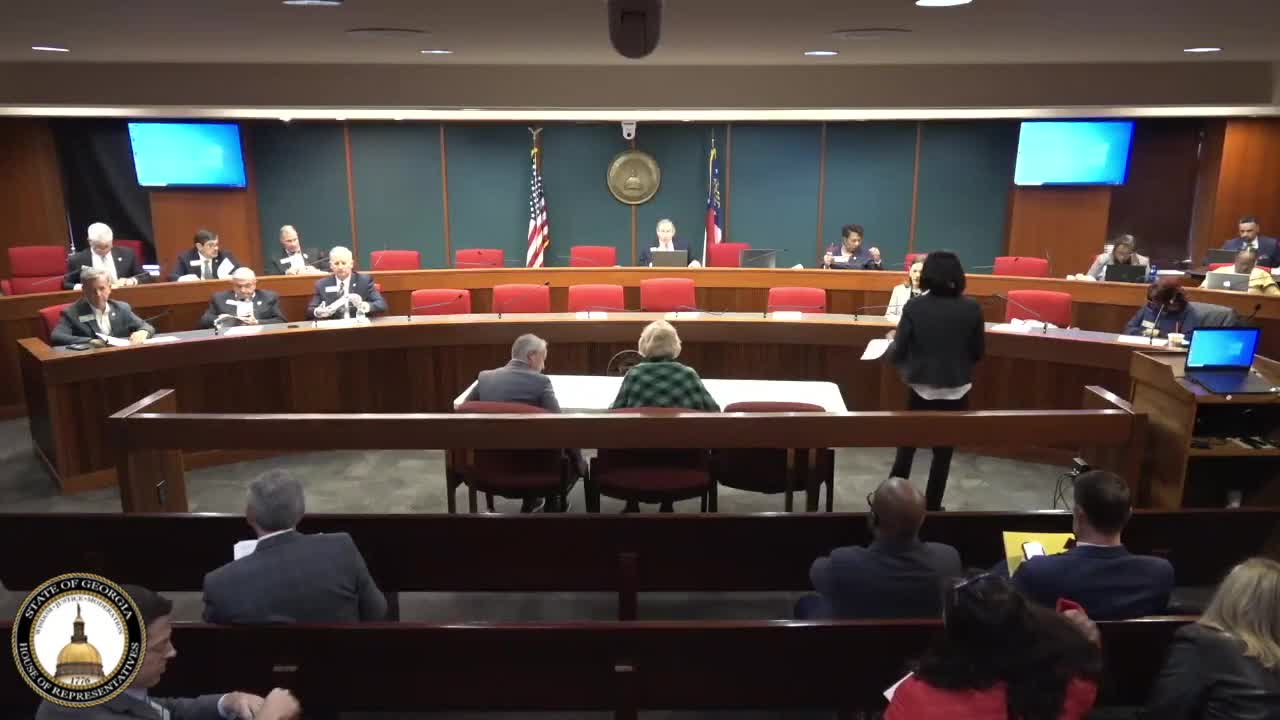
ATLANTA — The Georgia House Small Business Development Committee on Oct. 12 heard extended testimony on House Bill 250 (LC 520711S), a bill to adopt model standards for professional employer organizations, or PEOs, and then paused further action to allow additional meetings.
ATLANTA — The Georgia House Small Business Development Committee on Oct. 12 heard extended testimony on House Bill 250 (LC 520711S), a bill to adopt model standards for professional employer organizations, or PEOs, and then paused further action to allow additional meetings.
The bill’s sponsor, Chairwoman Shirley Taylor, said the legislation adopts a National Association of Professional Employer Organizations model to standardize PEO operations in Georgia, arguing that PEOs help small and midsize employers access payroll, benefits and human-resources services. "By providing these payroll benefits and HR services and assisting with . . . compliance issues for state and federal laws, PEO allows small businesses to improve their productivity and profitability," Taylor said. She cited figures in the bill text that put the number of Georgia businesses using PEOs at about 3,150, employing roughly 108,000 people.
Proponents said the measure would create transparency and reduce fly-by-night operators; opponents, including insurers, workers’ advocates and the State Board of Workers’ Compensation advisory council, said portions of the bill could allow PEOs or client employers to avoid full statutory workers’ compensation coverage.
John Walraven, a lawyer and lobbyist representing the National Association of Professional Employer Organizations, pointed to contract provisions in the draft (noting the language at lines starting around 402) that, he said, “make it abundantly clear who has to make this right,” and that agreements between PEOs and client employers must specify which party is responsible for workers’ compensation. Walraven told the committee the bill codifies those contractual duties.
Insurers and worker-advocate witnesses urged caution. Mike Iverson of the Independent Insurance Agents Association described how Georgia statutory workers’ compensation coverage operates and warned that PEO arrangements can create a “gap” if workers are not properly enrolled. "When you buy workers' compensation, it covers anybody who works for me . . . there is no schedule for workers' compensation," Iverson said, arguing the law's intent is to protect employees regardless of contract labels.
Bobby Potter, who chaired the State Board of Workers' Compensation advisory council, said advisory members had reviewed similar proposals and flagged multiple concerns: potential gaps when employees are hired but not yet reported to the PEO (a "Monday/Wednesday/Friday" scenario that can produce finger-pointing), conflicts with existing self-insurance rules, and language that could allow claim administration without required licensing oversight.
Doug Rohan of Georgia Injured Workers Advocates urged the committee to reject or amend the bill, saying an Administrative Law Judge decision (the "Nichols" case) showed how selective coverage by PEOs can leave workers uncovered. Rohan said an appellate panel later reversed that lower ruling, but warned that the current draft could still permit employers to insure only selected workers and thereby erode the workers' compensation system’s protections. "If HB 250 is advanced without an amendment or without revision, this untenable and catastrophic result will . . . hollow out the workers' compensation system," he said.
Legislative counsel Ali Rod told the committee that mandatory workers' compensation remains defined in Title 34, Chapter 9 of the Georgia Code and said he did not see the bill changing that requirement; other witnesses disagreed about how the bill’s contract-based language would operate in practice.
Committee chairmen and members repeatedly asked whether the bill would create an effective "opt-out" for some employees; the bill’s sponsor and PEO supporters said the draft requires the parties to designate responsibility and to procure coverage under several specified methods (language cited near lines beginning 402–428 and on page 17 of the draft), while critics said enforcement gaps and contract-driven enrollment could still leave injured workers without timely coverage.
After more than two hours of questions and testimony from insurer representatives, the State Board advisory council and worker advocates, committee leadership paused the bill’s consideration and directed the sponsor to meet with stakeholders before the committee reconvenes. Earlier in the meeting the committee approved its rules for the year by voice vote.
The committee did not take a formal recorded vote on HB 250 during the session reported here; sponsors and opponents agreed to continue discussions outside the formal hearing.
The bill text filed with the committee is identified in the hearing as LC 520711S and by the bill number House Bill 250. Committee staff and witnesses repeatedly referenced Title 34, Chapter 9 of the Georgia Code in relation to mandatory workers' compensation requirements.
• Votes at a glance: The committee approved the Small Business Development Committee rules for the session by voice vote.