Get Full Government Meeting Transcripts, Videos, & Alerts Forever!
Get email alerts on the Public Health Overdose Prevention topic
No spam. Unsubscribe anytime.
Committee reviews bill to place opioid antagonists next to AEDs at colleges, limit university liability
Summary
Lawmakers discussed HB 419, which would require or authorize opioid antagonist dispensers next to automated external defibrillators (AEDs) in government buildings and allow universities and technical colleges to host dispensers without civil or professional liability for empty units; funding would come from community sources.
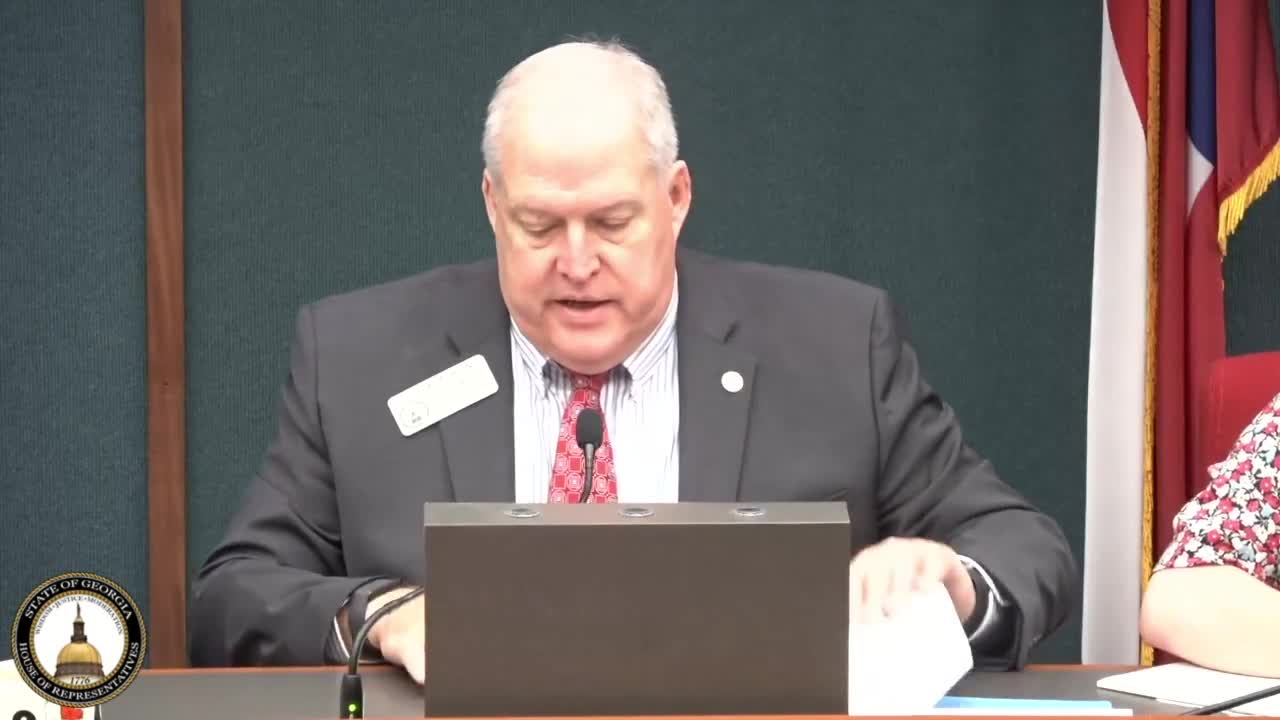
Chairman Hawkins presented House Bill 419 on opioid antagonists, telling the committee the measure would place Narcan-style dispensers next to AEDs in government buildings and work with the University System of Georgia and technical colleges on implementation.
The bill, Hawkins said, builds on last year’s House Bill 1170 and “we've added some things to this bill that's tightened up the bill and and how this works.” He described efforts to limit liability for universities and technical colleges, saying there was concern “about the Narcan being in the dispenser and then someone coming by and emptying the dispenser. So the universities and the technical college will not be liable for an empty dispenser.”
Hawkins and other members discussed funding and scope. The bill text says funding will come from “the community,” a phrase Hawkins summarized to mean local decisions: “If a community wants this in their local colleges, they will find a way to fund this system. If they do not feel like they have a problem, they don't.” Representative Glaze asked whether state opioid-settlement money could later be considered as a funding source for communities unable to pay; Hawkins said he would be willing to pursue amendments or a separate bill on funding if needed.
Jeffrey Love, testifying for the Georgia Council for Recovery, spoke in support and described outreach done statewide. “We need Narcan and opioid antagonists available where students will feel safe going to get them,” Love said, adding that the council and partner nonprofits expect to assist smaller colleges with access if communities cannot fund dispensers.
Committee members asked practical questions about placement and cost. Hawkins said dispensers would only be placed in buildings that already have AEDs. Vice Chairman Barrett asked about price; Hawkins said a two-dose box is about $42 and many sites keep two boxes on hand. Committee staff and counsel noted language in the draft that could be read inconsistently — one provision requires institutions to “acquire and maintain” supplies while another conditions that on receipt of “sufficient funding from community funding sources.” Hawkins agreed to work with members and counsel to clarify funding and permissive versus mandatory language before the bill returns for further consideration.
The committee did not take a formal vote on HB 419 during this workday; members agreed to continue refining the bill text and to socialize the measure with affected offices and stakeholders ahead of the next committee meeting.